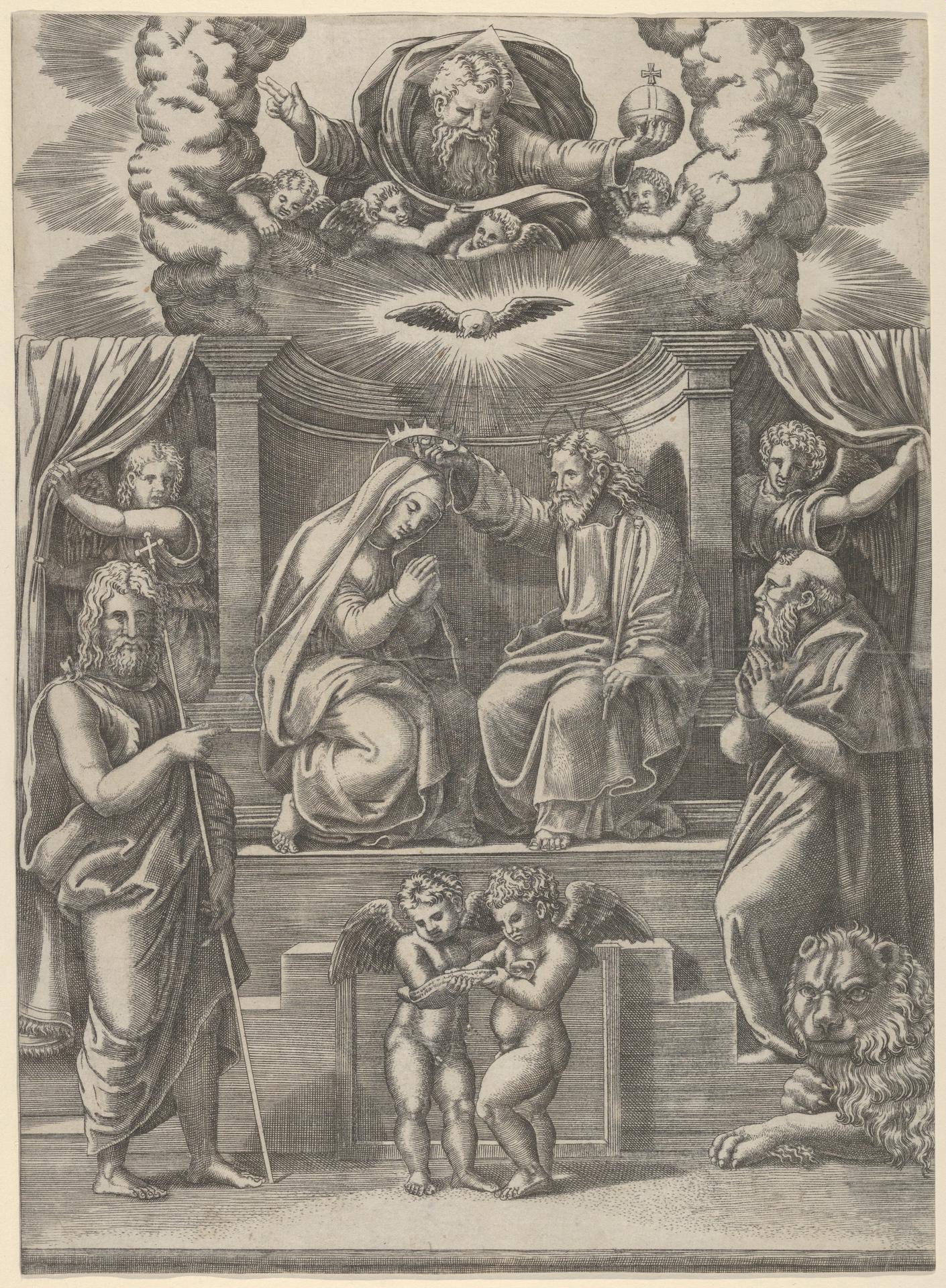
The Coronation of the Virgin, God the Father Above, St. Jerome Lower Right and St. John the Baptist Lower Left
Original title: The coronation of the Virgin, God the Father above, St Jerome lower right and St John the Baptist lower left
kurzbeschreibung
This engraving was made in the workshop of the Master of the Die between 1530 and 1560. It shows God the Father crowning Mary, with Jerome standing at the lower right and John the Baptist at the lower left. The image was executed as an engraving on paper.
Description
Mary is enthroned at the center while God the Father hovers above her and places the crown on her head. A cloud frames him, adorned with angels and a dove-bearing cross. At the lower right Jerome takes his place on a throne, and at the lower left stands John the Baptist; both wear traditional garments and look up toward Mary. Two angels below the saints hold an open book. To the left of God the Father appears a man with a staff, to the right a lion. The layout is symmetrical, the figures clearly ordered and worked out in fine lines.
Context
Behind the name Master of the Die is an Italian engraver of the sixteenth century whose monogram shows a die. This print belongs to a series of religious scenes made in Rome that spread the visual language of the High Renaissance. For the Coronation of the Virgin the artist draws on a common iconographic pattern based on inventions by Raphael.
Impact
The symmetrical arrangement and the calm bearing of the figures give the engraving a solemn, dignified air. Fine hatching produces a clear direction of light that emphasizes the action at the center and guides the viewer's eye to the devotional motif.
Technique
The lines were cut into a copper plate with a burin. Parallel and cross-hatched strokes model the bodies and create shadows that convey a sense of volume. The sheet measures roughly 37 x 26.5 cm, the plate 35.5 x 25.5 cm.
AI-generated description text
Source: Metropolitan Museum of Art · Public Domain (CC0 1.0)