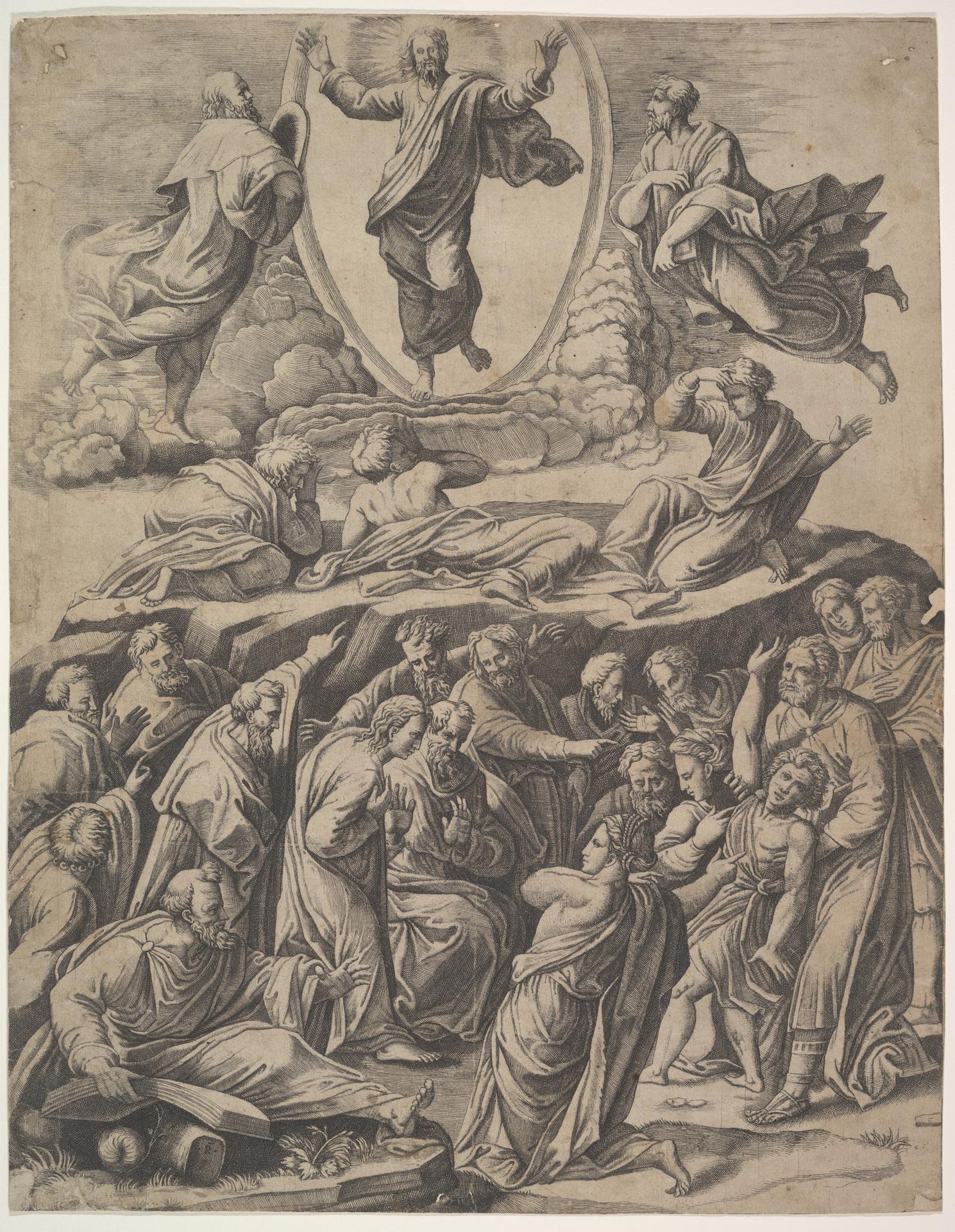
The Transfiguration of Christ
Original title: The Transfiguration of Christ, below him various figures including the Apostles
kurzbeschreibung
Unlike many contemporary prints of the same subject, this engraving by the Master of the Die (c. 1530–60) relies on a dense, almost crowded stacking of figures. It shows the floating Christ in a mandorla, surrounded by apostles whose postures range from frightened recoil to bewildered astonishment.
Description
Above the center, Christ hovers with arms outstretched inside a round mandorla against a light ground. On the left, an apostle raises his arm and points upward, while on the right a seated companion also gestures toward the event. Directly beneath the mandorla, several figures lie on the ground, some contorted, suggesting violent inner agitation. In the foreground, more apostles are scattered—kneeling, standing, or sitting—their garments rendered with careful folds. The layout feels restless: figures turn in various directions, the light stays diffuse, and the whole view is in grayscale.
Context
Behind the notname “Master of the Die” hides an unknown Renaissance engraver whose identity is known only through a monogram. His working period fell in an era when printed reproductions of biblical subjects circulated widely. The motif of the Transfiguration of Christ draws on the account in the Gospel of Matthew (17:1–9), according to which Jesus is transfigured before Peter, James, and John.
Impact
The crowded arrangement of figures and expressive gestures create a tension that forcefully underscores the miracle of the Transfiguration. Through the gray tones and soft, diffuse light, the sheet acquires a solemn, almost visionary mood that draws the viewer directly into the event.
Technique
Engraving as a print process depends on lines being incised into a metal plate and then pulled onto paper. Finely graded hatching and controlled linework allow detailed reproduction of fabrics and faces. The present impression measures 39.5 × 30.5 cm.
AI-generated description text
Source: Metropolitan Museum of Art · Public Domain (CC0 1.0)