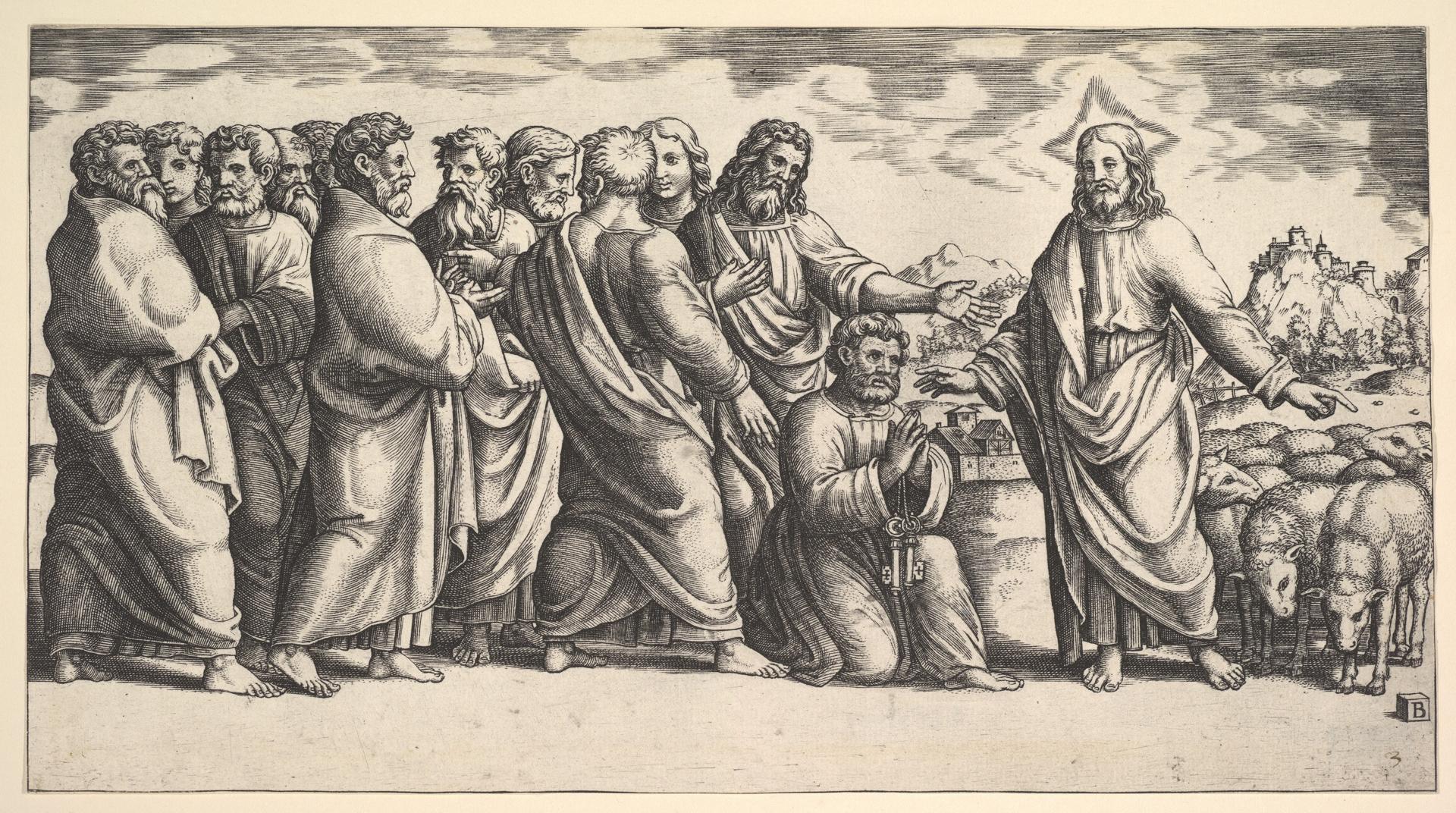
Christ standing at left indicating to a flock of sheep, before him kneels St. Peter holding the keys to the church, behind him to the left stand the Apostles
Original title: Christ standing at left indicating to a flock of sheep, before him kneels St. Peter holding the keys to the church, behind him to the left stand the Apostles
kurzbeschreibung
Peter kneels before Christ, who points to a flock of sheep; the apostle holds the keys to the church in his hands. The Master of the Die engraved this scene on copper between 1530 and 1560. The apostles stand in the left background, and a landscape with mountains and a village completes the picture.
Description
Christ stands on the right in the foreground, his long robe falling to his feet. One hand rests on the shoulder of the kneeling Peter, who carries the keys to the church; the other hand points to a row of sheep lined up on the right. To the left behind Christ, the apostles have gathered in traditional garments, with various hairstyles and beards, and they look toward him. Mountains and a village fill the background, the light falls evenly across the sheet, and the layout orders the figures according to their rank.
Context
The Master of the Die was an Italian engraver active in Rome and Florence in the first half of the 16th century. He often engraved after designs by artists such as Raphael and Perino del Vaga, which shows his close ties to the Roman art scene. The motif of the delivery of the keys to Peter belongs to Catholic iconography and gained particular significance during the Reformation. The work dates from a period when demand for religious prints in Europe was rising sharply.
Impact
The clear arrangement of the figures and the calm landscape evoke a dignified, solemn mood suited to the religious meaning of the scene. Evenly distributed light and precise linework give the print a quiet, almost narrative quality that invites close looking at the details.
Technique
An engraving: the image is incised into a copper plate and then printed on paper. Fine lines and even hatching create a clear contrast between light and shadow, typical of 16th-century printmaking. Monochrome in black and white, contours and layout stand out especially clearly.
AI-generated description text
Source: Metropolitan Museum of Art · Public Domain (CC0 1.0)