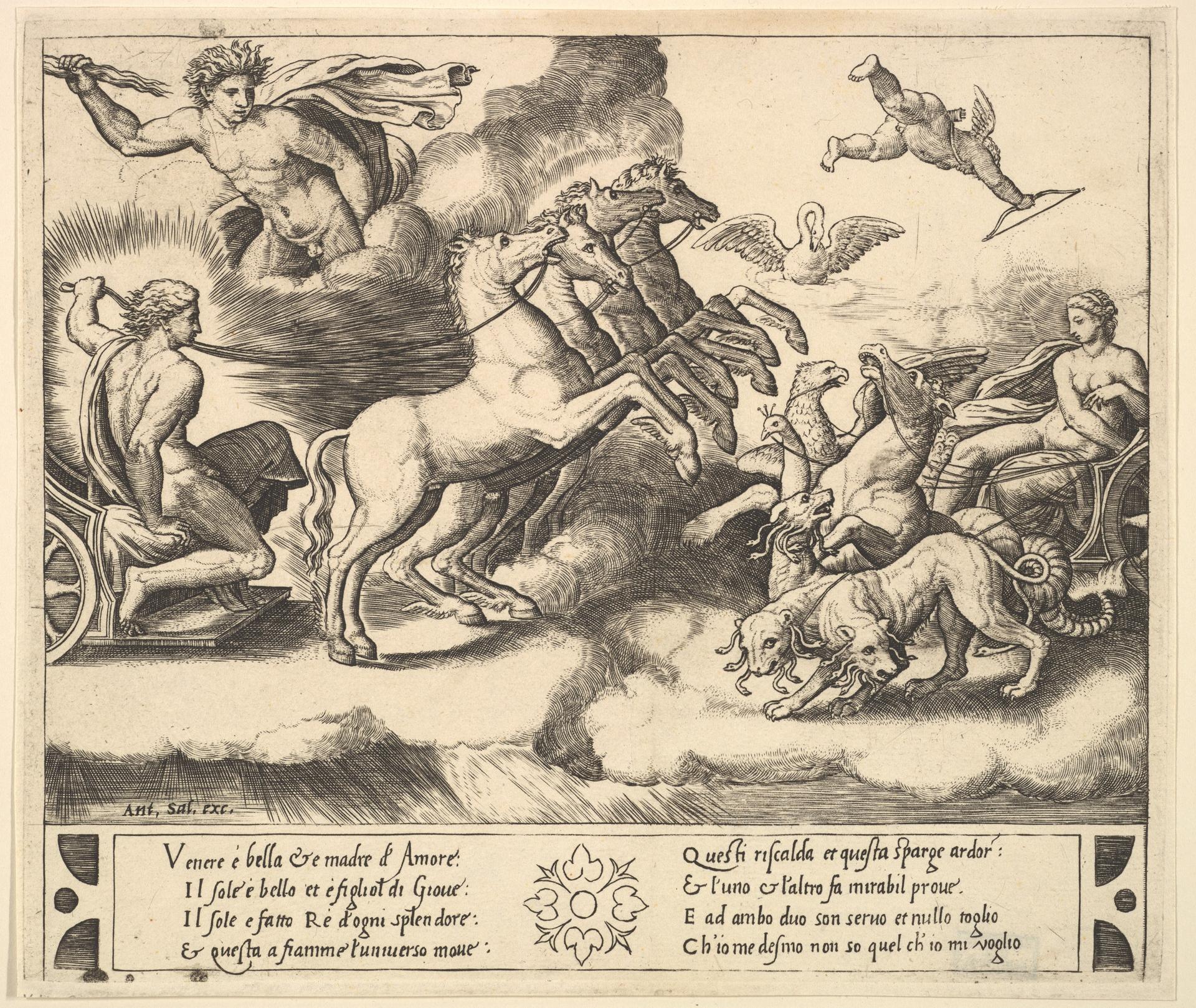
Apollo in his horse-drawn chariot at the left, above him above Jupiter hurls a thunderbolt, Venus at right in her chariot drawn by animals, from "Story of Apollo and Daphne"
Original title: Apollo in his horse-drawn chariot at the left, above him above Jupiter hurls a thunderbolt, Venus at right in her chariot drawn by animals, from "Story of Apollo and Daphne"
kurzbeschreibung
Apollo stands on a horse-drawn chariot while Jupiter, above him, hurls a thunderbolt and Venus appears at the right in a vehicle pulled by animals. This subject belongs to the 'Story of Apollo and Daphne' and was executed as an engraving by the artist Master of the Die between 1530 and 1560. The upright sheet measures 20 x 23 cm and carries a Latin poem in its lower part. It counts among the printmaking works of the Renaissance.
Description
Apollo drives a chariot drawn by several horses; his body is muscular, his garment flutters in the wind. High above, Jupiter takes aim to throw a bolt at an opponent. On the right, Venus appears in a chariot drawn by animals, everything in lively motion. An angel with an arrow flies close to Venus. Clouds and a river are suggested behind them. Below, a Latin poem with a floral ornament closes the image. The rendering remains monochrome, with sharp contours and richly detailed figures.
Context
The Master of the Die, an Italian engraver of the Renaissance, was active in the first half of the 16th century. His print was made in an era when mythological subjects enjoyed great popularity in printmaking and were often reproduced after designs by renowned artists such as Raphael. The myth of Apollo and Daphne found frequent entry into Renaissance art. This sheet belongs to a series that narrates the tale in several scenes and was likely produced for collectors and art lovers.
Impact
The dynamic arrangement emphasizes the movements of figures and animals. Clear contours and detailed execution give the sheet a precise, almost narrative quality. Mythological action and decorative poem enter into a connection that invites close looking.
Technique
In engraving, lines are cut into a metal plate to produce printed impressions. This method allows fine and exact lines, which were used for the detailed rendering of the figures and their movements. The monochrome palette corresponds to the conventions of printmaking of that time.
AI-generated description text
Source: Metropolitan Museum of Art · Public Domain (CC0 1.0)