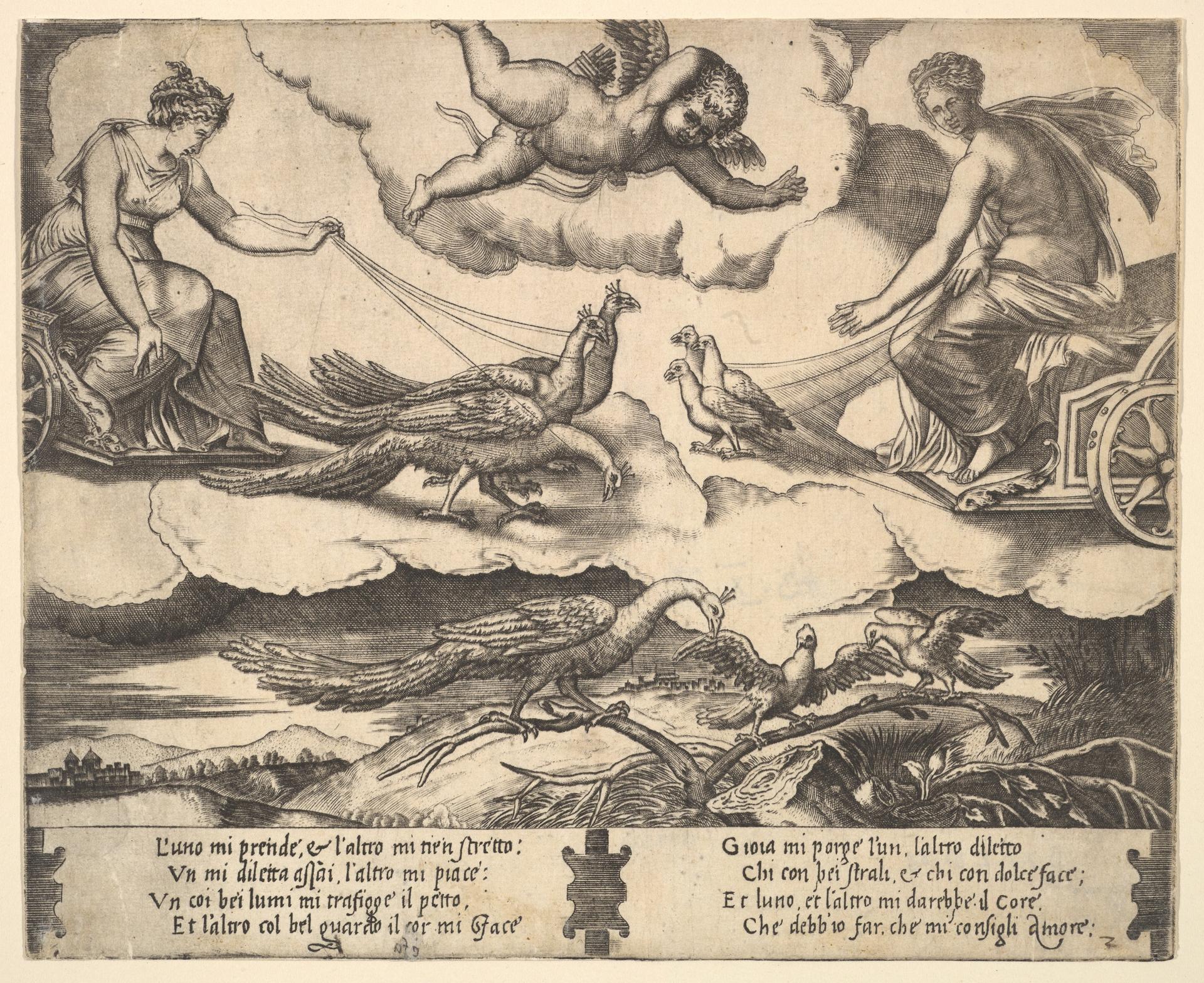
Allegory of Marriage and Love; Juno in a chariot drawn by peacocks at left, Venus in a chariot drawn by three doves at the right
Original title: Allegory of Marriage and Love; Juno in a chariot drawn by peacocks at left, Venus in a chariot drawn by three doves at the right
kurzbeschreibung
Juno and Venus appear in this engraving by the Master of the Die as embodiments of marriage and love. Juno approaches from the left on a chariot drawn by peacocks, while Venus arrives on the right in a carriage pulled by three doves. The print was made between 1530 and 1560 and belongs to the Renaissance; a Latin inscription runs along the lower edge of the sheet.
Description
Two figures in classical drapery sit enthroned in animal-drawn vehicles: on the left, an arrow pierces the figure, and a winged horse pulls her chariot; on the right, a figure steers three doves. Clouds envelop both in the upper area, while hills and trees below suggest a landscape. A Latin poem at the bottom names the figures.
Context
Named after the die in his signature, the Master of the Die was an Italian engraver of the Renaissance. His time saw the wide dissemination of allegorical depictions of gods in print. This sheet belongs to a series of engravings dealing with love and marriage. The Latin text below emphasizes the didactic character.
Impact
Two divine chariots dominate the layout, creating a symmetrical arrangement that also contains movement. Celestial sphere and earthly landscape interpenetrate to create a poetic mood. The precise linework of the engraving demands close looking and makes the elegance of the Renaissance tangible.
Technique
As an engraving, the motif was incised into a copper plate and then printed. Fine lines and hatching create graduated tonal values and reproduce details accurately. The plate was inked with printer's black and pulled on paper—a standard process of the period.
AI-generated description text
Source: Metropolitan Museum of Art · Public Domain (CC0 1.0)