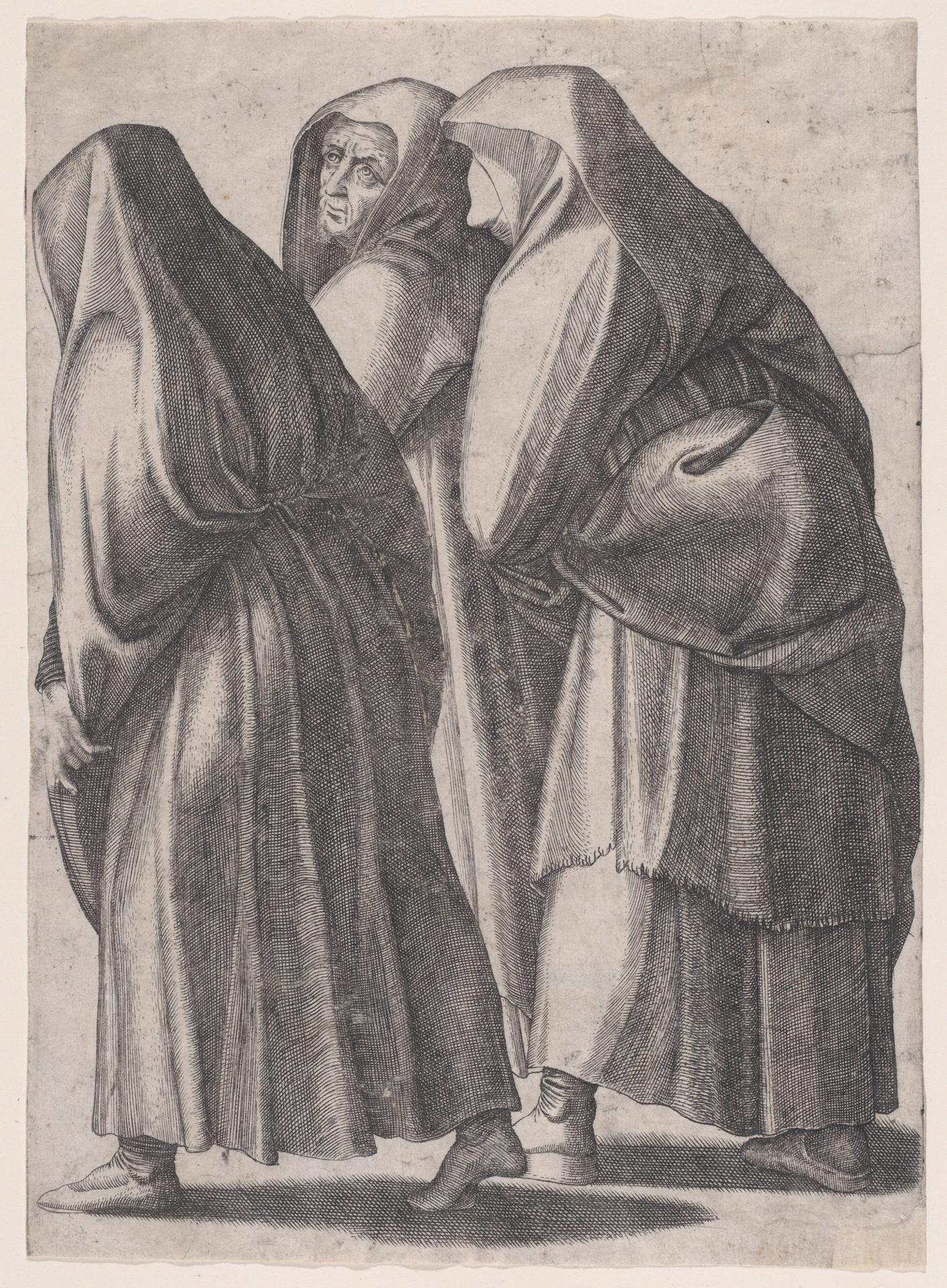
The Three Holy Women Going to the Sepulchre (ca. 1514–36, Met-Objekt 5908)
Original title: The three holy women going to the sepulchre
kurzbeschreibung
Agostino Veneziano (Agostino dei Musi) presents three women in this engraving from around 1514–36, a tall print measuring 29 by 17.8 cm. Dressed in traditional hooded robes, they are on their way to Christ's tomb. The artist focuses entirely on the figures, who act against an empty background, and explores their interaction and emotional state.
Description
Three women stand in the middle of the image, symmetrically arranged, in floor-length robes with long sleeves and hoods. Their faces are visible and reflect grief and astonishment. One woman leans forward as if she is looking at or addressing something, while the other two seem absorbed in conversation. The layout is balanced and directs the gaze clearly to the figures, with no distracting background elements. Light falls evenly, without visible shadows, so that the contours of the garments stand out precisely.
Context
Agostino Veneziano, an Italian engraver of the Renaissance, worked in the workshop of Marcantonio Raimondi. The motif of the three Marys at the tomb was widespread in Christian iconography and often appeared in printmaking. The dating around 1514–36 covers the artist's working years in Rome and Venice. The engraving was made during a period when reproductive printmaking flourished in Italy, making works by classical masters and biblical scenes accessible to a wider audience.
Impact
A calm, contemplative mood emanates from the print, supported by the symmetrical arrangement and even lighting. The finely engraved lines of the garments and the nuanced facial expressions create an intimate atmosphere that draws the viewer into the women's emotional state. Because all ornamentation is absent, attention is directed entirely to the narrative and psychological dimension of the motif.
Technique
For this engraving, lines were incised into a metal plate and then transferred to paper with printing ink. The process allows fine, precise lines that are clearly visible in the folds of the garments and the facial features. The even stroke and clear contours characterize the working method of Agostino Veneziano, who continued the Italian engraving tradition of the High Renaissance.
AI-generated description text
Source: Metropolitan Museum of Art · Public Domain (CC0 1.0)