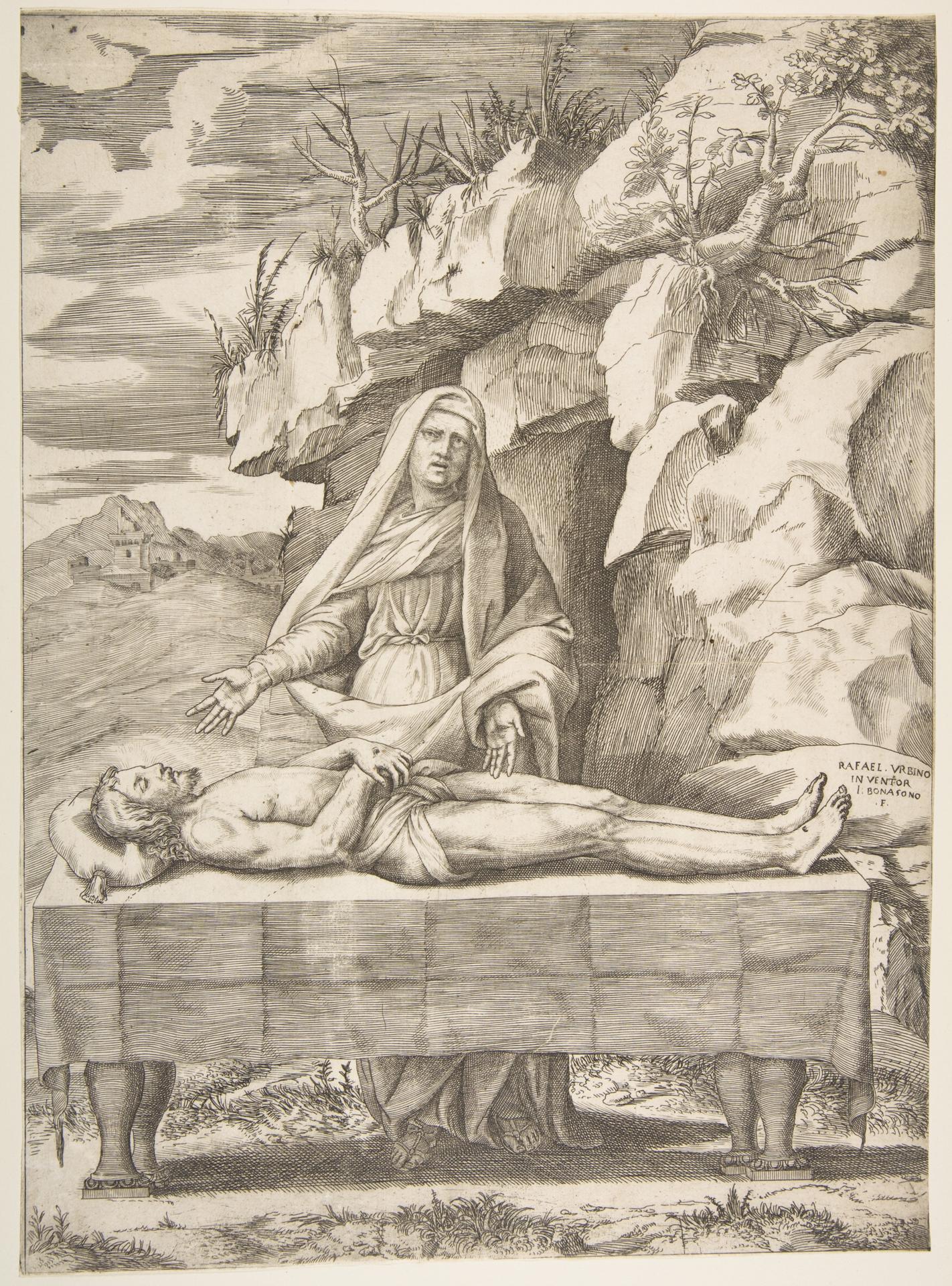
Pietà, Christ stretched out on a table in a landscape, the Virgin standing behind arms open
Original title: Pietà, Christ stretched out on a table in a landscape, the Virgin standing behind arms open
kurzbeschreibung
Mary stands behind her dead son with her arms thrown wide, while his body lies stretched across a table — Giulio Bonasone engraved this Pietà at some point between 1531 and 1576. The print belongs among his religious works and places the grieving Mother of God outdoors, in a landscape.
Description
On the left rises the figure of Mary, arms opened wide, while Christ's body rests on a table-like support to the right. Rocks, trees and a clouded sky fill the distance behind them. Fine hatching and careful tonal gradations give the image its monochrome depth. The arrangement is balanced and follows Renaissance principles: crisply outlined contours and strongly modelled bodies.
Context
Bonasone, a sixteenth-century Italian engraver, worked in Bologna and Rome and produced many reproductive prints after Raphael and Michelangelo. The Pietà was a widespread subject in the Renaissance, centring on Mary's lament over her son. Nothing further is known about the making of this particular sheet; it takes its place within a series of the artist's religious engravings.
Impact
A quiet, devotional mood emanates from the print, carried by its poised arrangement and clear draughtsmanship. Mary's open arms convey grief and surrender at once. The landscape behind invites lingering attention and deepens the contemplative character of the scene.
Technique
For an engraving, the lines are cut into a metal plate and then printed onto paper. Fine hatching and cross-hatching build stepped tonal values that give the figures their volume. The sheet measures 33.8 x 24.5 cm.
AI-generated description text
Source: Metropolitan Museum of Art · Public Domain (CC0 1.0)