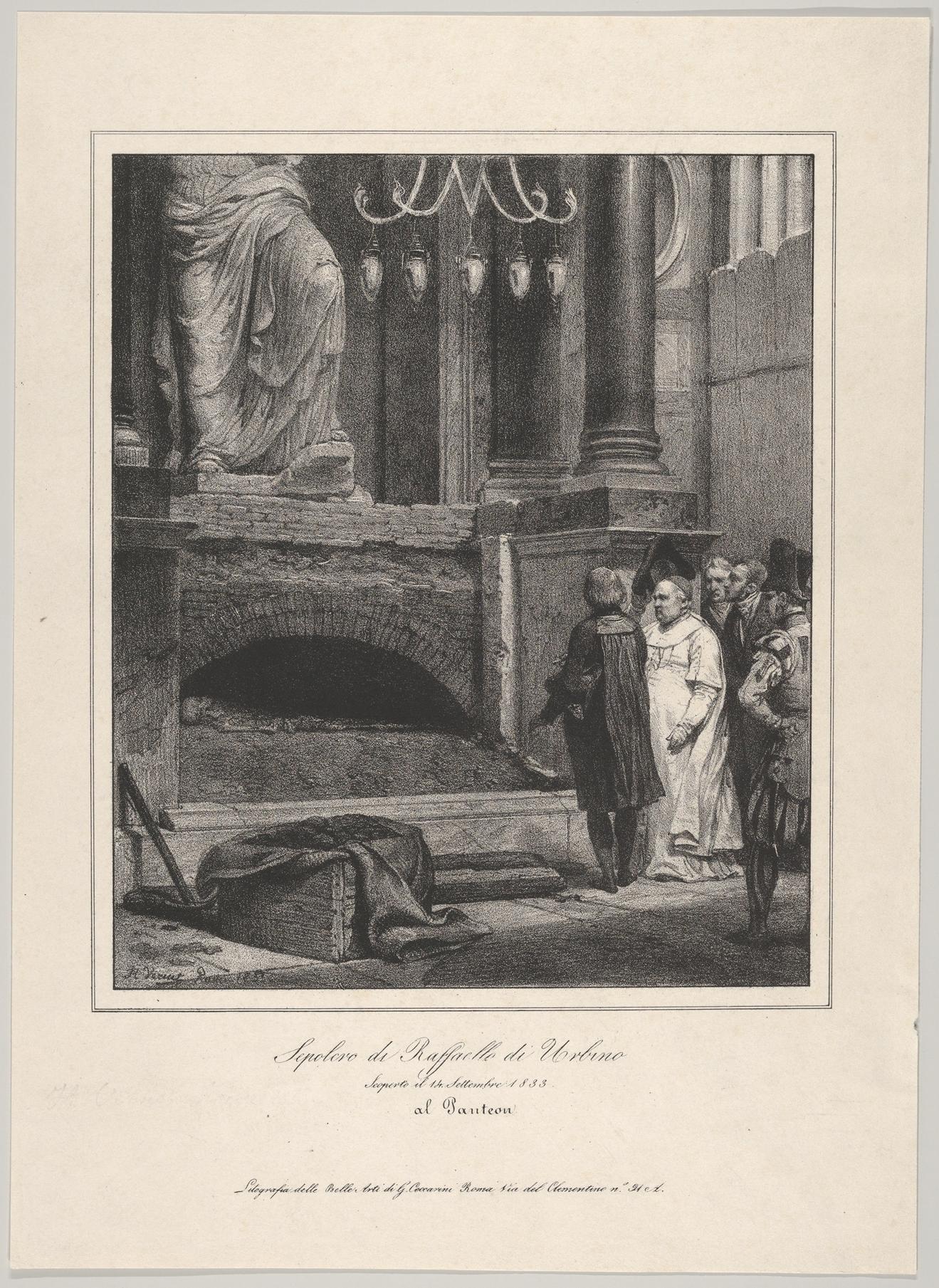
The Tomb of Raphael, Opened September 14, 1833, Pantheon, Rome
Original title: The Tomb of Raphael, Opened September 14, 1833, Pantheon, Rome
kurzbeschreibung
Unlike many contemporary images that celebrate Raphael's fame, Horace Vernet's 1833 lithograph focuses on the specific act of opening the tomb in the Pantheon. Measuring 37 by 25.8 cm, the sheet captures the moment when the Renaissance master's grave was first opened, bringing a historical event that unfolded before the eyes of contemporaries into the picture.
Description
A group of figures has gathered in the foreground around an object lying on the ground, draped with a cloth. Behind them stands a statue on a column, and several chandeliers hang from the ceiling. The monochromatic gray scale is typical of lithographs from this period. The layout is clearly structured: the group of people dominates the front zone, while the statue and chandeliers occupy the rear space. Subdued light creates a serious, dignified mood.
Context
The French painter and printmaker Horace Vernet made this lithograph in 1833, the year of the excavation. The tomb was opened at the behest of papal authorities, who had Raphael's remains examined. Vernet was in Rome at the time and recorded the events in several graphic works.
Impact
The print conveys a solemn yet intimate atmosphere that lends dignity to the excavation. The clear arrangement and subdued light draw the viewer into the scene, allowing them to directly experience the quiet, significant moment in art history.
Technique
Vernet's lithograph relies on a planographic printing process: the motif is drawn with greasy chalk on a limestone slab and then transferred to paper. The nuanced gray scale and precise linework demonstrate his confident command of this technique. The sheet is in portrait format and measures 37 by 25.8 cm.
AI-generated description text
Source: Metropolitan Museum of Art · Public Domain (CC0 1.0)