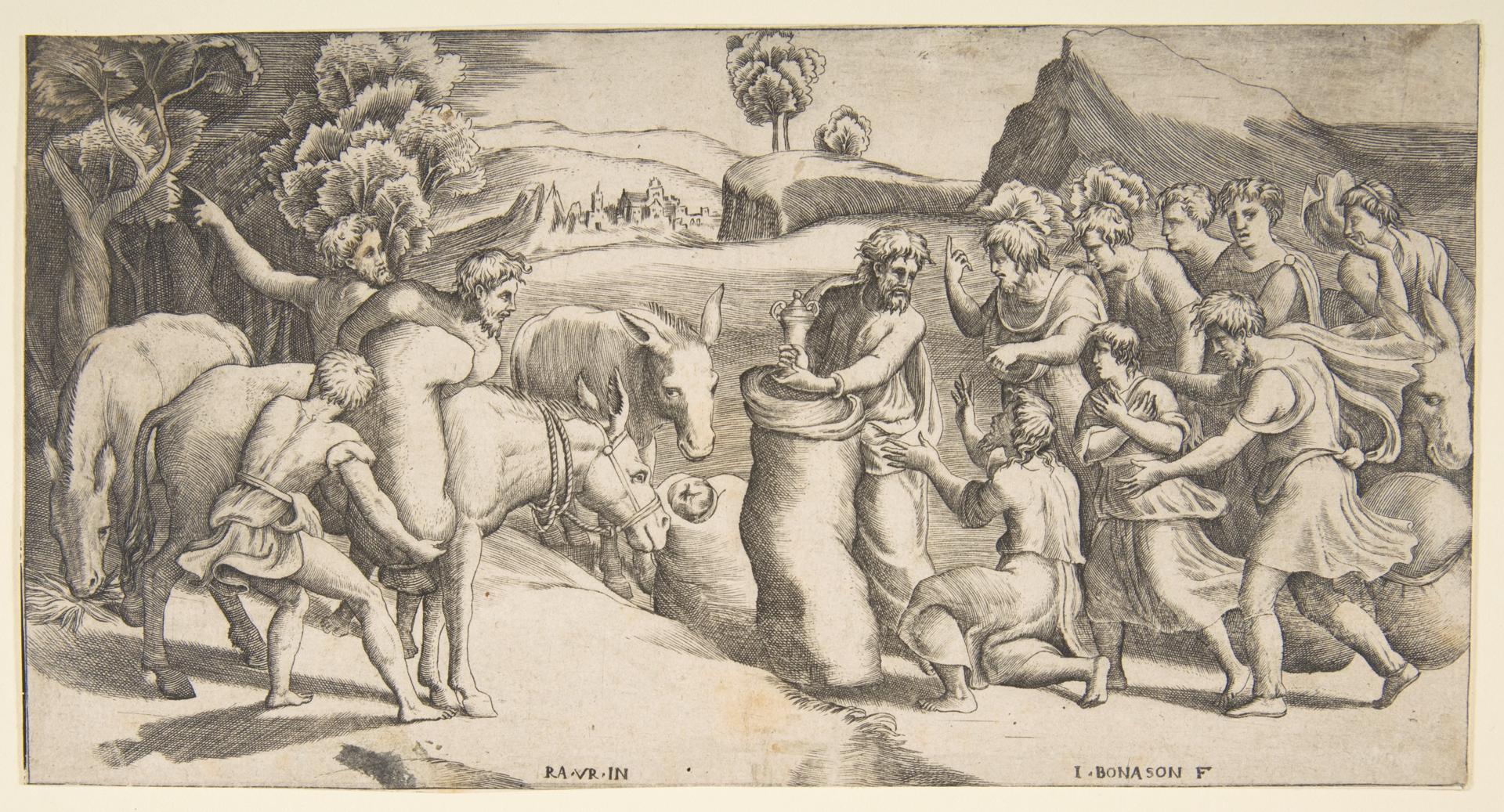
Joseph's Cup Being Discovered in Benjamin's Sack of Grain
Original title: Joseph's cup being discovered in Benjamin's sack of grain
kurzbeschreibung
With this engraving, made between 1531 and 76, Giulio Bonasone adds a biblical history to his printed oeuvre: the moment Joseph's silver cup is brought to light in Benjamin's grain sack. The upright sheet measures 12.5 × 23.7 cm and ranks among the carefully worked examples of Italian Renaissance printmaking.
Description
A knot of figures in antique-style dress has gathered around a heavy sack, a golden jug jutting from its mouth. Some argue with wide-sweeping gestures, others have dropped to the ground and examine the find. Trees, mountain ridges and a suggested town close off the distance, with two donkeys standing to one side of the crowd. The arrangement runs diagonally toward the sack, and that slant sets the whole grouping its downward pull. Tones sit evenly across the sheet, carried by fine hatching rather than hard contrasts of shadow.
Context
The print was made in mid-sixteenth-century Italy, when biblical histories were in strong demand for printed graphics. Bonasone worked in Bologna and Rome and left behind numerous sheets after both antique and biblical subjects. Its source is the story of Genesis 44, in which Joseph puts his brothers to the test. The small format suggests an object for a collector or an illustrated Bible edition.
Impact
Lively gestures and the open landscape create a narrative tension that draws the viewer quickly into the event. A calm, even handling of light takes much of the drama out of the moment and lends the view a reflective note. Fine linear work gives the picture surface richness of detail while keeping it clearly legible.
Technique
The sheet is executed as an engraving, which shows in the precise, steady linework and the fine parallel hatching. A burin cut the drawing into a copper plate, the plate was inked and then printed on paper. The monochrome rendering in grey tones follows from the process itself, which knows no halftones and models tonal values solely through lines and dots.
AI-generated description text
Source: Metropolitan Museum of Art · Public Domain (CC0 1.0)