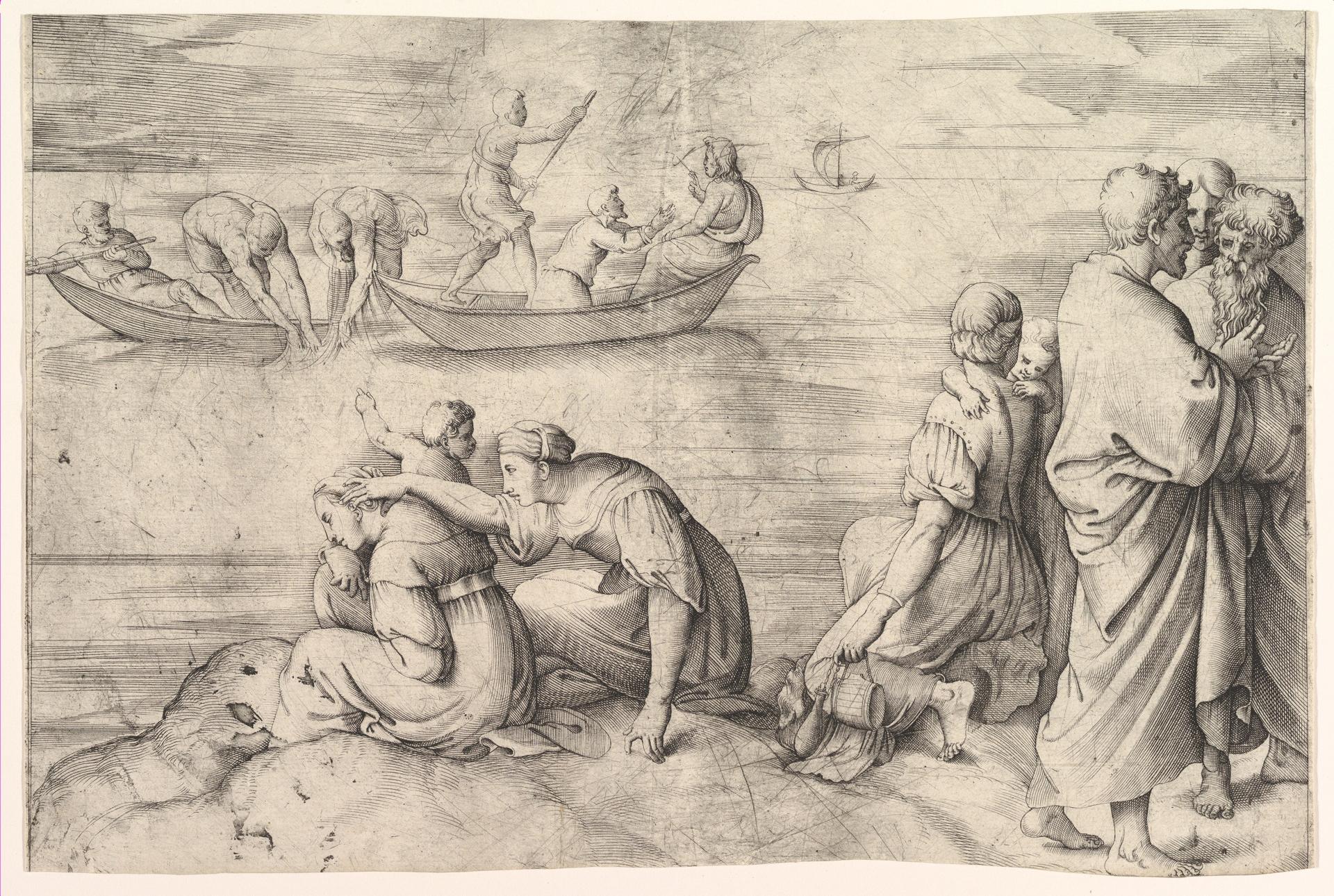
The Miraculous Draught of Fish
Original title: The Miraculous Draught of Fish
kurzbeschreibung
An engraving by Battista Franco of unknown date, this print presents the Miraculous Draught of Fishes. It depicts a scene by the water with several figures on shore and in boats. The work is an engraving on paper, measuring 25 x 37.5 cm.
Description
At the lower edge, several figures kneel and recline in simple garments, some barefoot, their hands clasped in prayer or their gaze directed expectantly forward. Behind them lies a boat with several occupants; some hold fish in their hands, suggesting a catch. Another boat can be made out in the rear. The drawing appears typical of an etching through its sharp lines and great attention to detail, while the color is limited to shades of gray and white.
Context
Battista Franco, an Italian artist of the Renaissance, likely made this engraving around the mid-16th century. The Miraculous Draught of Fishes is one of the well-known biblical motifs and was frequently taken up in art. Franco worked in Rome and Venice and drew inspiration from antiquity and the High Renaissance. The sheet may have served as a devotional image or been intended for collectors.
Impact
The praying figures in the foreground convey a calm, devout mood. The even distribution of light and the careful line work give a clear, detailed appearance that invites close study of the print.
Technique
The print was produced by engraving: the motif is incised into a copper plate and then printed on paper. The fine lines and wealth of detail are characteristic of this method, which demands high precision. The paper is trimmed at the edges to the plate mark, suggesting later treatment.
AI-generated description text
Source: Metropolitan Museum of Art · Public Domain (CC0 1.0)