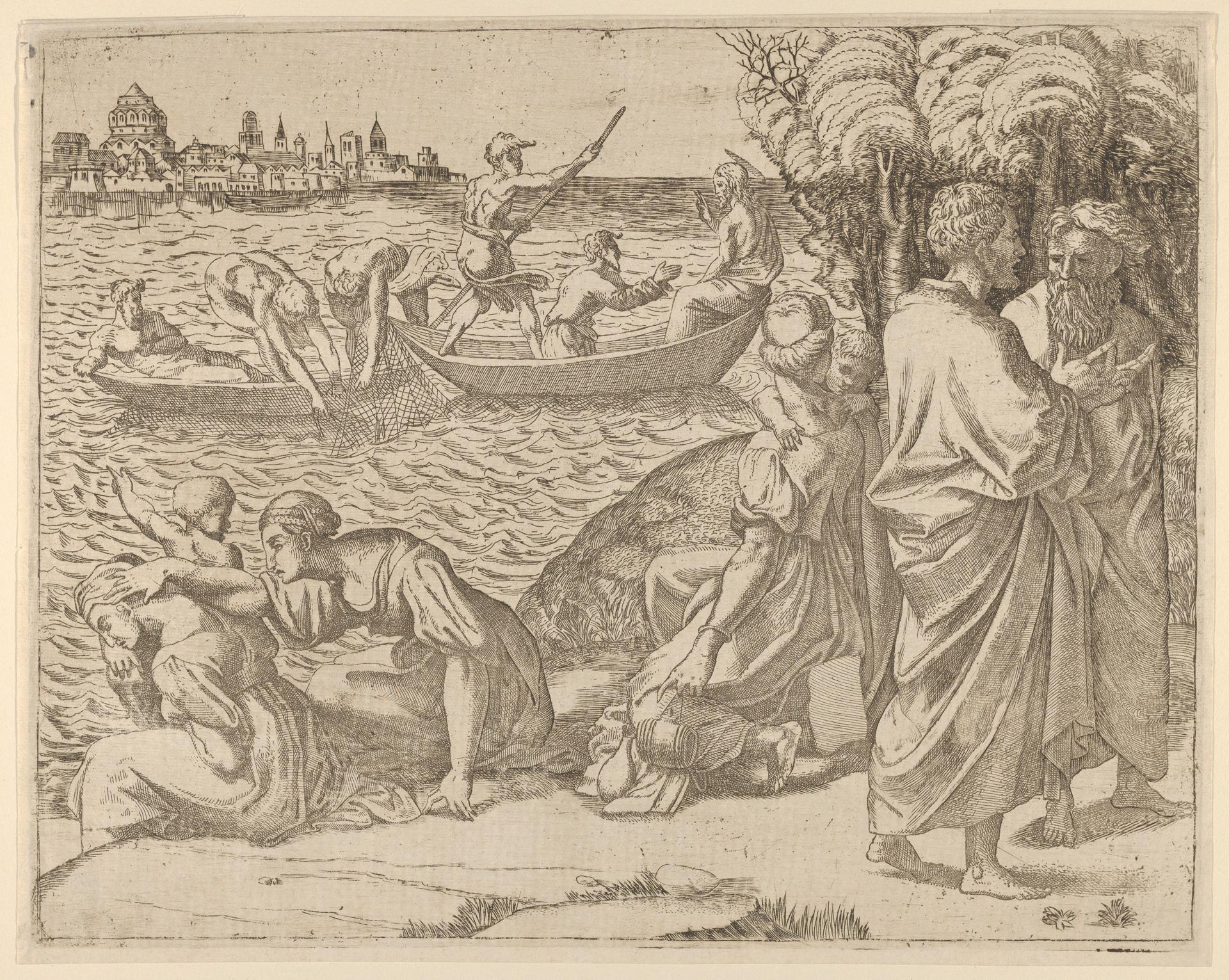
The Miraculous Draught of Fishes (1540–50, Met-Objekt 5884)
Original title: The Miraculous Draught of Fishes
kurzbeschreibung
An unknown artist from the School of Fontainebleau produced the etching Der wundersame Fischzug around 1540–50. The print presents a fishing scene by a body of water: in the foreground, people are on the shore pulling fish from a net, while behind them lie boats and a town.
Description
The image spreads out in a wide format. Along the shore, several figures handle a net; some wear simple clothing, others are barefoot. On the water, two boats with occupants can be made out, one man on a boat holding a lance. A town with towers and buildings, surrounded by trees and bushes, closes off the distance. The etching remains in shades of gray and white; the light is even, without strong shadows. Dense hatching and detailed lines convey the texture of the garments and the movement of figures and water.
Context
This sheet was made in France in the mid-sixteenth century, in the School of Fontainebleau, known for its Mannerist art. The subject of the miraculous draught of fishes, a biblical theme, was often taken up in the Renaissance. The School of Fontainebleau was strongly influenced by Italian artists working at the court of Francis I. Who created the print is not recorded—a circumstance typical of many prints of that era.
Impact
Balanced and detailed, the sheet works through its fine linework and calm, even distribution of light. Figures and landscape create a quiet, almost idyllic mood that draws the viewer into the action. The monochrome palette emphasizes the graphic quality and directs attention to the narrative details.
Technique
This work is an etching, an intaglio process: the drawing is scratched into a metal plate, which is then etched with acid. The etching and subsequent printing on paper produce the fine lines and hatching. The sheet measures approximately 26.3 × 33.4 cm (plate) and is in gray tones, as was usual for Renaissance etchings.
AI-generated description text
Source: Metropolitan Museum of Art · Public Domain (CC0 1.0)