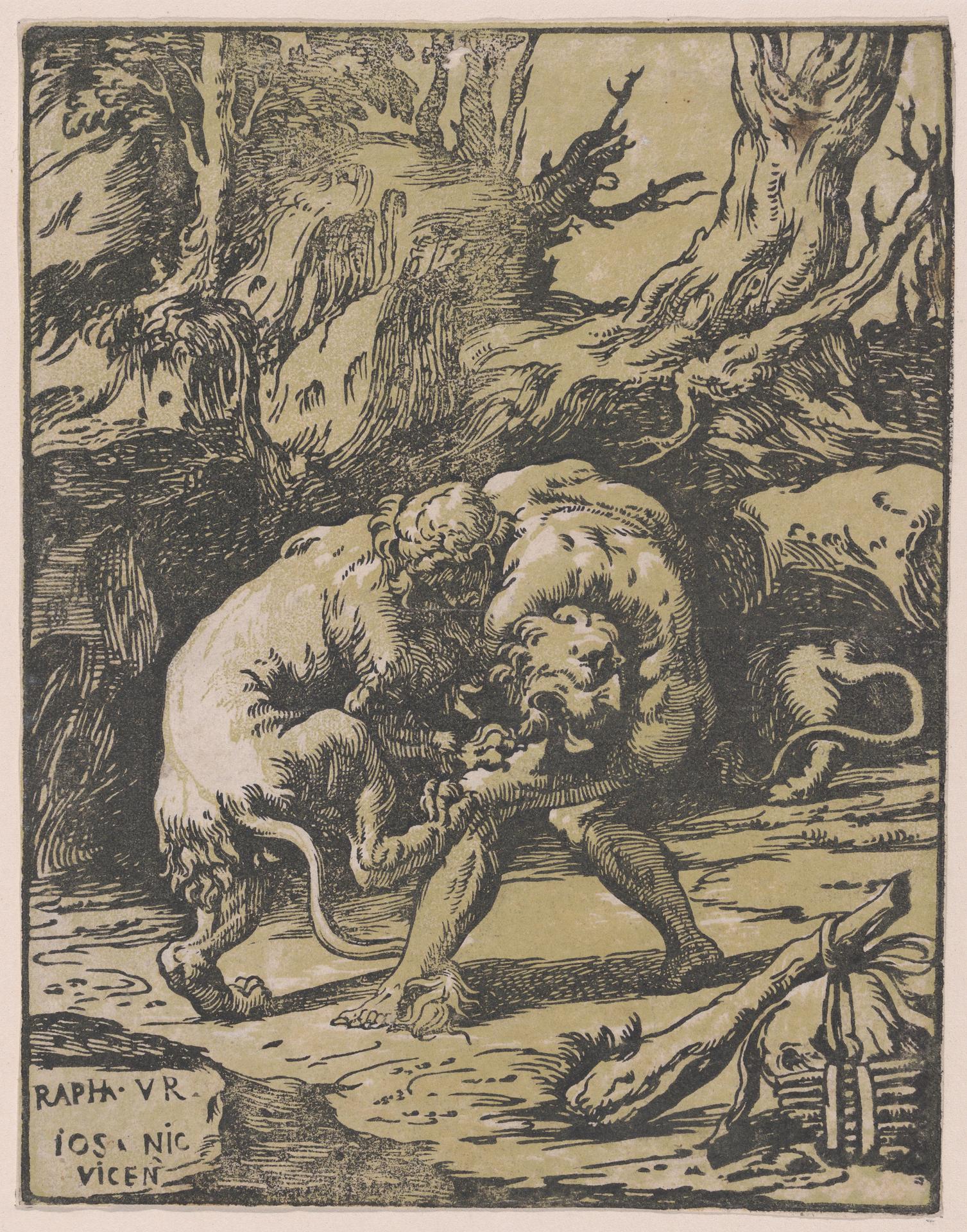
Hercules and the Nemean Lion (1540–50, Met-Objekt 5878)
Original title: Hercules and the Nemean Lion
kurzbeschreibung
Hercules subdues the Nemean Lion with his bare hands. Niccolò Vicentino captured this mythological subject around 1540–50 in a chiaroscuro woodcut from two blocks in pale blue (state ia/ii). The print focuses on the hero's physical strength as he wrestles the beast.
Description
Hercules grips the lion and holds it in a tight clinch while the animal resists with claws extended. The muscular hero looks determined; his posture conveys both power and control. Trees and rocks in the background suggest a wild natural landscape. At lower left, a stone bears the inscription 'RAPHA VR. IOS. NIC VICEN', referring to the artist and the workshop. Grey tones dominate the palette, as is typical of the chiaroscuro style.
Context
Niccolò Vicentino, a sixteenth-century Italian woodcutter, is known for his chiaroscuro woodcuts, often reproducing works by Raphael and other Renaissance artists. The fight with the Nemean Lion is one of the twelve labors of Hercules from Greek mythology. Prints of this kind were popular in the sixteenth century because they made artistic designs available to a wider audience. The inscription on the stone points to a connection with Raphael, whose work served as the model.
Impact
The dynamic layout creates immediate tension and draws the viewer into the struggle. Because only a few tones are used, attention shifts to the formal design and the expressive poses of the figures. The contrast of light and dark heightens the drama of the event.
Technique
The print was made using the chiaroscuro technique with two woodblocks: one block provided the lines, a second the tonal areas in pale blue. This allowed light and shadow effects reminiscent of a drawing on tinted paper. The impression belongs to the first state (ia/ii) and reveals the fine alignment of the two blocks.
AI-generated description text
Source: Metropolitan Museum of Art · Public Domain (CC0 1.0)