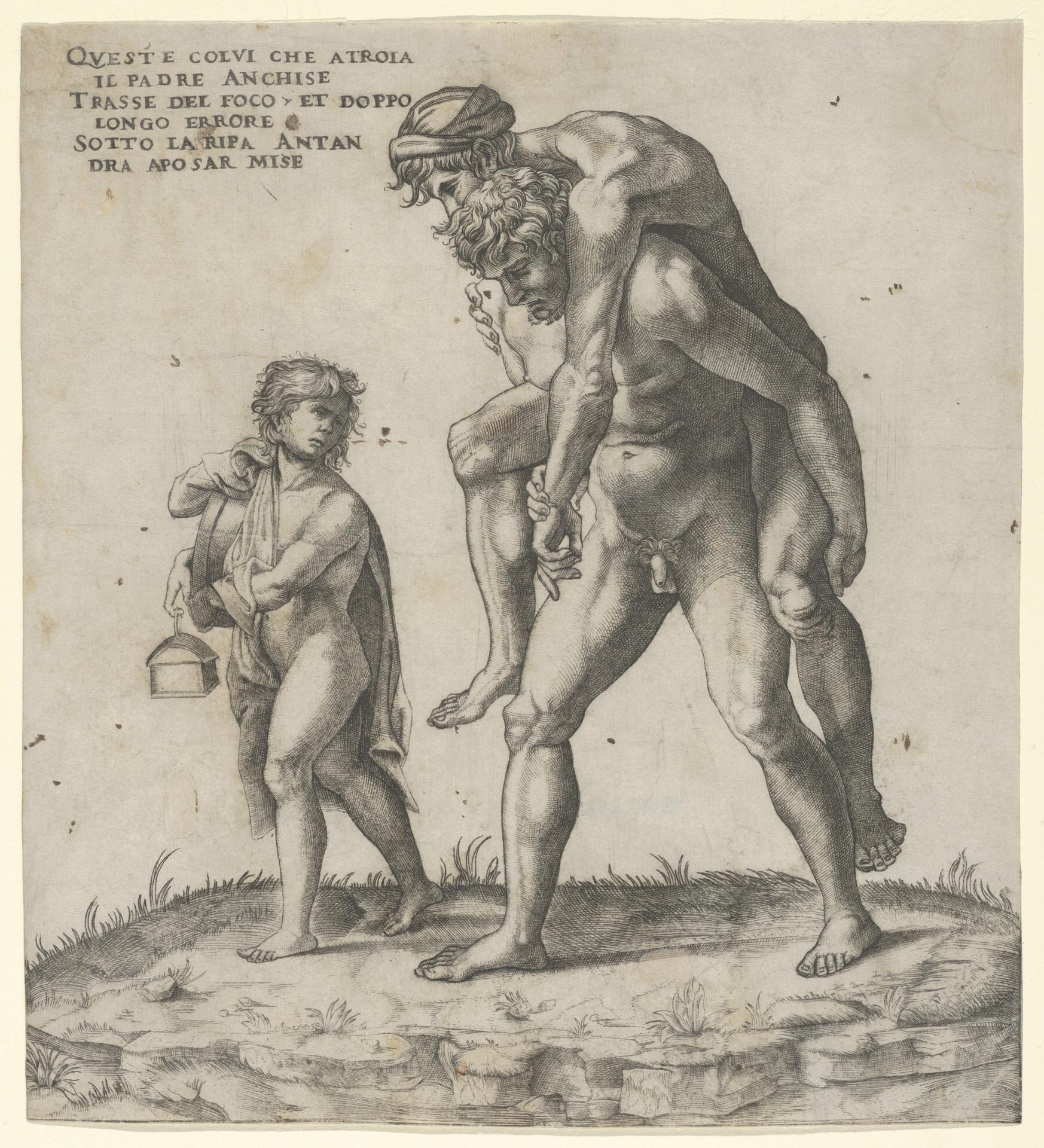
Aeneas rescuing Anchises, a young boy carrying a lantern at left
Original title: Aeneas rescuing Anchises, a young boy carrying a lantern at left
kurzbeschreibung
A boy with a lantern stands at the left edge while Aeneas carries his father Anchises out of burning Troy. Giovanni Jacopo Caraglio engraved this flight scene around 1525; the sheet measures 20.7 × 18.8 cm. Aeneas appears naked and powerful, with old Anchises on his shoulders, and the boy lights the way with his lamp.
Description
Muscular, with short curls and a headband, Aeneas steps forward wearing only a sash around his hips. Anchises, an older man in a robe, sits on his back. A small boy in a simple tunic, holding a lantern, occupies the left edge. The group stands on rocky ground with scattered plants, and a Latin text runs along the top. Aeneas is in front, the other figures staggered behind him, so the layout feels unbalanced; light falls evenly over all parts.
Context
Caraglio worked as an Italian Renaissance engraver, first in Rome and later in Poland. This print was made around 1525, when ancient myths were highly valued in art. The episode from Virgil's Aeneid was a common subject that highlighted virtues such as pietas and strength. It belongs to a series that Caraglio engraved after designs by artists such as Rosso Fiorentino.
Impact
Clear, flowing lines and carefully worked musculature carry the heroic tone of the print. Because the light is calm and evenly distributed, the scene gains something dignified, almost statue-like. The viewer's gaze thus remains fixed on the narrative core.
Technique
For this engraving, lines were cut into a metal plate and then printed on paper. The process allows fine details and renders textures such as fabric and hair precisely. The stated dimensions refer to the sheet trimmed at the plate edge.
AI-generated description text
Source: Metropolitan Museum of Art · Public Domain (CC0 1.0)