Triumph of Love
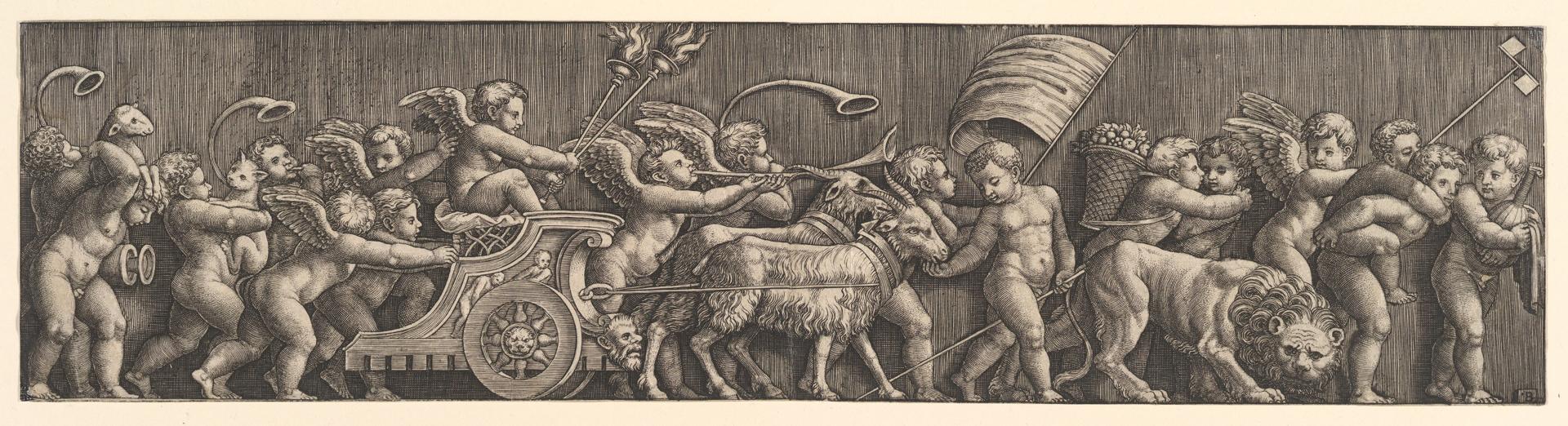
Original title: A frieze arrangement depcting the Triumph of Love; Cupid in a Chariot led by goats, many other putti filling the composition
kurzbeschreibung
This engraving by the Master of the Die was made between 1530 and 1560 and shows a festive procession of putti surrounding Cupid on a goat-drawn wagon. The horizontal print is monochrome and measures 10 × 40.5 cm.
Description
Cupid steers a wagon pulled by two goats at the center of the frieze, holding a bow, arrow, and torch. Putti swarm the image: they carry flowers, make music, or chatter. Some have taken places on the wagon, while others run or jump around it. A large inflated bladder held by one putto appears in the background. The figures are arranged with lively movement, and the shading ranges from light to dark, emphasizing motion and spatial depth.
Context
The Master of the Die, a sixteenth-century Italian engraver, took his name from the die in his monogram. He often worked after designs by Raphael and his school, which explains the classical and elegant style of the frieze. The print was made in the High Renaissance, when ancient triumphal imagery served as a model for secular and allegorical subjects. The Triumph of Love adopts the ancient iconography of the triumphal wagon and turns it into a cheerful, playful scene.
Impact
The bustling arrangement of the putti and the expressive linework create a lively, joyful mood. Thanks to the delicate shading, the figures appear plastic and almost bodily, even though the print is monochrome.
Technique
The print was made as an engraving: lines are cut into a copper plate with a burin and then printed. Fine parallel hatching allows subtle tonal gradations that model the volume and movements of the figures. The sheet has been trimmed, suggesting later use as a frieze or decorative element.
AI-generated description text
Source: Metropolitan Museum of Art · Public Domain (CC0 1.0)