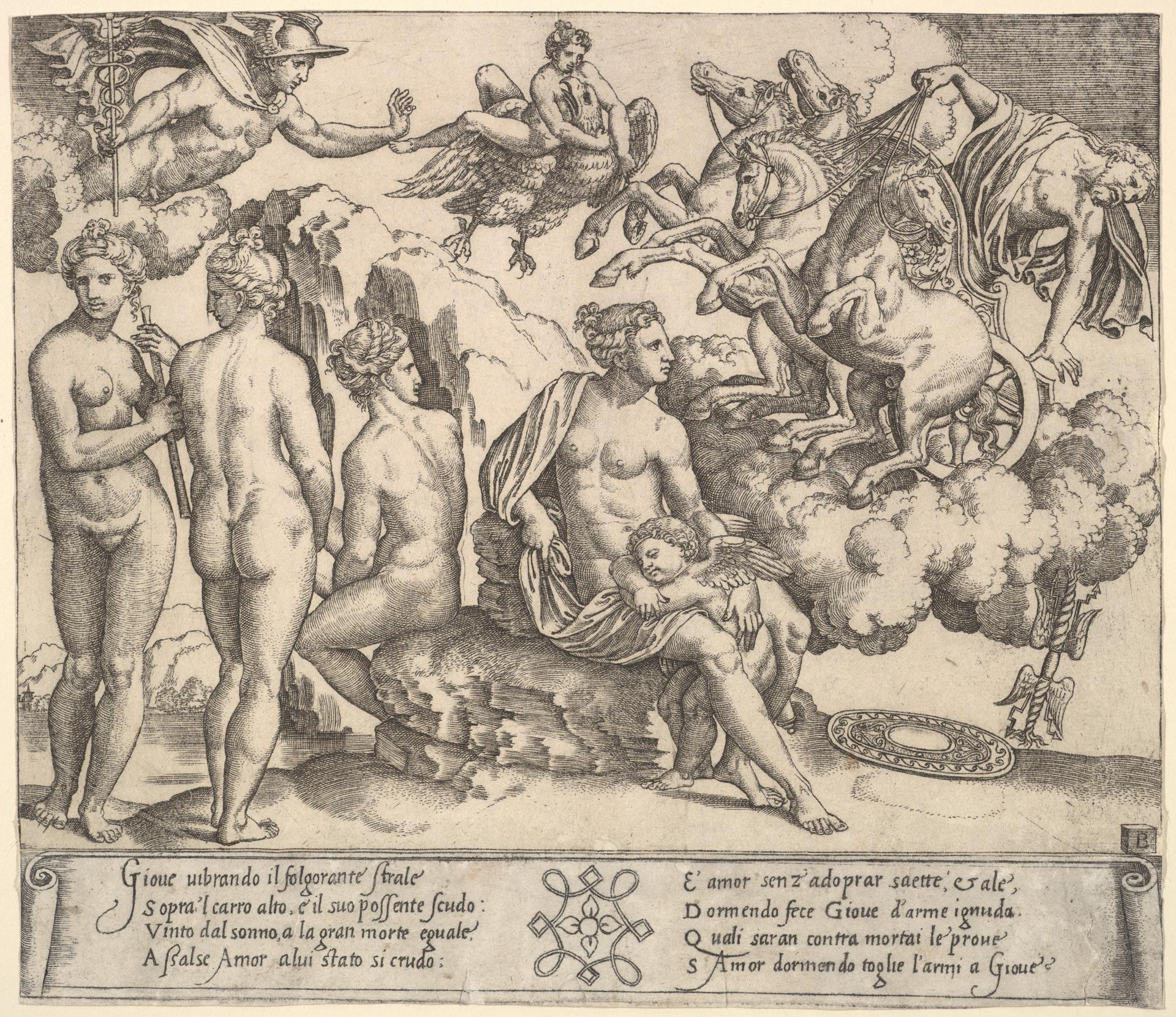
Jupiter Tumbling from a Horse-Drawn Carriage
Original title: Jupiter tumbling from a horse-drawn carriage at right, Ganymede riding Jupiter's eagle upper center, below Venus and to her right, the three Graces
kurzbeschreibung
This copper engraving by the anonymous Master of the Die was made between 1530 and 1560. It presents a layered mythological narrative: on the right, Jupiter tumbles from a horse-drawn chariot, while above, Ganymede rides on Jupiter's eagle. Below, Venus appears with Cupid alongside the three Graces.
Description
Clouds and a suggested landscape with trees form the setting. On the right, Jupiter is seen falling from a horse-drawn wagon, while Ganymede has taken his place on Jupiter's eagle in the upper middle. At lower left, the three Graces hold wreaths and shallow bowls; at lower right stands Venus with her child Cupid. Antique drapery marks the figures as mythological beings of the period. Fine lines and hatching produce even lighting in black and white.
Context
The Master of the Die, an Italian Renaissance engraver, owes his notname to a die in his signature. Many engravings after designs by artists such as Raphael and Giulio Romano come from his hand. This sheet belongs to a series of mythological scenes made in Rome in the first half of the 16th century. Latin inscriptions along the bottom edge, customary for such prints, explained the scenes depicted.
Impact
Several mythological figures come together in a lively celestial scene of intricate design. The clear arrangement of the figures and the delicate linework give the sheet a calm, balanced aesthetic. Even lighting and monochrome execution bring the graphic quality to the fore.
Technique
An engraving — an intaglio process in which lines are cut into a metal plate — is at hand here. Tonal gradations and volume arise from fine lines and hatching. The print on paper measures 19 x 22 cm.
AI-generated description text
Source: Metropolitan Museum of Art · Public Domain (CC0 1.0)