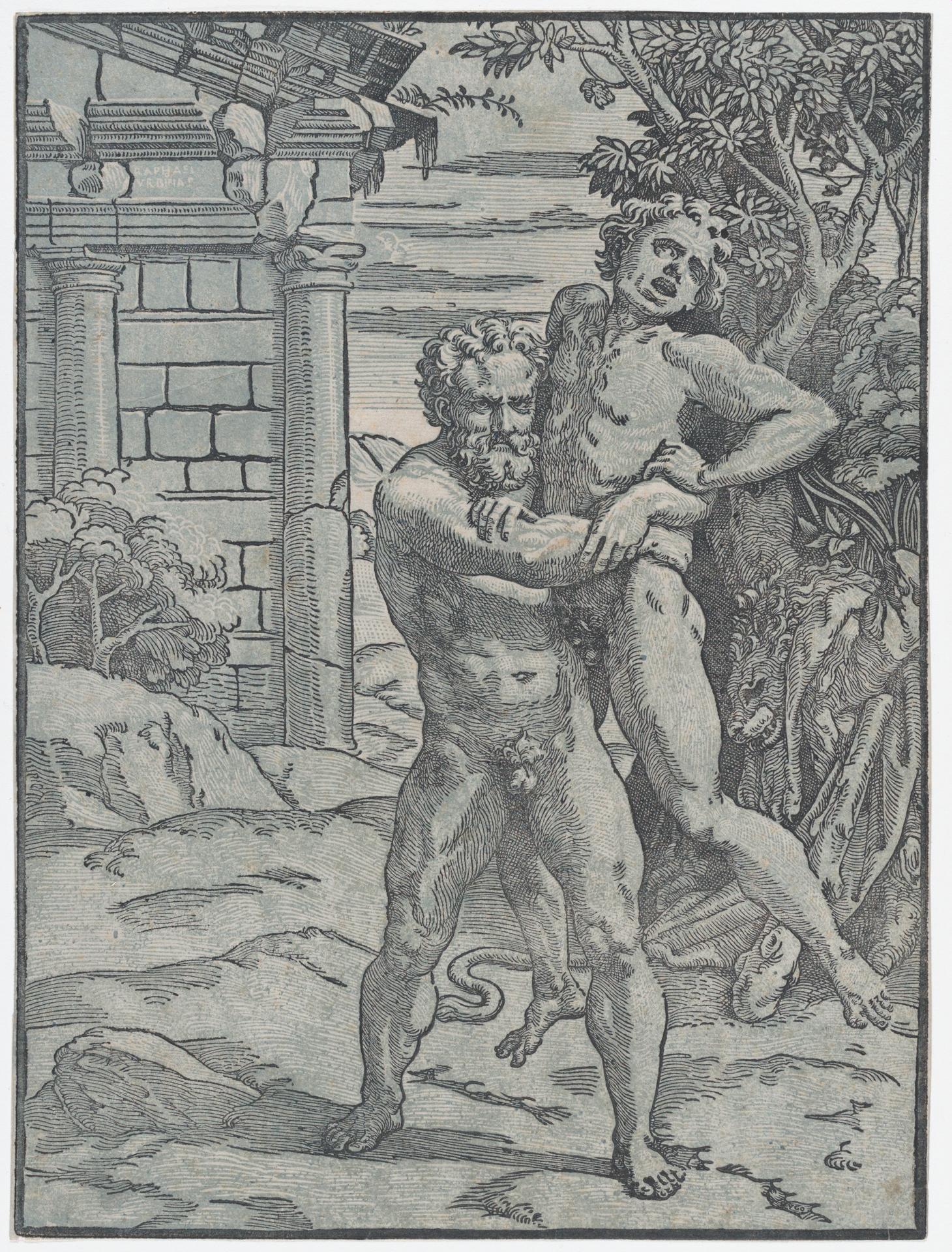
Hercules and Antaeus (ca. 1517–18)
Original title: Hercules and Antaeus
kurzbeschreibung
Where many contemporary Hercules images celebrate the hero alone, this sheet puts the wrestling match itself at the centre. Ugo da Carpi's Hercules and Antaeus, made around 1517–18, stages the mythic duel in a chiaroscuro woodcut printed from two blocks in green-blue. The muscular bodies of the two opponents stand out in a restless, tightly interlocked arrangement.
Description
Two powerful men grapple in the foreground: Hercules has seized Antaeus from behind, and the giant's body twists in a violent, almost overwhelmed turn. Both figures occupy the middle of the sheet, their musculature worked out in detail with sharp lines and shading. Ruins and trees behind them suggest an ancient landscape. The palette stays within greys and blues, and the tension between the fighters and their setting heightens the drama.
Context
Ugo da Carpi, an Italian printmaker, established the chiaroscuro woodcut in Italy. The sheet dates from the Renaissance, an era drawn to classical myth and to the rendering of the human body. Its action follows the myth in which Hercules defeats Antaeus by lifting him off the ground, since the giant drew his strength from the earth. The work belongs to a group of mythological scenes made for collectors.
Impact
The central group and the strong contrasts seize the eye at once. The green-blue tone gives the scene a calm, almost nocturnal mood that makes the violence of the struggle stand out all the more. The precise drawing of muscle stresses the physical effort and lets the viewer feel something of the wrestlers' strain.
Technique
A chiaroscuro woodcut uses two blocks: one for the tonal areas, one for the contours. The green-blue effect comes from two tones that model light and shadow. This method allows soft transitions and gives the print a painterly quality.
AI-generated description text
Source: Metropolitan Museum of Art · Public Domain (CC0 1.0)