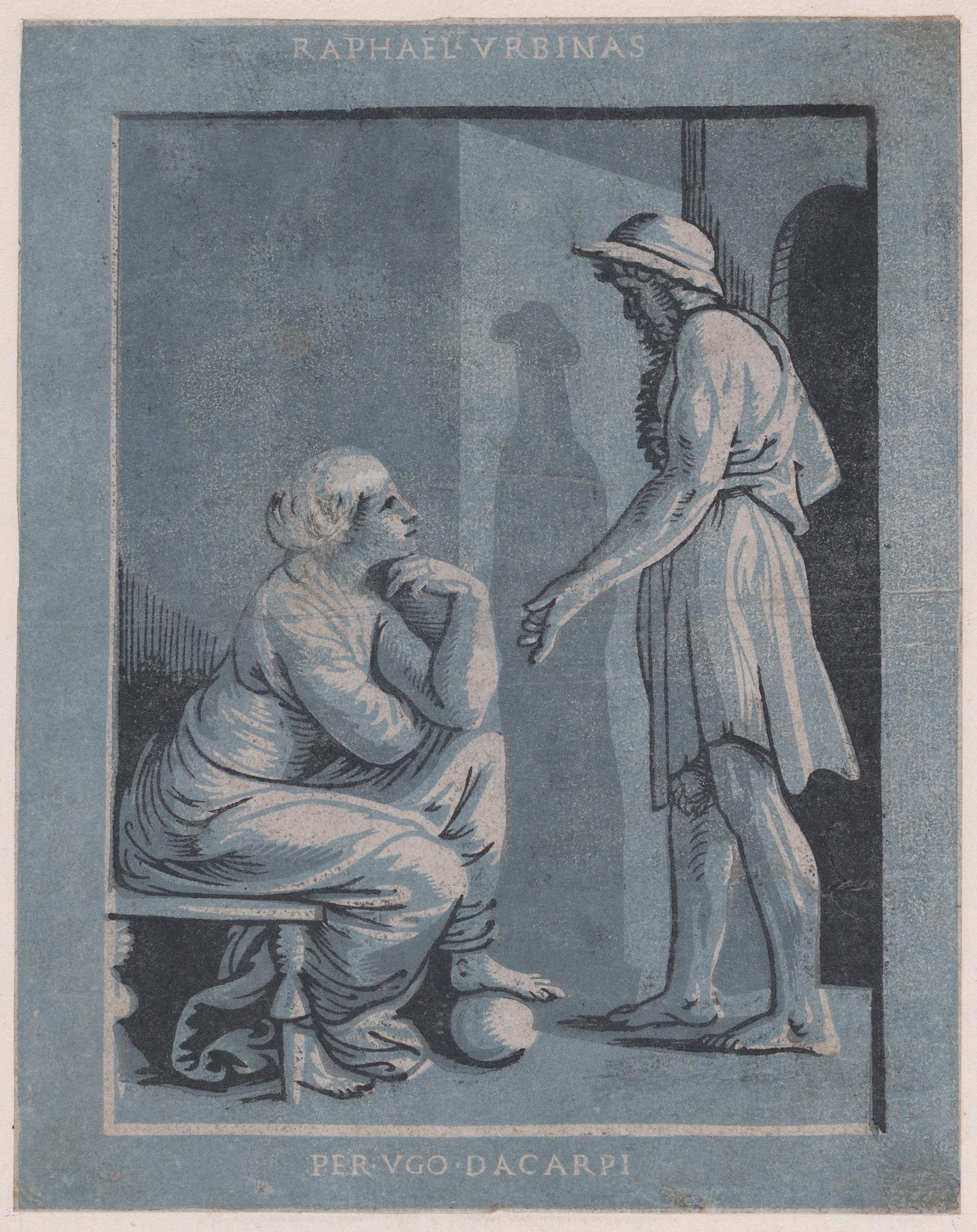
Penelope and Odysseus
Original title: Penelope and Odysseus
kurzbeschreibung
Penelope and Odysseus sit together in a quiet interior in this chiaroscuro woodcut by Ugo da Carpi, made around 1520–27. The print follows a design by Raphael and was produced from three woodblocks in shades of blue and gray.
Description
A woman, likely Penelope, sits in the foreground on a low seat; her long robe falls in heavy folds, her arms are crossed, and her head tilts slightly—a pensive pose. Before her stands Odysseus in simple clothing and a hat, apparently about to speak to her. Walls and a window define the room behind them; light enters from the side, casting shadows. The palette stays within blue and gray tones, while sharp, clear lines accent the details of the woodcut.
Context
Ugo da Carpi, an Italian printmaker, helped establish the chiaroscuro woodcut in Italy. This sheet came from Raphael's workshop, where the design was conceived, and it documents the collaboration between painter and printmaker in the Renaissance. The inscriptions 'RAPHAEL VRBINAS' and 'PER VGO DACARPI' name Raphael as the author of the design and Ugo da Carpi as its executor.
Impact
The restrained blues and grays create a calm, almost monochrome mood that draws attention to the intimate encounter between the two figures. Crisp contours and the side lighting give the image a sculptural depth characteristic of chiaroscuro prints.
Technique
Three woodblocks were printed one over another in blue and gray inks—a method that builds tonal values and shading by layering different plates. The precise execution and sharp lines attest to Ugo da Carpi's high level of craftsmanship.
AI-generated description text
Source: Metropolitan Museum of Art · Public Domain (CC0 1.0)