Sentimens des plus Habiles Peintres sur la Pratique de la Peinture et Sculpture, mis en Tables de Preceptes, avec Plusieurs discours Accademiques
Original title: Sentimens des plus Habiles Peintres sur la Pratique de la Peinture et Sculpture, mis en Tables de Preceptes, avec Plusieurs discours Accademiques
kurzbeschreibung
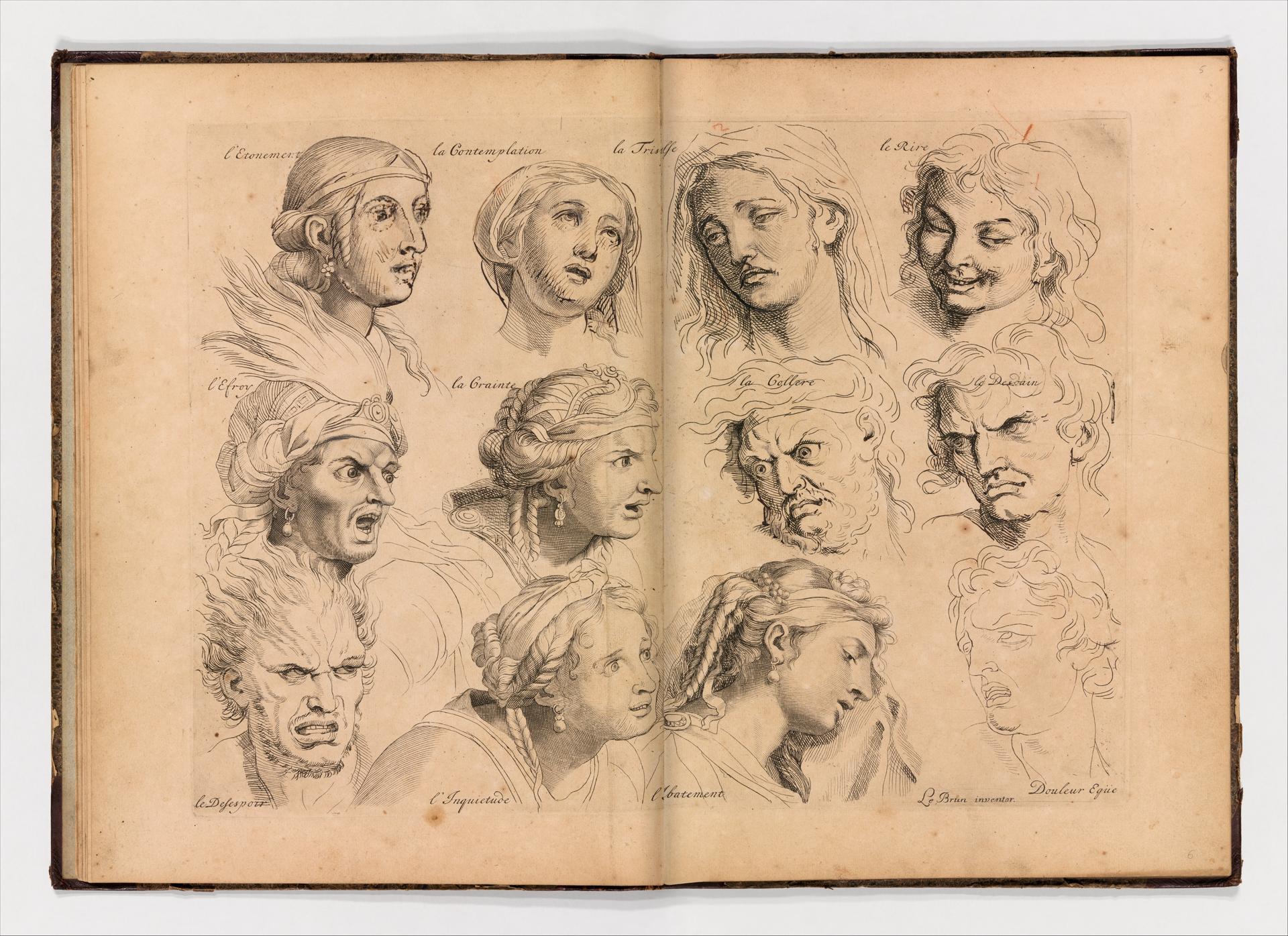
This 1696 print by Henri Testelin brings together eight portraits of human heads, each demonstrating a different emotion. Etching and woodcut capture expressions such as astonishment, contemplation, grief, and laughter, with French labels on every sheet.
Description
Eight heads are arranged in two columns and four rows, each devoted to a specific feeling. The top row, from left to right, shows 'l'Étonnement', 'la Contemplation', 'la Tristesse', and 'le Rire'. The second row continues with 'l'Espoir', 'la Crainte', 'la Colère', and 'le Désespoir'. The third and fourth rows vary familiar expressions like 'l'Inquiétude', 'l'Étonnement', 'l'Espoir', and 'la Douleur' in a different order. Delicate lines and shading model the facial features in black and white.
Context
The French painter and theorist Henri Testelin (1616–1695) taught at the Académie royale de peinture et de sculpture in Paris. His 'Sentimens' appeared posthumously in 1696 and gave systematic form to academic rules for depicting emotions in painting. Artists used the plates as teaching material to render affects according to established conventions.
Impact
The emotions stand out clearly and schematically, directing the viewer's gaze toward precise observation. The recurrence of certain expressions underscores the systematic nature of affect depiction and feels instructive, leaving little room for individual interpretation.
Technique
Etchings, in which acid bites the drawing into a metal plate, form the basis of the plates. Woodcuts are also present, suggesting a combination of printing processes. The black-and-white execution, with its precise lines, achieves a clear graphic effect suited to teaching purposes.
AI-generated description text
Source: Metropolitan Museum of Art · Public Domain (CC0 1.0)