Apollo and the Muses on Parnassus
Original title: Apollo and the Muses on Parnassus
kurzbeschreibung
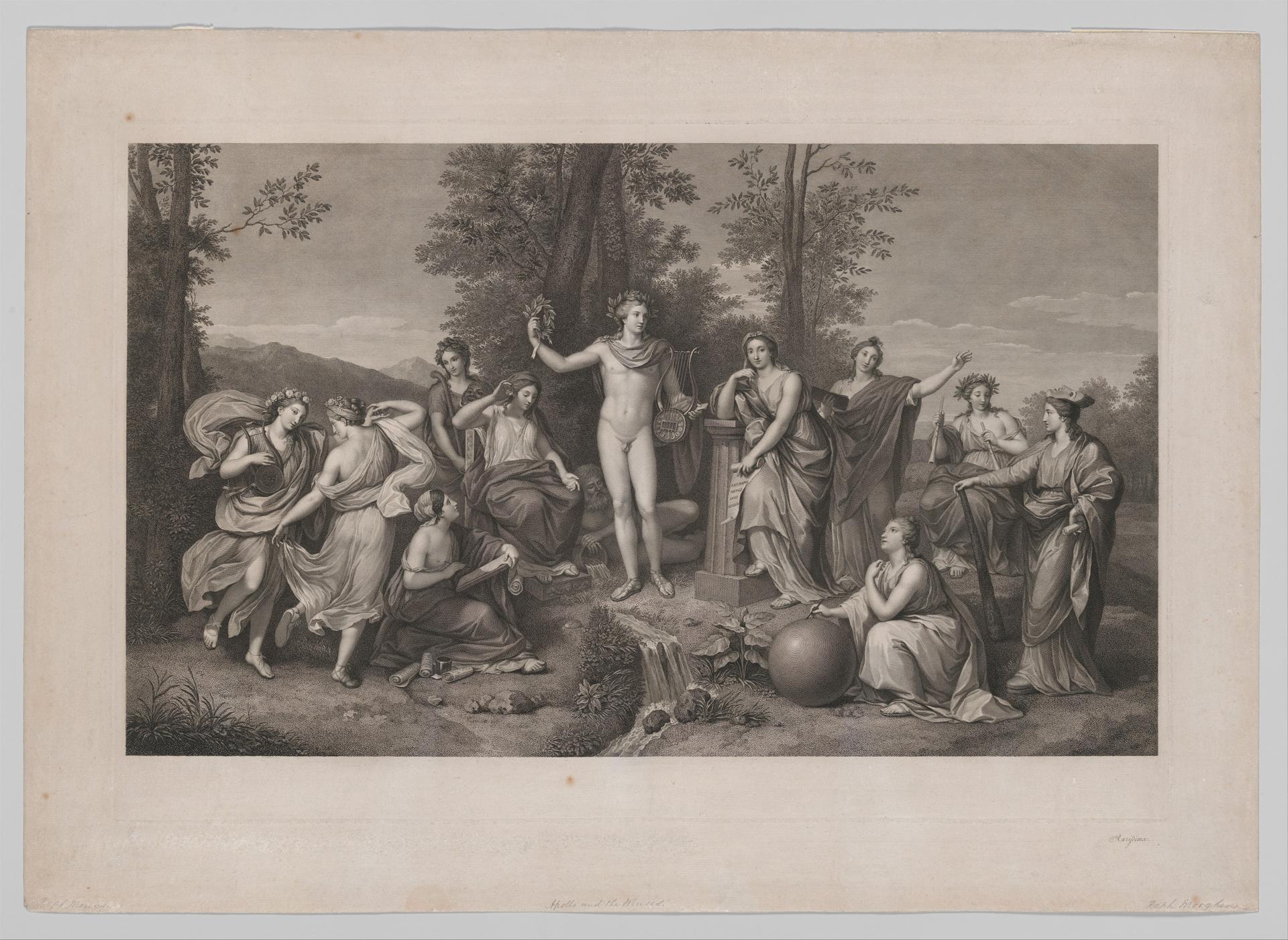
Raphael Morghen's etching of 1784 gathers Apollo and the nine Muses on Parnassus. This Neoclassical print brings music, poetry and nature into a single harmonious whole.
Description
Apollo anchors the image: barefoot, a cloth wrapped around his hips, he holds a lyre and a flower. Around him the Muses stand, sit or dance in antique garments. The layout feels symmetrical, Apollo at the centre, the Muses spread to either side. Trees, rocks and an expansive mountain landscape form the backdrop. Everything stays monochrome, with evenly distributed light, as is characteristic of an etching.
Context
The Italian Raphael Morghen (1758–1833) worked as a copper engraver and was known for reproductive prints after famous paintings. This sheet dates from 1784, when Neoclassicism shaped Europe and ancient mythology served as a model of beauty and order. Morghen often worked from other artists' designs; which exact source served for this work cannot be securely established.
Impact
Calm and lofty, the print draws its effect from the symmetrical arrangement and the idealized figures. Precise lines and a clear organization of the image reinforce the classical harmony and give the work a timeless elegance.
Technique
The work was made as an etching: the lines were incised into a metal plate, which was then bitten with acid. With fine, exact strokes Morghen worked out the details of the figures and the landscape. This process allows high precision and an even distribution of tones, which suits the reproduction of Neoclassical compositions.
AI-generated description text
Source: Metropolitan Museum of Art · Public Domain (CC0 1.0)