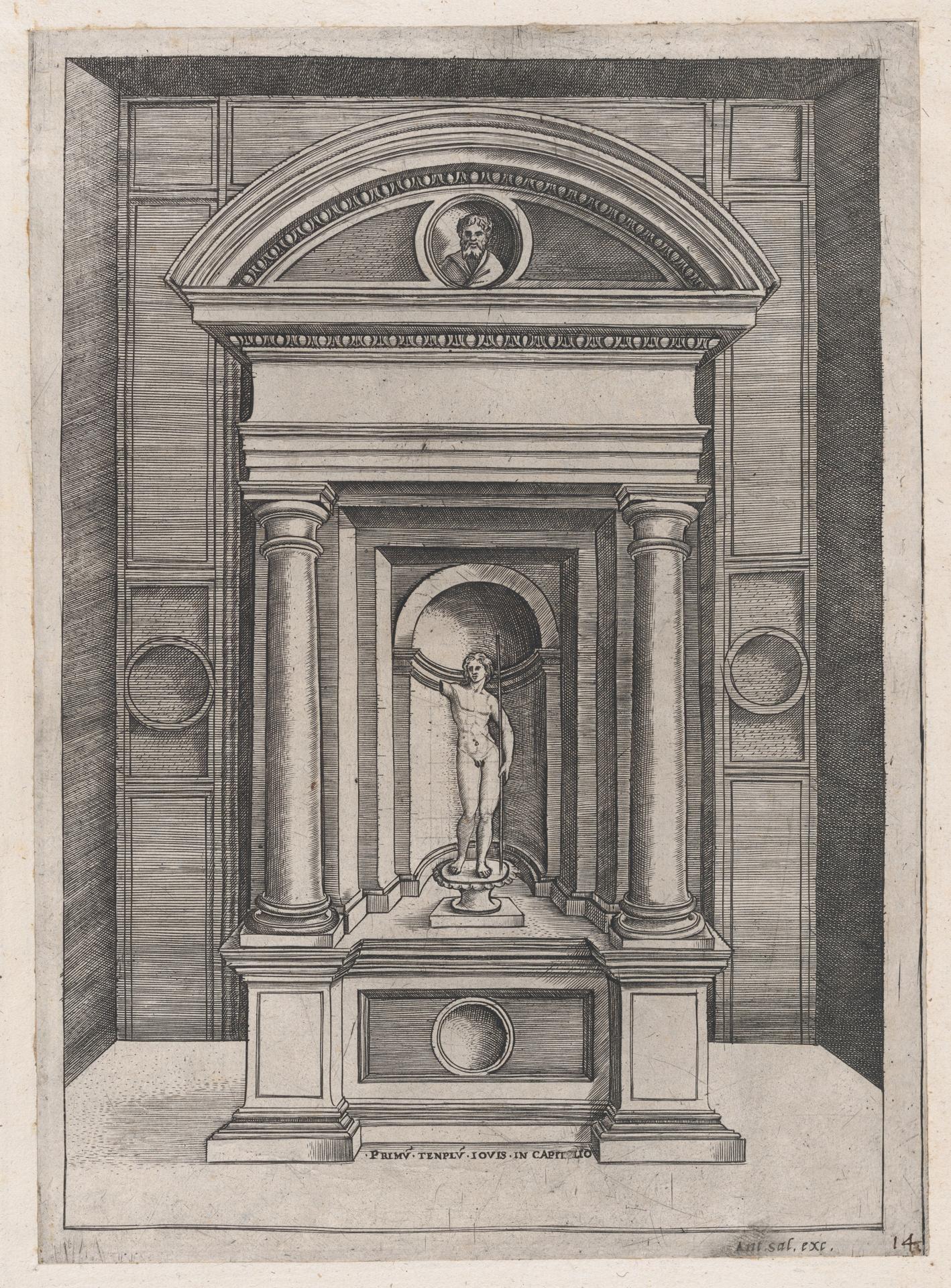
The Altar of Jupiter in the Oldest Temple on the Capitol, from "Speculum Romanae Magnificentiae"
Original title: The Altar of Jupiter in the Oldest Temple on the Capitol, from "Speculum Romanae Magnificentiae"
kurzbeschreibung
Between 1514 and 1536, Agostino Veneziano (Agostino dei Musi) made this engraving of the altar of Jupiter in the oldest temple on the Capitoline. The print belongs to the 'Speculum Romanae Magnificentiae' collection and reproduces an ancient cult site with a statue and architecture.
Description
A statue of a naked man with shield and spear stands on a pedestal, framed by two columns. An architrave above carries a relief with a head. A wall with ornamental elements and round-arched windows forms the setting. A text at the bottom of the image gives the title and presumably the name of the artist or publisher. The layout is symmetrical, the figures clearly outlined, the coloring monochrome and the light even.
Context
This engraving was made in the first half of the 16th century, when artists and antiquarians in Rome increasingly documented ancient monuments. Agostino Veneziano, a pupil of Marcantonio Raimondi, was known for his reproductive prints. Antonio Lafreri published the 'Speculum Romanae Magnificentiae', a collection that brought together views and reconstructions of Roman buildings. The Renaissance antiquarian interest in Roman antiquity is tangible in this work.
Impact
The symmetrical arrangement and clear linework give the sheet a calm, monumental presence. The statue of Jupiter is surrounded by a solemn, cultic aura that the architectural framing emphasizes.
Technique
Engraving is a process in which the motif is incised into a copper plate and then printed on paper. The finest lines and precise details can be achieved this way, which suits the reproduction of architectural and figural elements.
AI-generated description text
Source: Metropolitan Museum of Art · Public Domain (CC0 1.0)