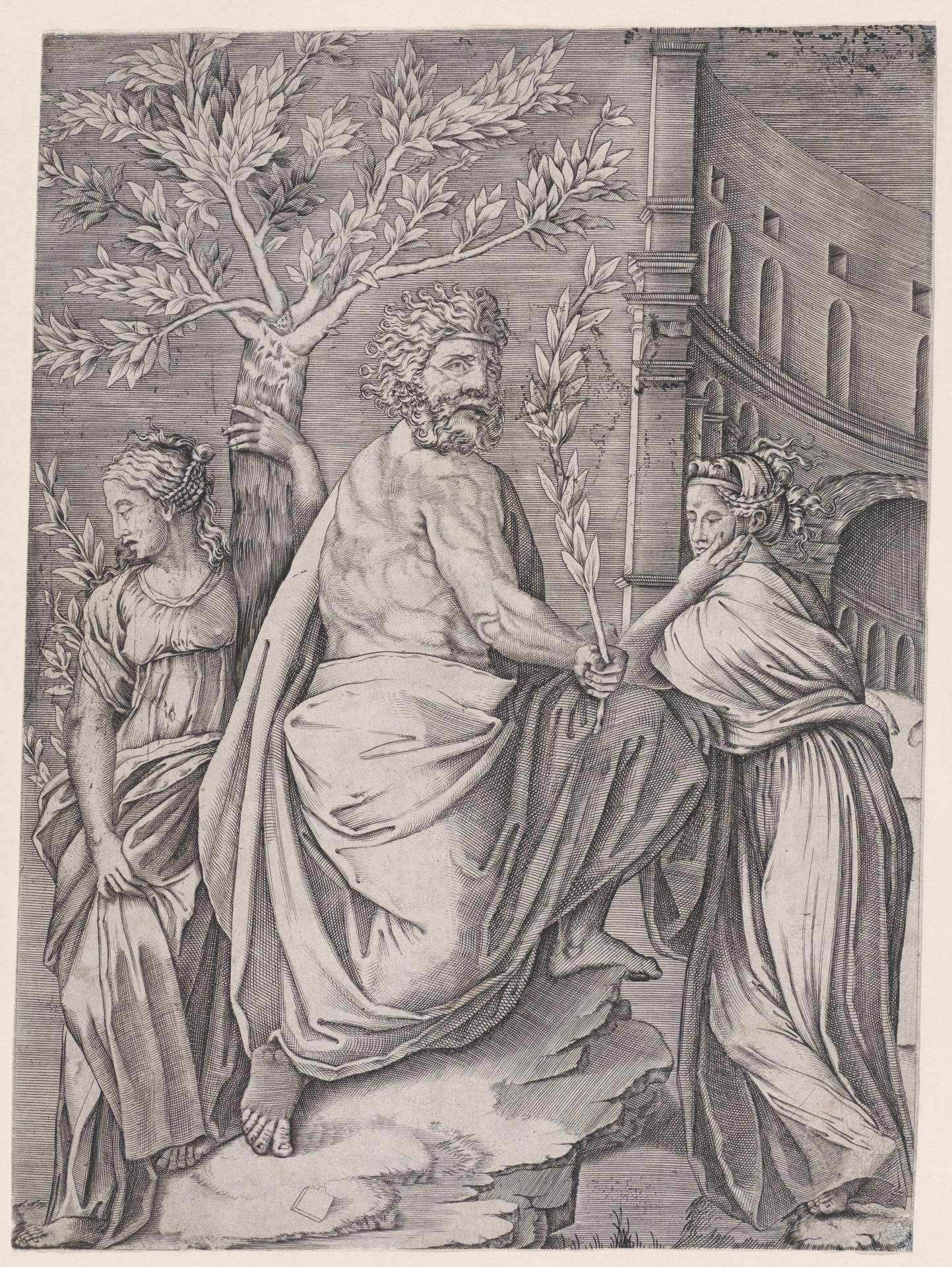
The Man with a Laurel Branch
Original title: The Man with a Laurel Branch
kurzbeschreibung
Unlike related prints that isolate a single figure, this engraving by Agostino Veneziano brings together three figures in antique dress. The work was made between about 1514 and 1536. The central male figure holds a laurel branch in his right hand.
Description
A symmetrical layout lines up three figures in a row before an ancient building with columns and arcades. In the middle stands a bearded man with long, curly hair in a simple garment; he too carries the laurel branch in his right hand. Flanking him are a woman with long curls on the left and another with her hair tied back on the right, both also holding laurel branches. At the back left appears a tree with individually worked leaves. Fine lines and open areas model light and shadow.
Context
The Italian Renaissance engraver Agostino Veneziano worked in the workshop of Marcantonio Raimondi and often reproduced works by Raphael and Giulio Romano; hence the classical subject of this print. The dating around 1514–36 falls within his Roman period, when antique motifs and architecture were everywhere. Laurel branches refer to ancient traditions in which laurel stood for victory and poetry.
Impact
A calm, symmetrical arrangement creates a solemn classicism. Precise lines and exact textures give the figures and architecture an almost sculptural presence. The monochrome directs attention to the balance of the layout and the calligraphic quality of the burin work.
Technique
In engraving, an intaglio process, lines are cut into a metal plate. Dense, fine lines form the shadows; the highlights remain as open areas of the plate. This allows very fine detail, as seen in the curls, garments and leaves.
AI-generated description text
Source: Metropolitan Museum of Art · Public Domain (CC0 1.0)