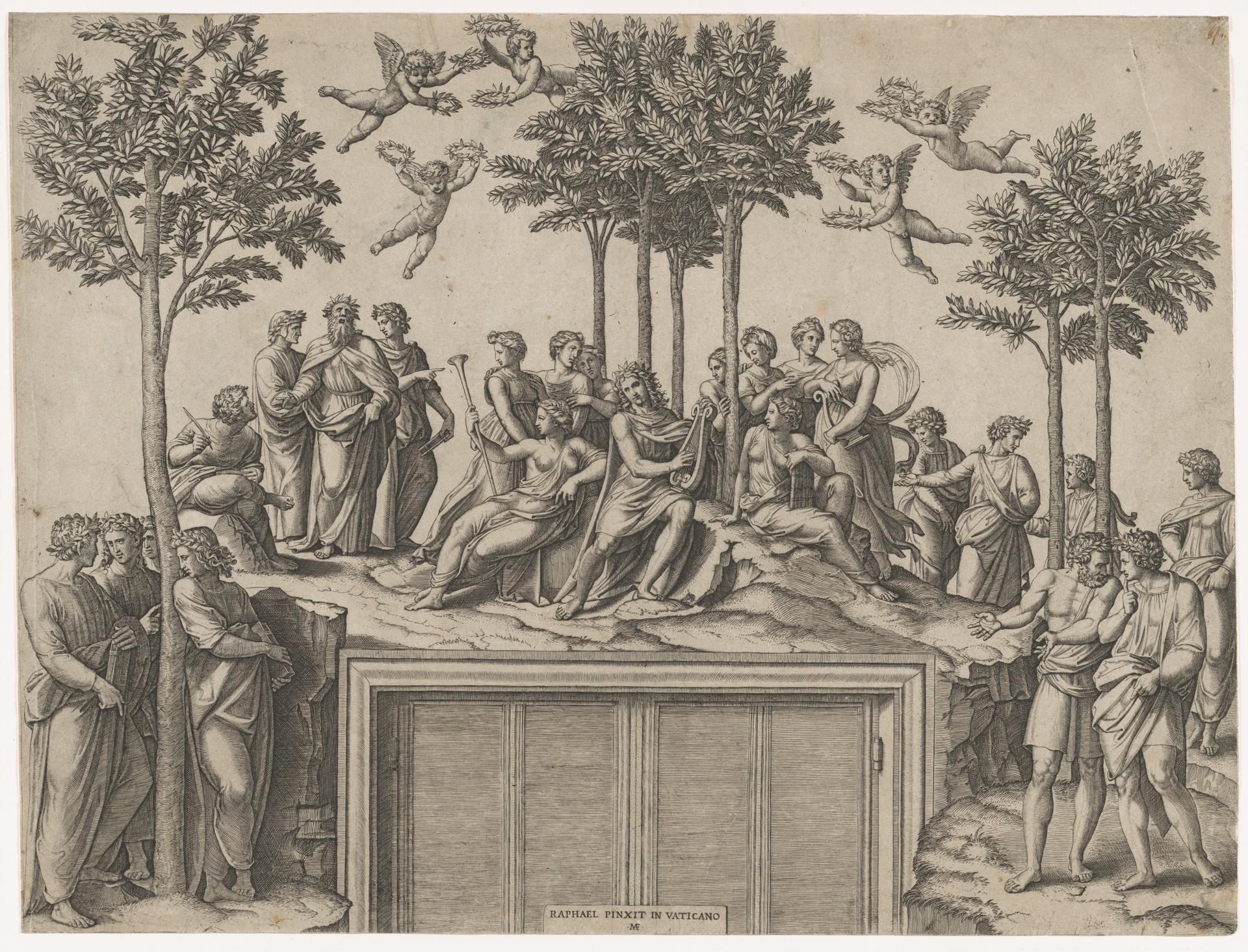
Apollo sitting on Parnassus surrounded by the muses and famous poets (ca. 1517–20, Met-Objekt 5853)
Original title: Apollo sitting on Parnassus surrounded by the muses and famous poets
kurzbeschreibung
Around 1517–20, Marcantonio Raimondi engraved this print of Apollo enthroned amid muses and celebrated poets in an imagined landscape. The sheet survives as the second of five states.
Description
Apollo occupies the middle, while several muses and famous poets fan out around him. The muses wear antique dress and carry musical instruments and other attributes; the poets, similarly clothed, stand talking together. Trees fill the rear, two angels hover above, and rocky outcrops break up the terrain. In front stands a table with an inscription that tells us about the artist and where the work was made. The arrangement feels balanced and nearly mirror-symmetric, rendered in greys with even light that casts hardly any shadow.
Context
Raimondi, an Italian engraver of the Renaissance, became best known for his reproductive prints after Raphael. This sheet belongs to his productive Roman years, when he worked closely with Raphael. Parnassus was a classical subject often used in the Renaissance to celebrate the arts. The engraving reflects both the pull of antiquity and the humanist ideals of the early sixteenth century.
Impact
The steady layout and idealized figures convey calm and harmony. Grey tones and soft light give the sheet a clear, sober elegance characteristic of Raimondi's style. The subject carries a timeless, classical mood and draws the viewer into the world of ancient myth and poetry.
Technique
Fine lines and hatching, incised into the copper plate and then printed, build detail and tonal nuance with great precision. Raimondi varied the density of his strokes to shape transitions and internal drawing. The second of five states preserves an early version that differs from later pulls in the treatment of the plate and the printing process.
AI-generated description text
Source: Metropolitan Museum of Art · Public Domain (CC0 1.0)