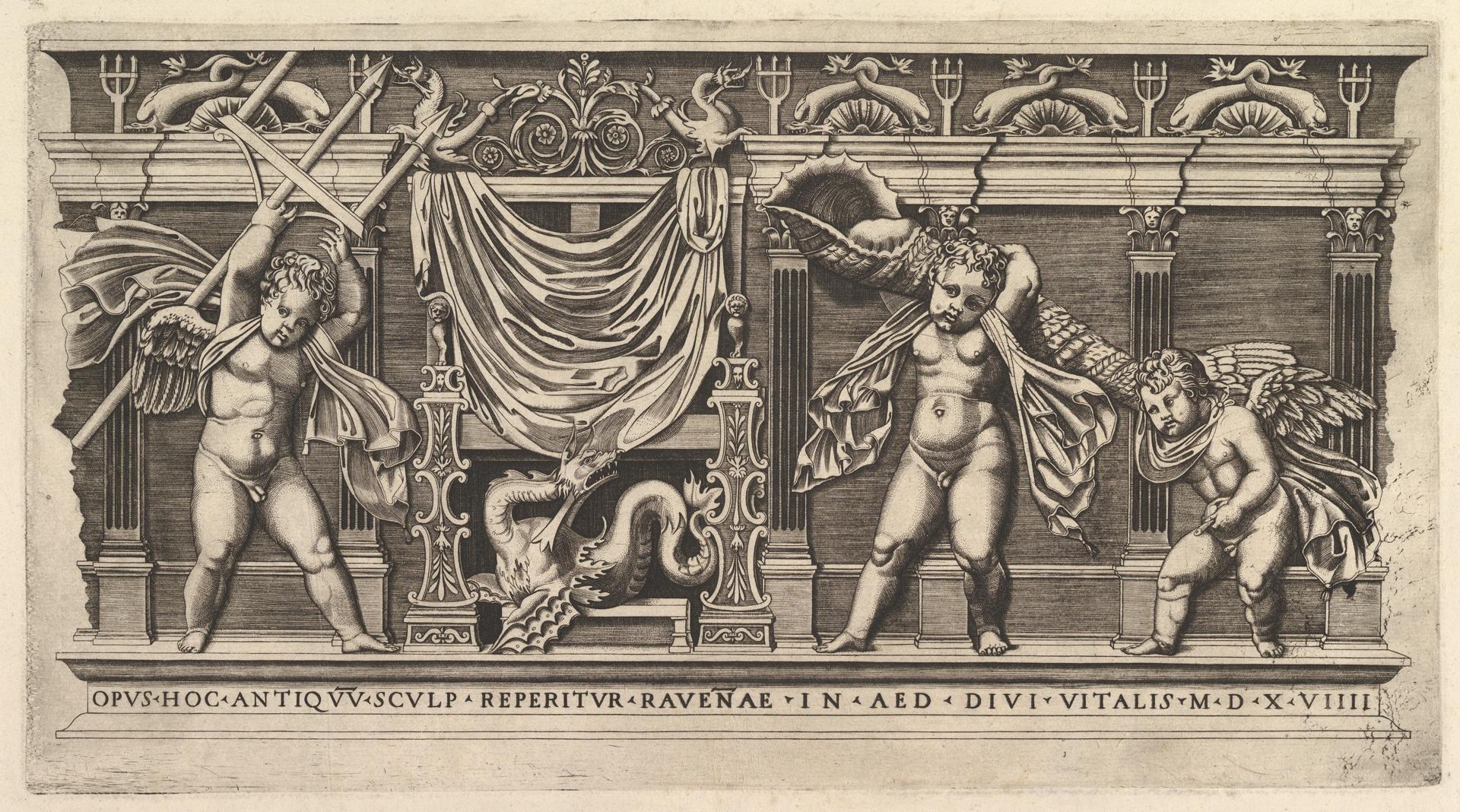
Bas-Relief with Three Cupids, from "Speculum Romanae Magnificentiae" (1519, Met-Objekt 5850)
Original title: Bas-Relief with Three Cupids, from "Speculum Romanae Magnificentiae"
kurzbeschreibung
Around 1519, Marco Dente engraved a flat relief with three putti. The print belongs to the 'Speculum Romanae Magnificentiae' collection, which recorded ancient monuments and ornaments. Clear lines and a symmetrical layout are hallmarks of this example of Renaissance printmaking.
Description
Three putti appear within an architecture of columns and an ornamented baldachin. The left putto carries an arrow and a writing quill, the middle one blows into a shell, and the right holds a bowl. Below the relief, a Latin inscription band records Marcantonio Raimondi and the year 1519. The figures are rendered with movement, the arrangement is balanced, and the light falls evenly.
Context
The 'Speculum Romanae Magnificentiae' collection brings together engravings published from 1519 onward by Marcantonio Raimondi and his workshop. Marco Dente, a pupil of Raimondi, took part in the production. The aim was to spread ancient and contemporary Roman art; the prints served artists and lovers of antiquity as models.
Impact
The print's calm balance strikes you first, thanks to the symmetrical arrangement and clear contours. Movement enters through the poses of the putti, which hold the viewer's gaze. Because the image remains monochrome, the details of the ornaments and figures stand out distinctly.
Technique
In engraving, lines are cut into a copper plate and then printed. Even lines and fine hatching create a sculptural effect; monochrome printing is characteristic of this process. At 18.3 x 35.5 cm, the format matches a collected volume and allows for detailed reproduction.
AI-generated description text
Source: Metropolitan Museum of Art · Public Domain (CC0 1.0)