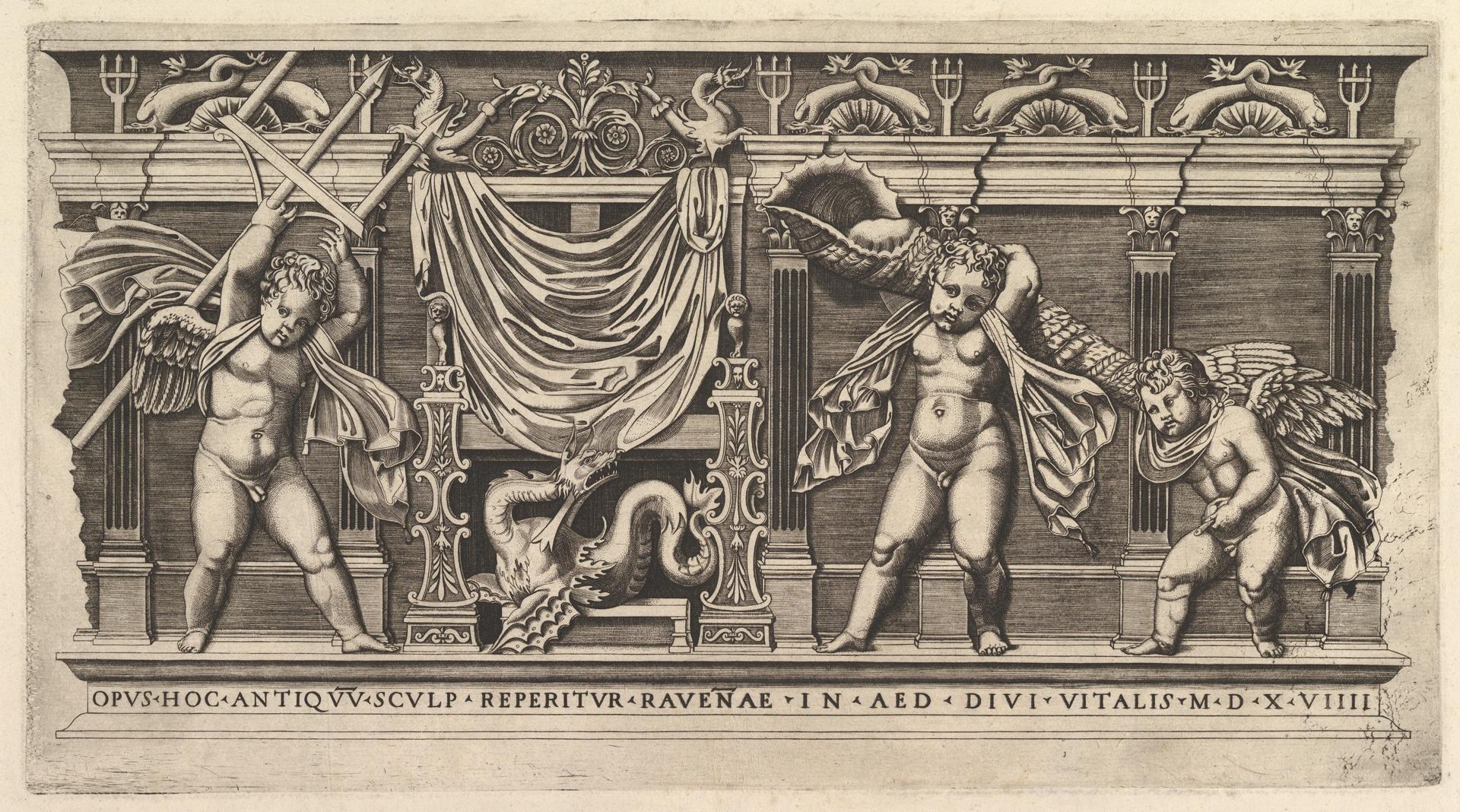
Bas-Relief with Three Cupids, from "Speculum Romanae Magnificentiae" (1519, Met-Objekt 5849)
Original title: Bas-Relief with Three Cupids, from "Speculum Romanae Magnificentiae"
kurzbeschreibung
Marco Dente's 1519 engraving reproduces a flat relief featuring three putti. Three winged boy figures are arranged in a symmetrical layout, framed by architectural and ornamental elements. The print belongs to the 'Speculum Romanae Magnificentiae', a series that gathered ancient Roman monuments.
Description
Three half-naked, winged putti dominate the image. The left boy holds an arrow and shield, the middle one wears a shell on his head, and the right one carries a cloth. Columns flank the structure, along with a dragon and a curtain. The arrangement is built as a mirror image around the putti, with the columns and dragon at the edges. The image remains monochrome, with even lighting, clear lines, and detailed textures.
Context
The Italian engraver Marco Dente, a Renaissance printmaker, issued this sheet in 1519. It forms part of the 'Speculum Romanae Magnificentiae', an important collection of prints that recorded the buildings and artworks of ancient Rome. As a kind of visual encyclopedia, such engravings spread knowledge of Roman antiquity across Europe. Dente, a pupil of Marcantonio Raimondi, was known for accurate reproductions of antique reliefs.
Impact
The mirror-like arrangement and richly varied lines give the print a calm and balanced quality. The putti introduce a playful, almost cheerful note that stands out against the monumentality of antiquity. Overall, the engraving displays a clear, ordered aesthetic characteristic of the Renaissance.
Technique
This engraving was made by incising the design into a copper plate and then printing it on paper. Fine lines and hatching create the detailed textures and shading. The plate measures 19 x 35.5 cm, the sheet 31.5 x 47.5 cm, suggesting a high-quality print.
AI-generated description text
Source: Metropolitan Museum of Art · Public Domain (CC0 1.0)