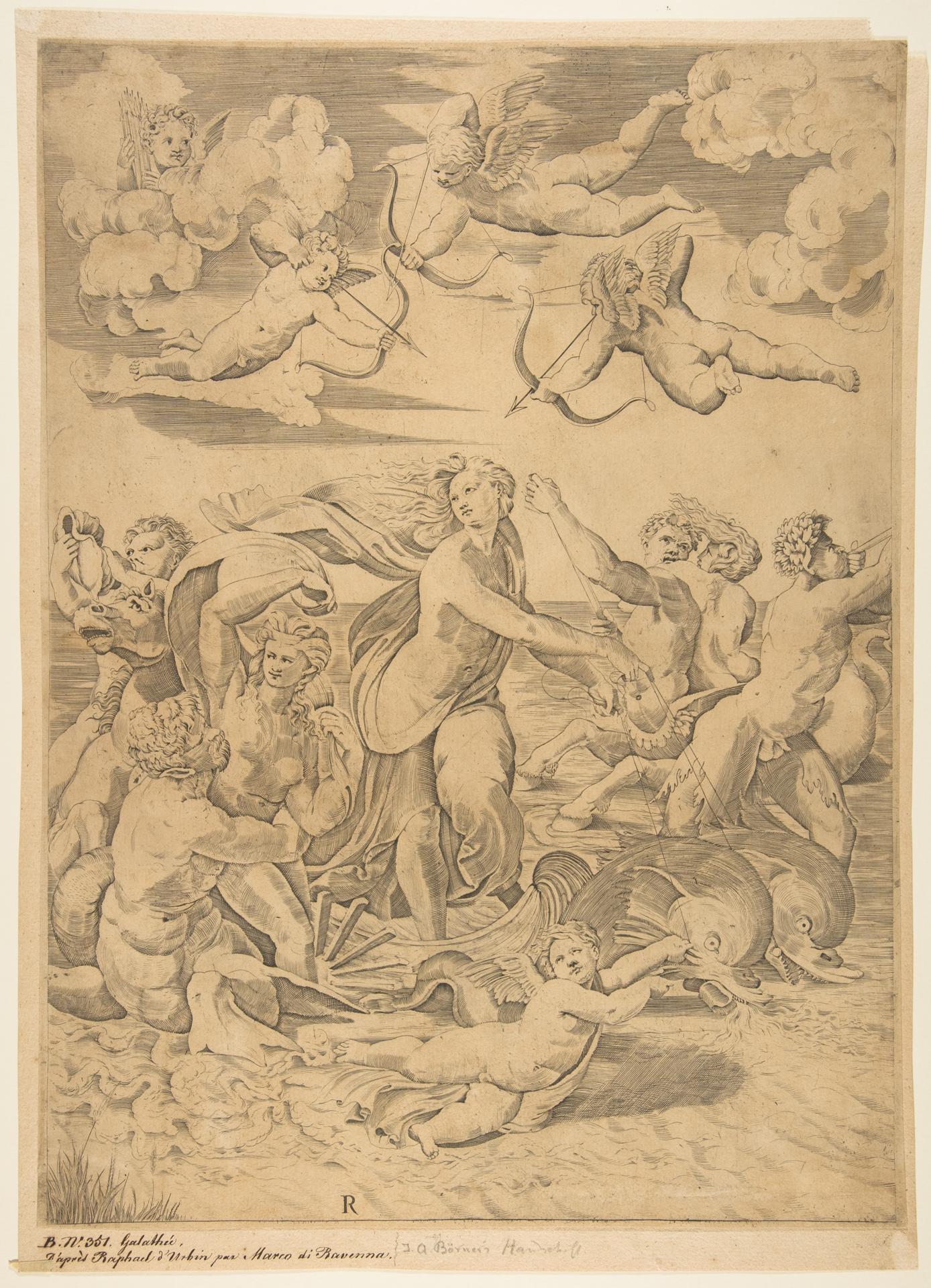
Galatea riding in a shell pulled through the water by dolphins, a cupid below and four more above, at left a triton embracing a nymph and behind them a man on horseback blowing a conch, at right a figure blowing a horn and behind him a nymph riding on a centaur
Original title: Galatea riding in a shell pulled through the water by dolphins, a cupid below and four more above, at left a triton embracing a nymph and behind them a man on horseback blowing a conch, at right a figure blowing a horn and behind him a nymph riding on a centaur
kurzbeschreibung
Riding a shell chariot drawn by dolphins, the sea nymph Galatea glides through the waves in this engraving by Marco Dente from around 1515–27. Amoretti, tritons and other figures from the mythological repertoire surround her. The print hints at the love and spiritual bond between Galatea and Acis as an allegory.
Description
Galatea sits in a shell-shaped boat that two dolphins pull forward. Directly below her appears a Cupid with bow and arrow, while above four more winged cherubs hover in the air with arrows. On the left a triton embraces a nereid; behind them a man seated on a horse blows into a conch shell. On the right a figure raises a horn, and in the distance a nereid rides on a centaur. The style is detailed and lively, with grey tones and vigorous linework that emphasize energy and dynamism.
Context
The Italian Renaissance engraver Marco Dente based this print on a design by Raphael, who had painted the Galatea theme as a fresco in the Villa Farnesina in Rome. Dente was known for his reproductive engravings after works of the High Renaissance; through them Raphael's inventions could circulate widely. The period of its creation was an era in which mythological subjects and the rediscovery of antiquity held high importance in art. Ovid's Metamorphoses, which tell the tragic love story of Galatea and Acis, serve as the literary source.
Impact
The layout feels lively, making the movement of the water and the bustle of the figures vividly tangible. Fine lines and careful shading give the bodies plasticity, so that they seem almost to step forward in space. Erotic grace and mythological grandeur enter into a union that secures the print's lasting aesthetic appeal.
Technique
For this engraving the lines were cut into a metal plate and then printed on paper. The method allows high precision and fidelity to detail, as can be seen in the fine contours and hatching. The impression is trimmed to a sheet of 40 × 29.3 cm — a format typical for collectors of the time.
AI-generated description text
Source: Metropolitan Museum of Art · Public Domain (CC0 1.0)