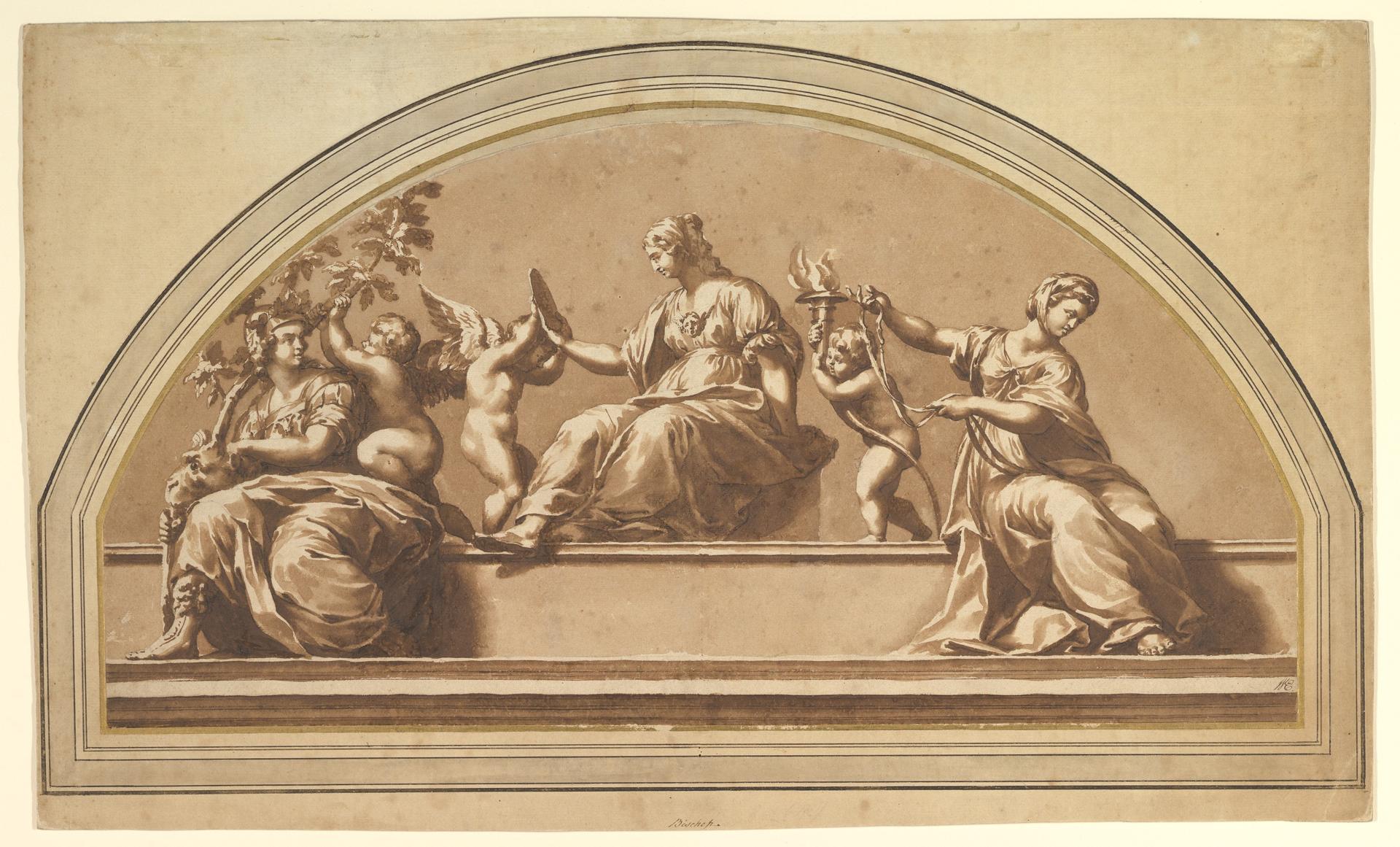
The Three Virtues (after Raphael)
Original title: The Three Virtues (after Raphael)
kurzbeschreibung
Unlike many contemporary allegories, Jan de Bisschop's drawing "The Three Virtues (after Raphael)" of about 1665 arranges the three classical virtues — Prudence, Justice and Fortitude — in a semicircular layout. The sheet is executed in pen and brown ink, with brush and brown wash over black chalk.
Description
Three female figures sit on a bench within a semicircular frame. At the centre, a crowned figure wearing a laurel wreath is presumably Prudence. To her left, a figure holds scales and a sword, pointing to Justice, while on the right a figure with sword and shield embodies Fortitude. Putti with a candle and a palm branch animate the space between them. Brown tones dominate the monochrome sheet, and the flat backdrop pushes the figures forward.
Context
The Dutchman Jan de Bisschop, a lawyer by profession, is known for his reproductive prints after Italian masters. He made this drawing around 1665, during a period of intensive engagement with the Italian Renaissance. It derives from a work by Raphael, which probably reached de Bisschop through engravings or drawings. Such copies often served him as models for his own printed works.
Impact
The symmetrical arrangement and the calm yet animated poses give the sheet a balanced and dignified presence. The restrained brown tonality supports a classical elegance that emphasises the allegorical meaning of the virtues.
Technique
Pen and brown ink define the execution, supplemented by brown wash and an underdrawing in black chalk. Precise pen lines and soft brushwork produce delicate shading and a sense of volume. The unusual semicircular format suggests the sheet was intended as a model for a decorative piece.
AI-generated description text
Source: Metropolitan Museum of Art · Public Domain (CC0 1.0)