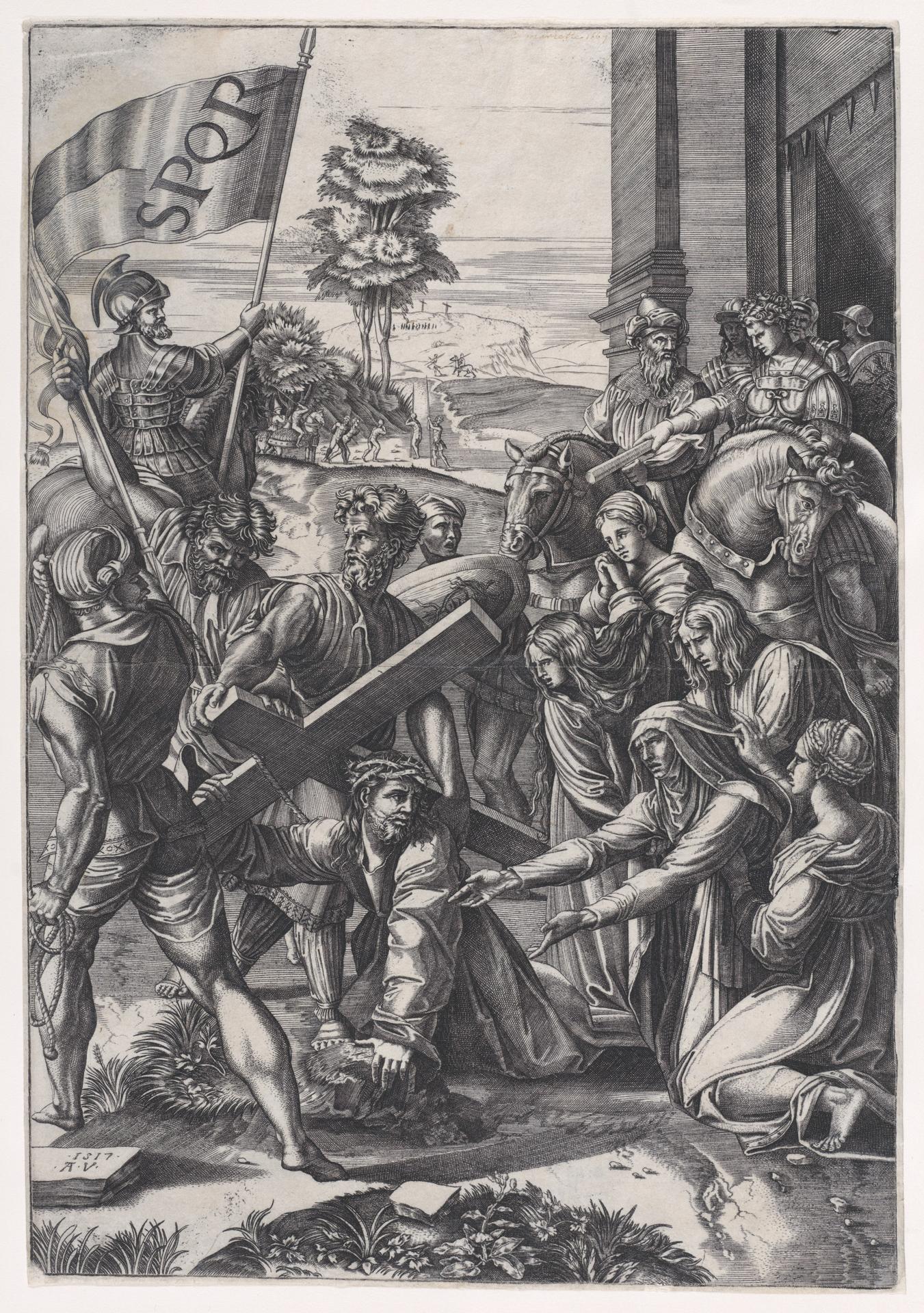
The Bearing of the Cross
Original title: The Bearing of the Cross
kurzbeschreibung
Agostino Veneziano, also known as Agostino dei Musi, engraved The Carrying of the Cross in 1517. The image centres on Jesus Christ, who collapses on the way to his execution under the weight of the cross. A landscape crowded with figures surrounds the moment, capturing the Stations of the Cross as a single, charged instant.
Description
At the front, low to the ground, Christ crawls forward with effort, the crossbeam across his shoulders; his body is bent, his face marked by pain. Around him people stand and kneel, some taking part, some mourning, others apparently at prayer. Further back, soldiers with weapons appear, one of them carrying a banner inscribed 'SPQR'. Trees and a hill enclose the action, and the restless arrangement of the picture draws the eye back to Christ.
Context
Agostino Veneziano, called Agostino dei Musi, was an Italian engraver of the Renaissance who worked in the workshop of Marcantonio Raimondi. The print was made in Rome in 1517, at a time when demand for printed images was strong. The motif of the carrying of the cross was widespread in sixteenth-century religious art, serving both devotion and the wider circulation of biblical scenes.
Impact
The precise description and the expressive posture of Jesus give the sheet an immediate emotional force. The animated layout steers the viewer's attention toward Christ's suffering and creates a dense, affecting atmosphere.
Technique
For this sheet the image was incised into a copper plate and then pulled on paper. The lines are drawn finely and with assurance, as is characteristic of Renaissance engravings. The monochrome rendering, with its even distribution of light, belongs to the particular qualities of this printing technique.
AI-generated description text
Source: Metropolitan Museum of Art · Public Domain (CC0 1.0)