Frieze with Eros and a Siren
Original title: Frieze with Eros and a Siren
kurzbeschreibung
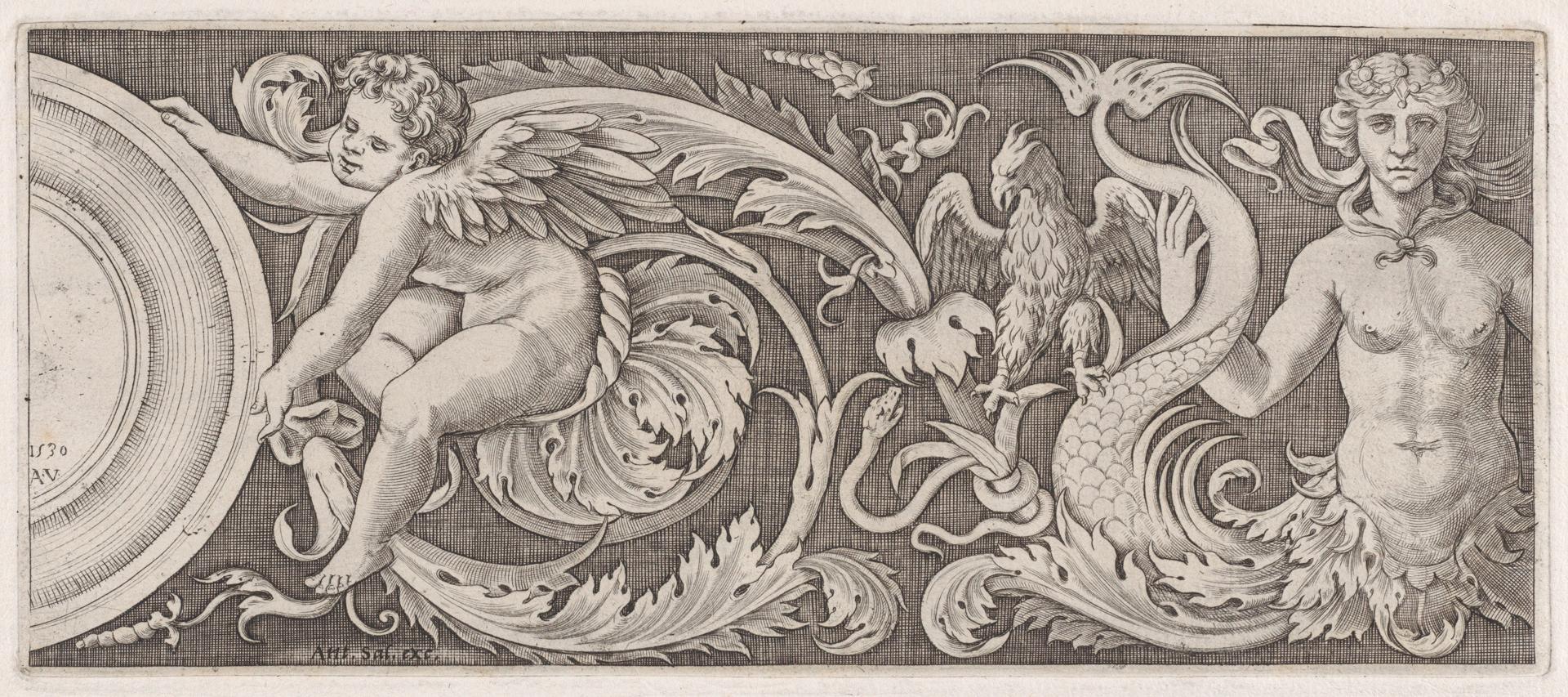
This 1530 copperplate engraving by Agostino Veneziano, also known as Agostino dei Musi, takes up a frieze motif in the antique manner. In the horizontal arrangement, a winged Eros, a siren, and an eagle meet, framed by stylized plants and wavy lines.
Description
A winged boy, Eros, has settled on a wave-like form and stretches out his arms as if reaching for something. Beside him stands a siren, one hand pointing to an eagle. The eagle sits at the center of the sheet, wings spread wide. The siren combines human and fish-like features: long hair and a fish tail. Stylized plants and waves frame the action and emphasize both the movement of the figures and their nature.
Context
Agostino Veneziano belonged to the circle of Italian Renaissance engravers and worked in the workshops of Marcantonio Raimondi. In 1530, when antique friezes and grotesques were in high demand as models for decorative prints, this sheet was created. Such works often served craftsmen as models and collectors as coveted objects.
Impact
The symmetrical arrangement and clear outlines give the frieze a calm and balanced appearance. Because mythological beings and ornamental elements come together, the print acquires a decorative character that also hints at a story.
Technique
For this engraving, the lines were cut into the copper plate with a burin. Fine shading and contours create the monochrome effect and make the figures and their surroundings stand out plastically.
AI-generated description text
Source: Metropolitan Museum of Art · Public Domain (CC0 1.0)