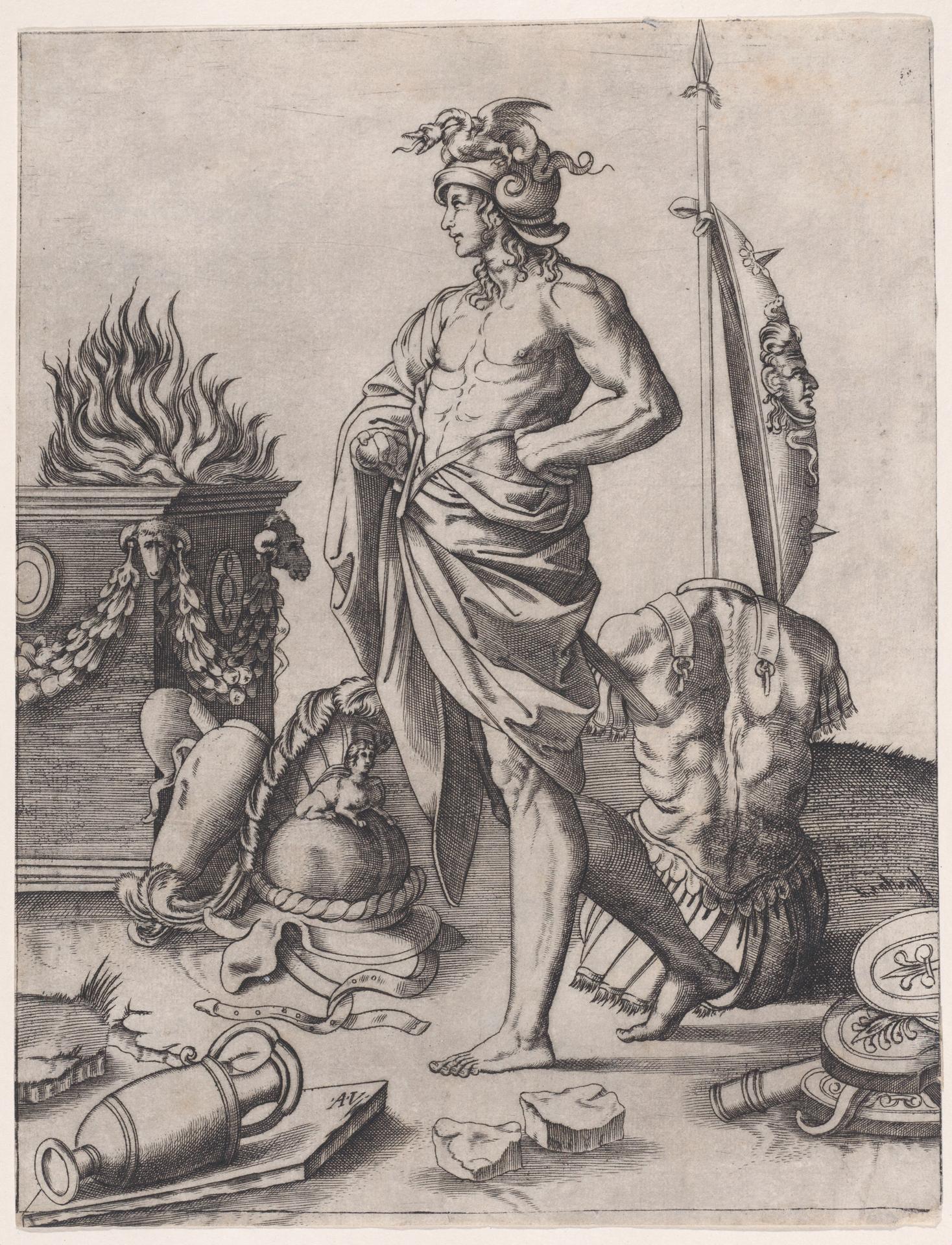
A Young Warrior Standing by an Altar, after Raphael
Original title: A Young Warrior Standing by an Altar, after Raphael
kurzbeschreibung
A young warrior in ancient armor, wearing a helmet and holding a lance, stands beside a blazing altar. This engraving by Agostino Veneziano (Agostino dei Musi) was made around 1514–36 and derives from a design by Raphael. The print is executed in the engraving technique.
Description
Upright and muscular, the warrior occupies the center of the image. A tunic drapes over his shoulders and a helmet sits on his head. His right hand holds a lance, and his gaze turns to the left. Beside him stands an altar with leaping flames, adorned with a garland and decorated with lion heads at the corners. Beneath the altar, amphorae, a bowl, and other artifacts are piled up; the ground is strewn with debris. The layout feels symmetrical, the light evenly distributed, the lines clear, and the shading rich in detail.
Context
Agostino Veneziano, an Italian engraver of the Renaissance, worked in the workshop of Marcantonio Raimondi and reproduced numerous works after designs by Raphael. This engraving was made in the first half of the 16th century in Rome, where Raphael's influence on printmaking was strong. The motif of a warrior at an altar draws on ancient sacrificial scenes, which in the Renaissance served as models for heroic and cultic themes.
Impact
The symmetrical arrangement and the warrior's calm posture give the print a solemn, almost monumental presence. The delicate lines and detailed shading create a sculptural, relief-like appearance that underscores the classicizing character of the work.
Technique
In this engraving, the lines were cut into a copper plate with a burin and then printed. This process allows for precise, fine lines and even shading that captures the texture of fabric, metal, and stone.
AI-generated description text
Source: Metropolitan Museum of Art · Public Domain (CC0 1.0)