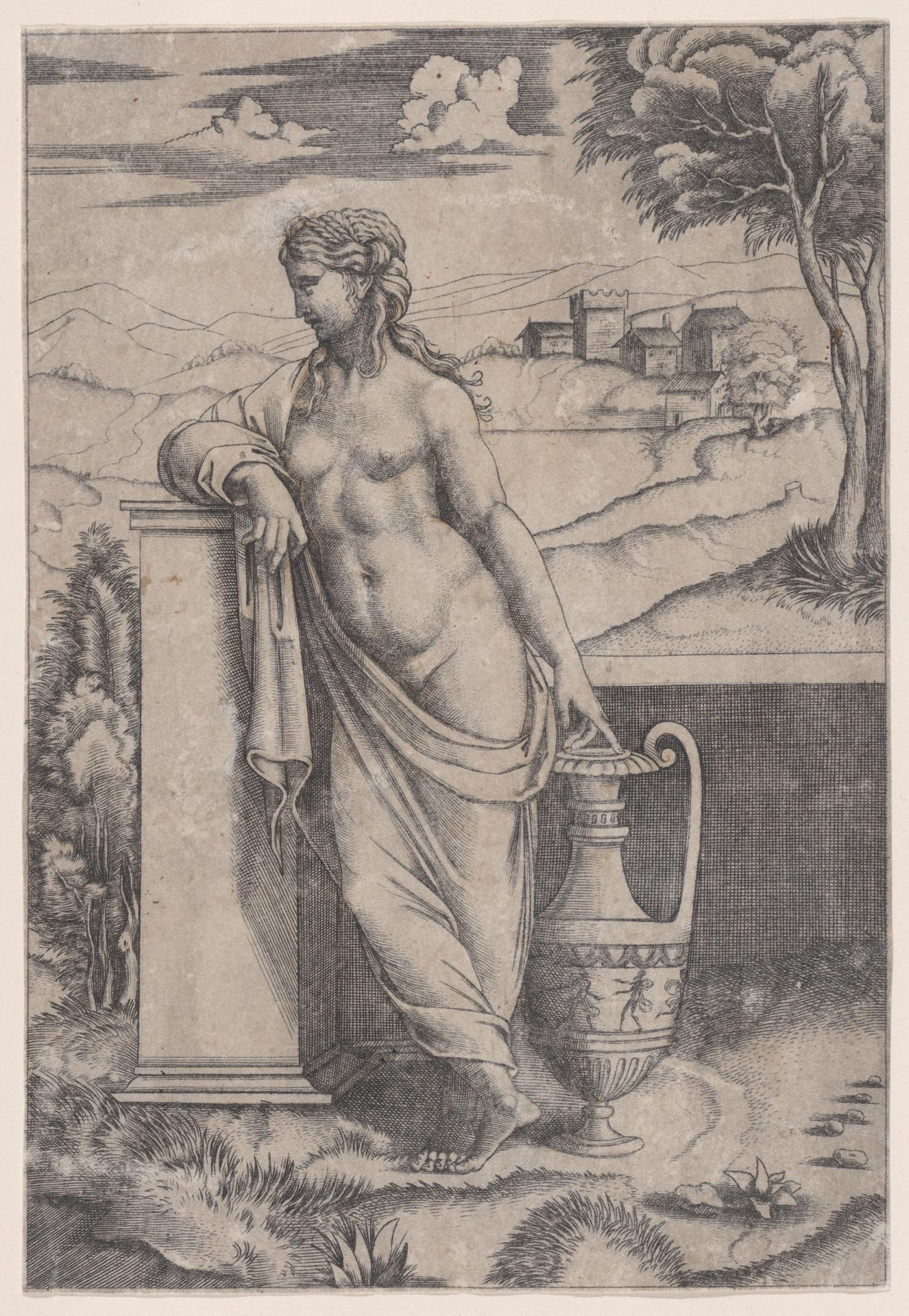
Woman Standing near a Vase (ca. 1514–36, Met-Objekt 5812)
Original title: Woman Standing near a Vase
kurzbeschreibung
Agostino Veneziano (Agostino dei Musi) made the engraving Frau, die neben einer Vase steht between about 1514 and 1536. It shows a barefoot woman in a landscape with classical overtones. Her simple dress flows around her body; in her right hand she holds a cloth, while her left rests on a large, decorated amphora. The execution reflects the Renaissance style.
Description
The woman anchors the image; her dress falls in soft folds over shoulders and body. A cloth is held in her right hand, and her left touches a large amphora adorned with figures and ornaments. Behind her, a landscape with hills, trees and buildings opens up. The linework is careful, with shading that brings out forms and textures. Even light prevails, with no harsh shadows.
Context
The Italian engraver Agostino Veneziano worked in the Renaissance, in the workshop of Marcantonio Raimondi. This print was made in the first half of the 16th century, when printed graphics spread widely in Italy. The motif of a woman with a classical vase draws on classical themes that were popular in the Renaissance.
Impact
The layout is calm and balanced, and the soft contrasts create a harmonious mood. The detailed rendering of the amphora and the landscape invites close looking. Overall, the print conveys an elegant, classical feel.
Technique
In engraving, lines are incised into a copper plate and then printed. This technique allows fine hatching and precise details, as visible in the analysis of the image. The even distribution of light suggests careful linework.
AI-generated description text
Source: Metropolitan Museum of Art · Public Domain (CC0 1.0)