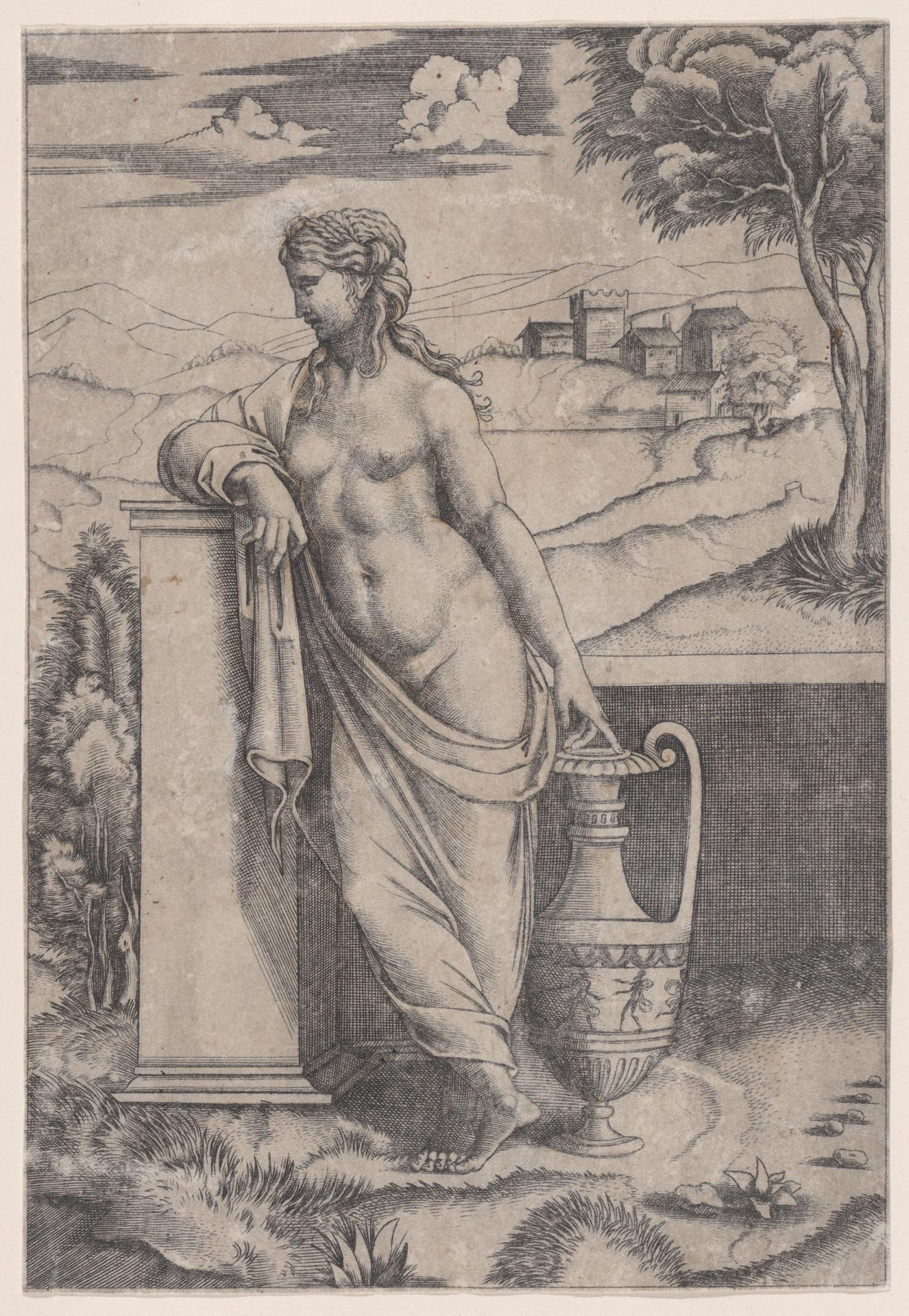
Woman Standing near a Vase (ca. 1514–36, Met-Objekt 5811)
Original title: Woman Standing near a Vase
kurzbeschreibung
A barefoot woman in a loosely falling tunic, one arm resting on a column — that is the subject of Agostino Veneziano's engraving 'Frau an einer Vase stehend', made between 1514 and 1536. Veneziano (Agostino dei Musi) sets the figure in an idealized landscape with a village and hills; the print presents a single figure with an antique-style vase before a wide panorama.
Description
The woman stands barefoot, wrapped in a tunic that slips from her shoulders; her hair is knotted. Her right arm leans on a column, while her left hand holds a scrap of cloth. Beside her rises an amphora-shaped jug with one handle. Trees, a hill, and a village with buildings and a castle fill the rear, under a cloudy sky. The figure occupies the left, the view opens to the right — a balanced arrangement, rendered in monochrome shades of gray.
Context
Agostino Veneziano, an Italian engraver of the Renaissance, worked closely with Marcantonio Raimondi. This sheet was made at a time when printmaking was spreading rapidly in Italy and often served as a model for artists. Its date is disputed, falling somewhere between 1514 and 1536. The motif belongs to the then-popular tradition of antique-inspired subjects.
Impact
The woman's calm, statuesque pose and the balanced layout give the sheet a solemn, classical air. The engraving's delicate lines produce a clear, detailed image that rewards close looking.
Technique
For this engraving, the design was incised into a copper plate and then printed on paper. The process allows fine hatching and precise contours, yielding subtle gray tones. The plate measures 21.4 x 14.7 cm; the craftsmanship is of high quality.
AI-generated description text
Source: Metropolitan Museum of Art · Public Domain (CC0 1.0)