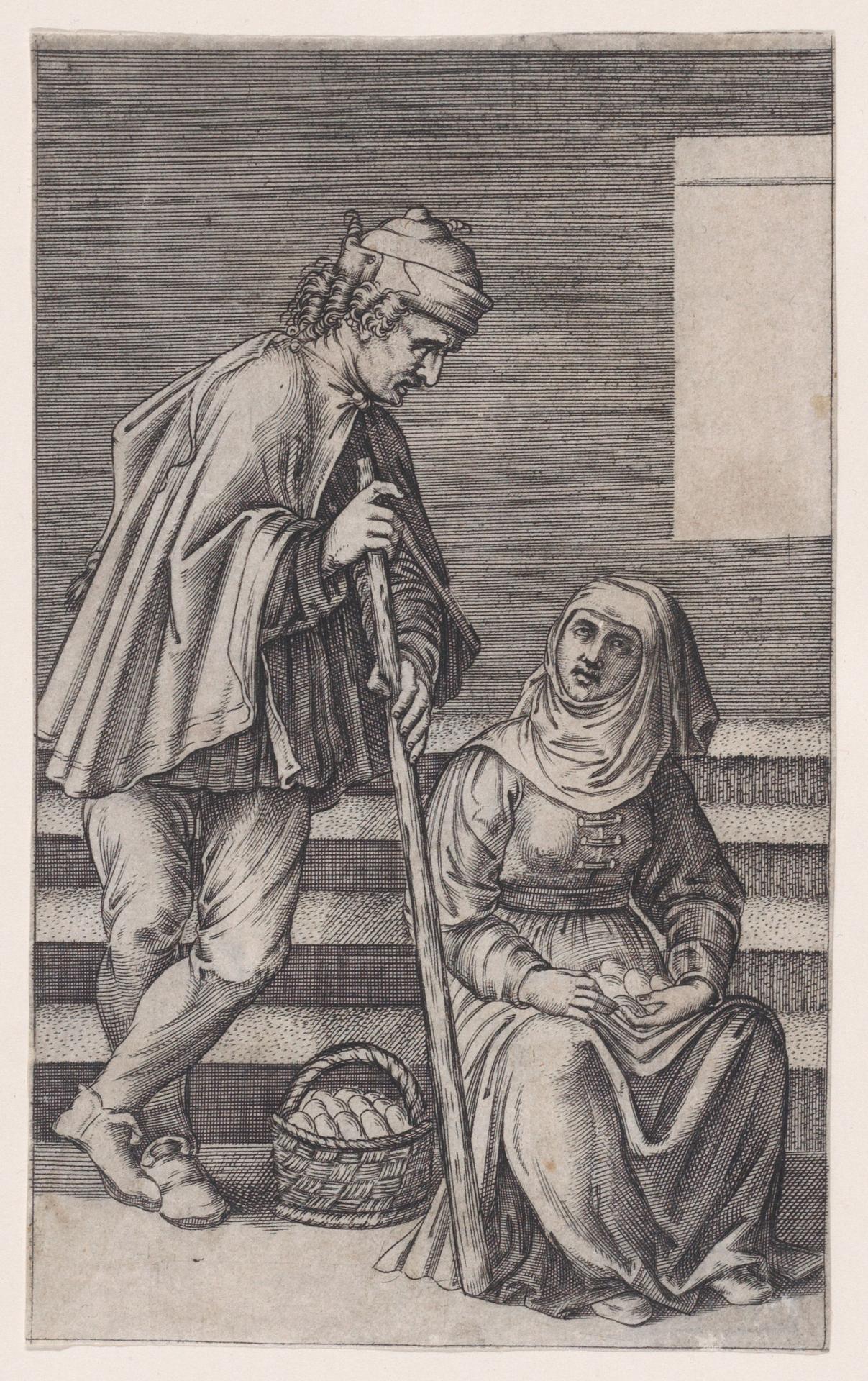
Peasant and a Woman with Eggs
Original title: Peasant and a Woman with Eggs
kurzbeschreibung
Agostino Veneziano (Agostino dei Musi) made "Bauer und Frau mit Eiern" (ca. 1514–36), a rural genre piece of the Renaissance. A standing man and a seated woman appear in a peasant setting, and the exchange of food is what the print turns on. The sheet belongs among the typical engravings of this kind.
Description
The layout reads as balanced. On the left the man stands in a cap, a staff in his hand, leaning slightly toward the seated figure. To the right the woman has taken her place, dressed in traditional clothes with a head covering and a belt, holding a bowl of eggs; a basket of eggs stands beside her. The action unfolds on a plain patterned surface that can be read as the ground. Light falls evenly across the monochrome sheet, and the lines are rich in detail and carefully engraved.
Context
Agostino Veneziano, an Italian engraver of the Renaissance, worked in the workshop of Marcantonio Raimondi. The subject arose in the first half of the sixteenth century, when peasant genre scenes were growing more popular. Prints like this served as collectors' objects and carried artistic ideas abroad. Because the exact date is uncertain, a span of ca. 1514–36 is assumed.
Impact
The symmetrical arrangement and the calm bearing of the figures give the sheet a balanced, harmonious effect. Detailed linework lends the view a fine, almost narrative note and draws the viewer into rural daily life. The monochrome treatment underlines the graphic clarity and the precision of the craft.
Technique
Engraving as a technique depends on lines being cut into a metal plate, which is then inked and printed on paper. The even, fine hatching is characteristic of Renaissance printmaking and allows exact rendering of details such as folds of cloth and facial features.
AI-generated description text
Source: Metropolitan Museum of Art · Public Domain (CC0 1.0)