The Love of Glory
Original title: The Love of Glory
kurzbeschreibung
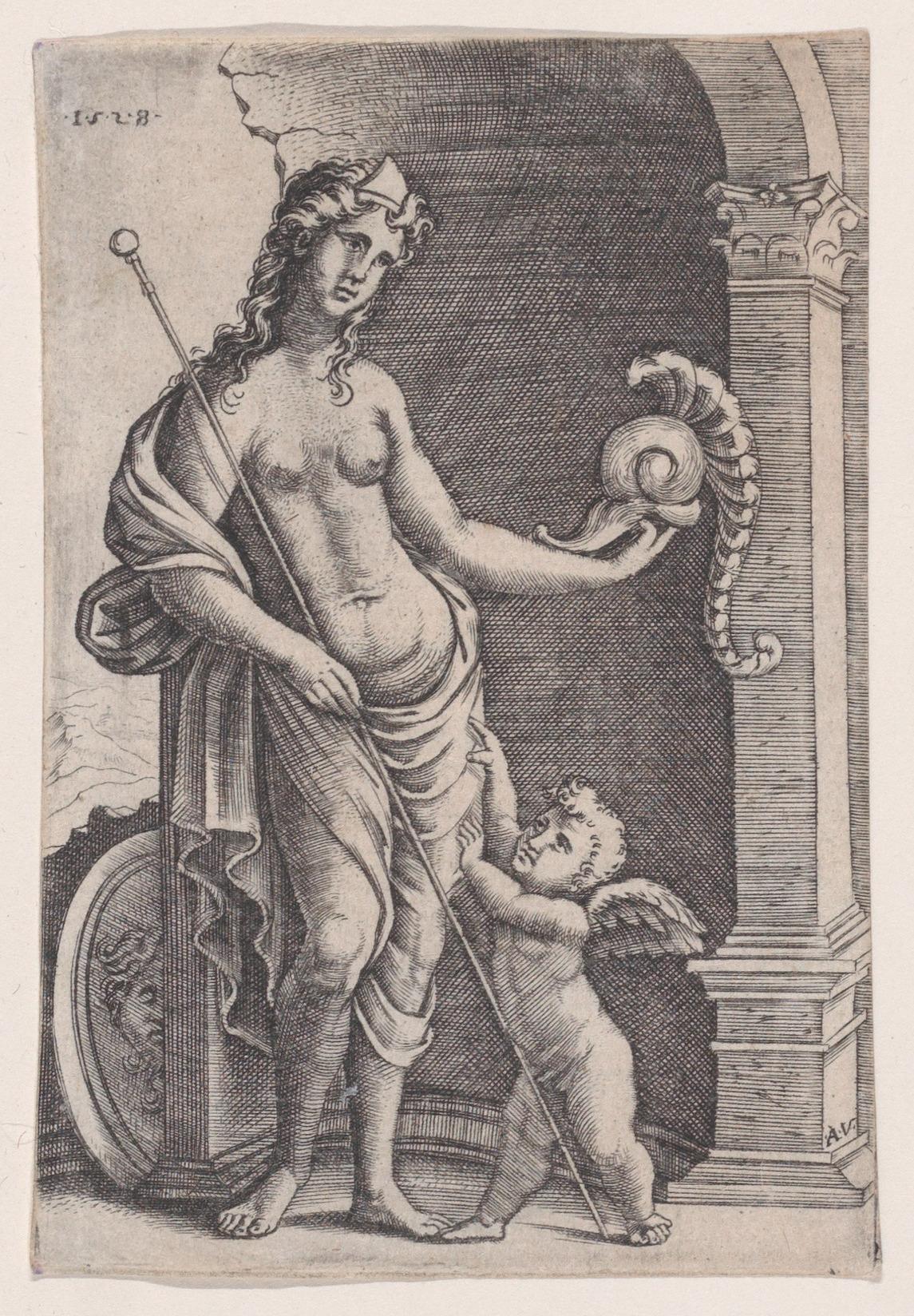
This engraving by Agostino Veneziano carries the date 1528 and the title "Der Ruhm" (Fame). Measuring 9.0 x 6.1 cm, the sheet presents a female allegorical figure understood as a personification of Fame. As the caption notes, the medium is engraving.
Description
A barefoot woman stands with her upper body uncovered, while a garment wraps her legs and lower body. In her right hand she holds a long, crescent-shaped object, perhaps a staff or something like a shield. Her left hand is raised, touching a snail or shell clinging to a wall. A small winged angel kneels beside her with its back turned. A column rises behind them, and at lower left sits a round, ornamented object, possibly a coat of arms.
Context
Born Agostino dei Musi, Agostino Veneziano was an Italian engraver of the Renaissance who worked in the shop of Marcantonio Raimondi. He made this print in 1528, while active in Rome, translating antique and contemporary motifs into printed graphics. Allegories of Fame were popular in the Renaissance and were often tied to military or virtuous symbols. Neither a model nor a patron for this engraving has come down to us.
Impact
Fine lines give the print its texture, and the layout feels clear and well balanced. The half-clad woman with her crescent-shaped attribute seems at once lofty and enigmatic. The small format rewards close looking and offers an intimate, richly detailed aesthetic.
Technique
In engraving, lines are cut into a copper plate with a burin. This method allows precise, fine detail and a wide range of tonal values. The plate is then inked and printed onto paper, and the resulting impressions are usually black and white.
AI-generated description text
Source: Metropolitan Museum of Art · Public Domain (CC0 1.0)