Temperance
Original title: Temperance
kurzbeschreibung
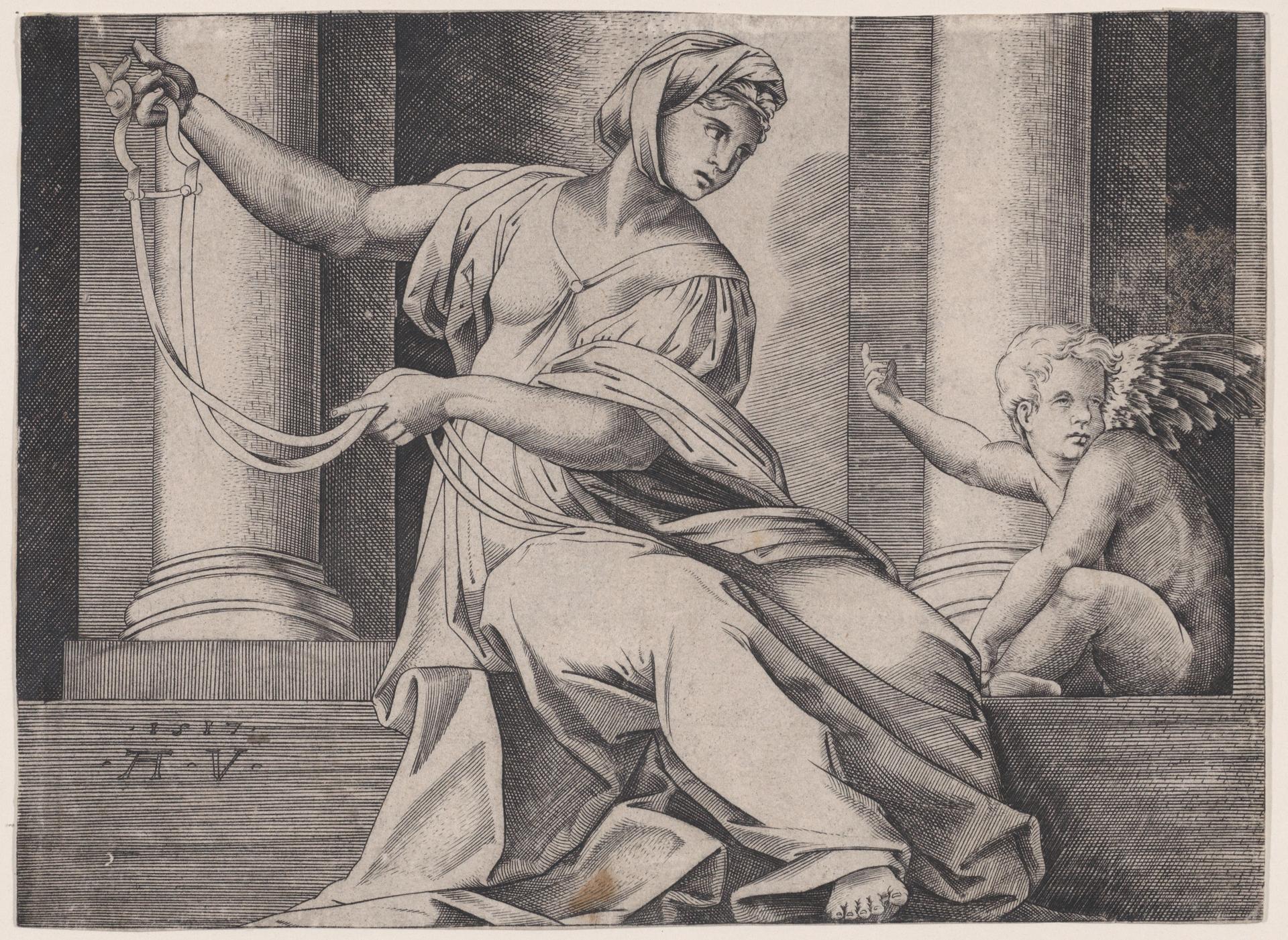
Agostino Veneziano, born Agostino dei Musi, turned in 1517 to the allegory of Temperance: a seated woman with an angel forms the subject of this engraving. The portrait-format print measures 15.9 x 21.6 cm and belongs to the graphic art of the Renaissance.
Description
The eye is drawn first to the seated woman wearing a headscarf, her hand closing around a loop; a winged angel at her side points at her with an outstretched finger. Antique-style draperies envelop both figures. Columns and a wall close off the space behind them into a symmetrical order. The sheet remains colourless; fine hatching shapes light and shadow, and precise, richly detailed lines define the engraving.
Context
The Italian Agostino Veneziano worked as an engraver in the Renaissance, including in the workshop of Marcantonio Raimondi. Allegories of virtue such as Temperance were highly popular in the humanist art of the sixteenth century. During his Roman period, the artist took up both ancient and contemporary models and translated them into print.
Impact
Calm and balanced, the print affects the viewer: the woman's seated pose and the symmetrical arrangement dampen any unrest. Fine lines and clear contours produce a restrained elegance that keeps its distance yet remains aesthetically engaging.
Technique
In engraving, lines are cut into a metal plate with a burin and then transferred to paper with printing ink. Tonal values and corporeality arise here solely from fine hatching and cross-hatching, entirely without colour.
AI-generated description text
Source: Metropolitan Museum of Art · Public Domain (CC0 1.0)