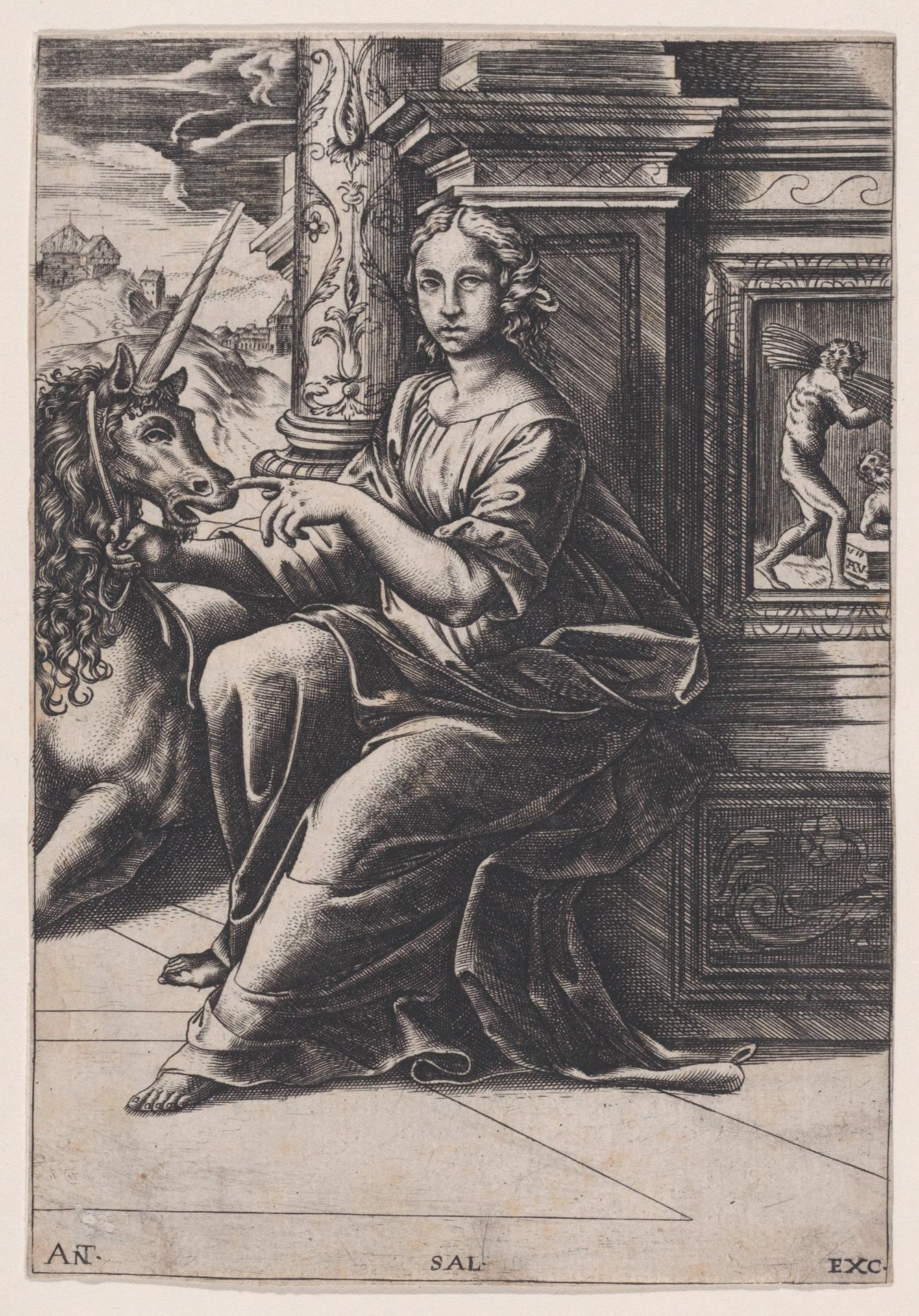
Allegory of Chastity
Original title: Allegory of Chastity, woman seated, a unicorn to her right
kurzbeschreibung
A seated woman with a unicorn to her right appears in Agostino Veneziano's engraving 'Allegorie der Keuschheit'. Created around 1515–30, the print measures 16.3 x 11.2 cm and focuses on the virtue of purity, drawing on the visual language of the Renaissance.
Description
In the foreground a woman sits in traditional dress, holding a flower. To the right, a unicorn leans against a column adorned with flowers. A landscape with buildings and a tower suggests a peaceful setting behind her. On the right side, a relief with an angel appears. The layout feels clear and symmetrical, with the woman at the center, and even light emphasizes contours and details.
Context
Agostino Veneziano, also known as Agostino dei Musi, was an Italian engraver of the Renaissance who worked in Marcantonio Raimondi's workshop. The Allegory of Chastity was made at a time when antique and humanist motifs were common in printmaking. The unicorn and flower were traditional symbols of virginity and purity, familiar in both courtly and religious iconography. Nothing is known about the exact commission; the small format, however, points to private use, perhaps as a devotional or collector's print.
Impact
Symmetry and the woman's calm seated pose give the print a balanced, statuesque effect. Delicate lines and shading create a clear, almost idealized atmosphere in which chastity appears as a lofty yet approachable virtue.
Technique
For this engraving, lines were cut into a copper plate with a burin and then printed on paper. This technique allows precise, fine lines and even tonal gradation, so that textures and shadows can be rendered in detail. The monochrome execution matches Renaissance printmaking.
AI-generated description text
Source: Metropolitan Museum of Art · Public Domain (CC0 1.0)