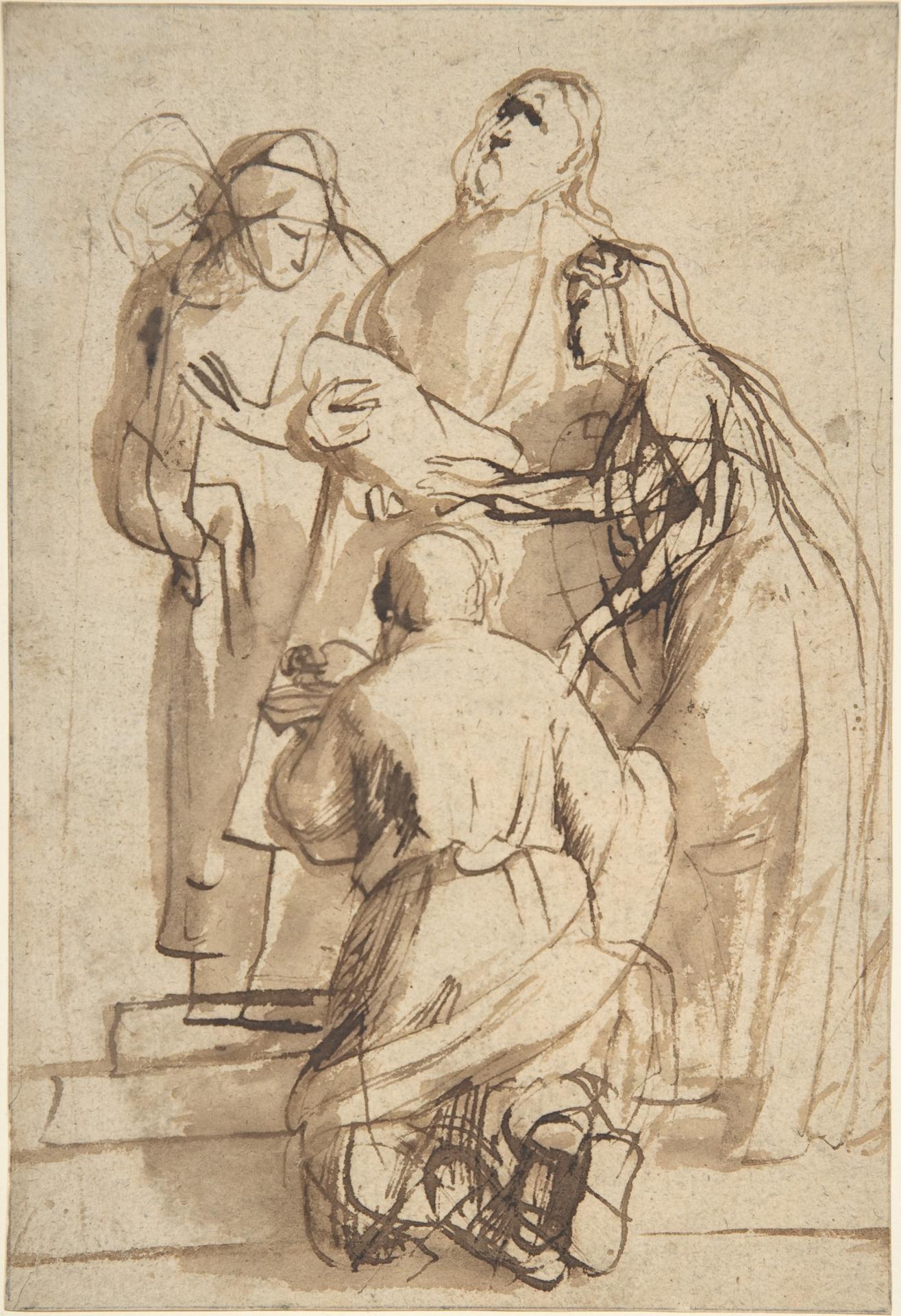
Presentation in the Temple
Original title: Presentation in the Temple
kurzbeschreibung
In 1611, Peter Paul Rubens drew this temple scene in brown ink on light brown paper. Four figures take part in a religious ritual. On the reverse is another study from 1601–2, executed in black chalk and brown ink.
Description
Four figures spread across the sheet: to the left and right of a seated figure in a long robe, seen from behind, stand two women. One of them hands something to the seated figure. A fourth person with long hair looks upward further back on the left. Brown tones dominate the drawing, interspersed with gray shadows applied with a brush. Diffuse light falls from the front, bringing out the figures and their clothing. Form and structure are paramount; the stroke remains sketchy.
Context
Rubens made this sheet in Antwerp, where after returning from Italy in 1608 he was regarded as the city's leading painter. The Presentation in the Temple was a widespread motif in the Counter-Reformation, emphasizing Mary's virginity and Christ's revelation. The reverse, with a study from 1601–2, belongs to his Italian period, when he studied ancient sculpture and Renaissance works. The drawing likely served as a preparatory study for a larger painting or altarpiece.
Impact
From the first glance, the loose, sketchy execution captivates, making Rubens's working method immediately palpable. The brown tones and diffuse light create a calm, devotional mood that underscores the religious event. Clear forms and fine shadows give the figures plasticity and liveliness.
Technique
For the front, Rubens used pen and brush with brown ink on light brown paper, working with varying stroke widths and shadows. The reverse carries a study in black chalk and brown ink, indicating multiple use of the sheet. The thin, light paper was suitable for sketches and preparatory studies.
AI-generated description text
Source: Metropolitan Museum of Art · Public Domain (CC0 1.0)