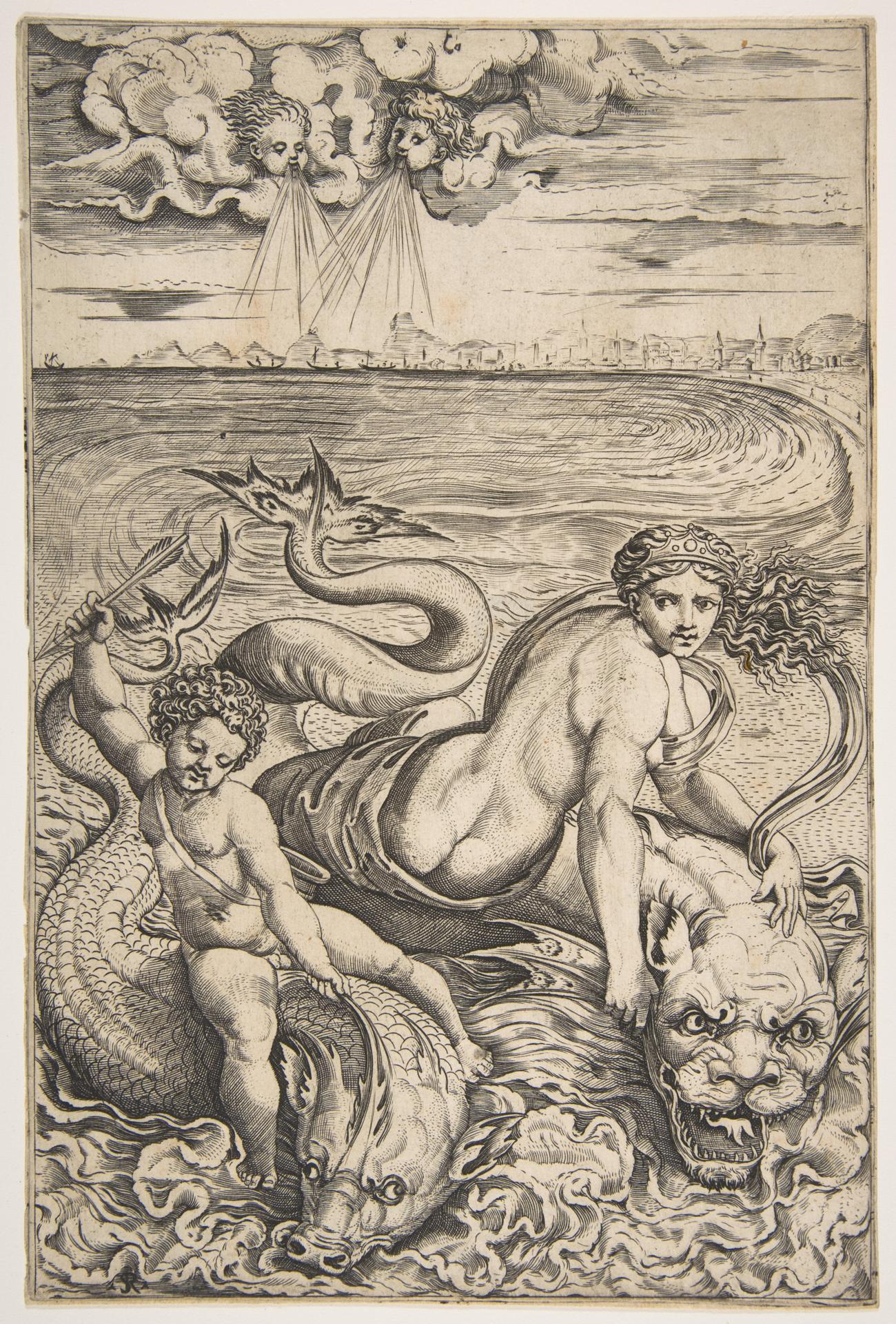
Venus and Cupid riding two sea creatures, Cupid raising an arrow with his right hand and two heads representing wind in the clouds above
Original title: Venus and Cupid riding two sea creatures, Cupid raising an arrow with his right hand and two heads representing wind in the clouds above
kurzbeschreibung
Venus and Cupid ride on two sea creatures in this engraving by Marco Dente, made around 1515–27. Venus sits on one animal and turns her gaze toward the viewer, while Cupid, mounted on the second, raises his arrow in his right hand. The sheet belongs among Renaissance prints that drew on mythological subjects.
Description
Venus rides in front on a sea creature and looks out of the picture; beside her Cupid sits on another animal and lifts his right hand with an arrow. Above them, two heads of wind gods emerge from the clouds, rays streaming from them. A coast with buildings and a city closes off the space. The layout is mirrored, with the two figures in front and the wind heads behind. Sharp, dense lines and hatching stand out black on white, defining the fur of the sea creatures and the faces of the figures.
Context
Marco Dente worked as an Italian Renaissance engraver in Rome and stayed close to models by artists such as Raphael. Venus riding a sea creature with Cupid was already widespread in antiquity and remained popular in the Renaissance. The sheet probably falls in a period when demand in Italy for printed reproductions of ancient and mythological scenes was rising. For Roman printmaking of the 1510s and 1520s it was common to take ancient sculptures and paintings as models, and this print takes its place among them.
Impact
The mirrored arrangement and clear lines lend the sheet calm and balance. Sea creatures and wind heads bring movement into the scene without breaking its order. Looking more closely, one can follow the delicate hatching and the expressions of the figures.
Technique
For this etching the drawing was incised into a metal plate, which was then bitten with acid so that fine, precise lines became possible; this can be traced in the present sheet, especially in the shading of the sea creatures and the clouds. Printing was done on paper, with the black lines against the white ground forming the contrasts.
AI-generated description text
Source: Metropolitan Museum of Art · Public Domain (CC0 1.0)