Phaeton
Original title: Phaeton
kurzbeschreibung
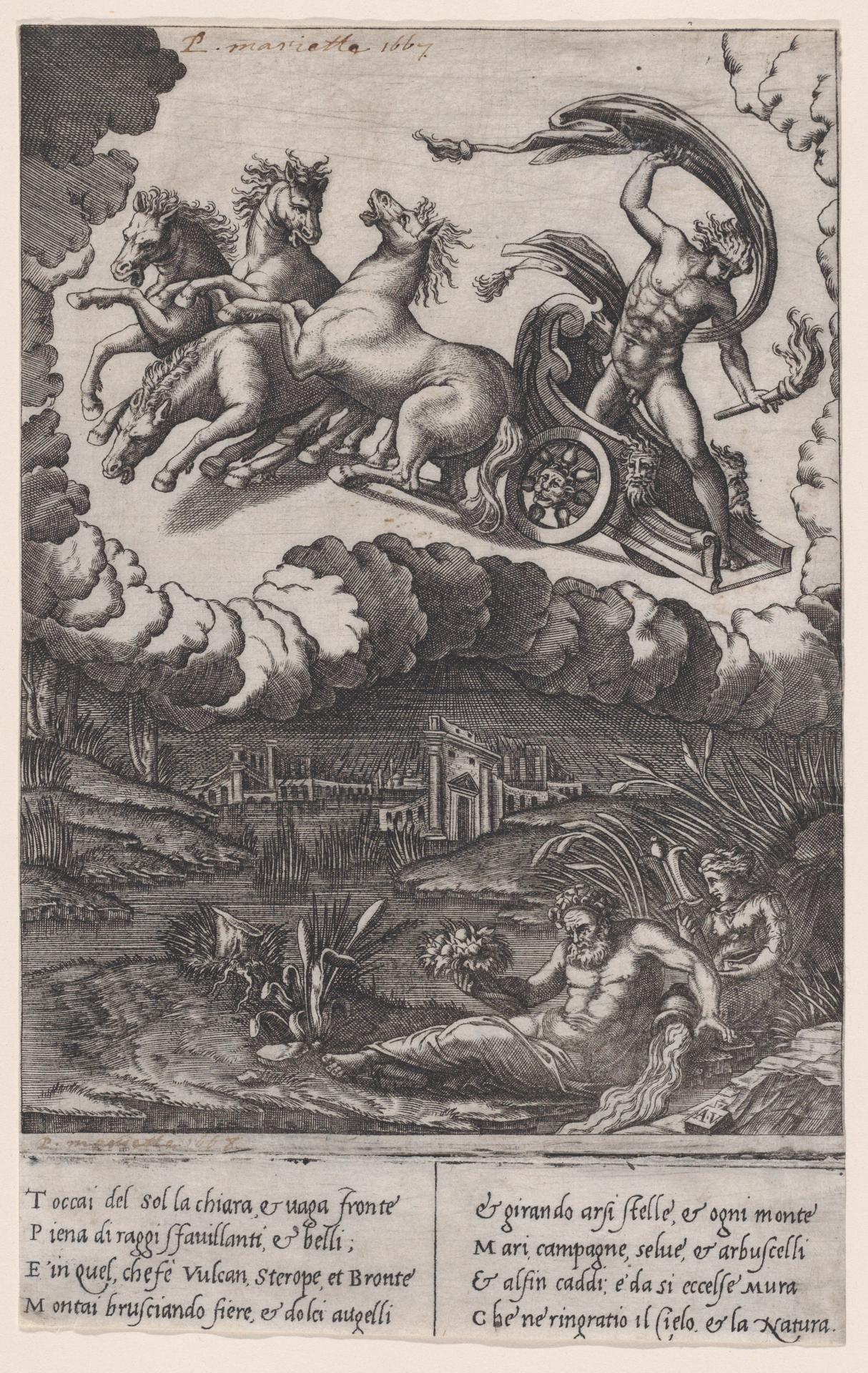
Agostino Veneziano, also known as Agostino dei Musi, engraved Phaeton around 1514–36. The mythological figure appears in a chariot drawn by four horses, with a landscape opening above that includes an ancient temple and additional figures. The print is a fine engraving measuring 21.7 by 13.7 cm.
Description
Phaeton dominates the upper part, barefoot on the chariot, his garment streaming behind him as four horses with long strides and wings pull in rapid motion. Below lies a landscape with an ancient temple and two people, one on the ground and the other standing upright. Plants, trees, and clouds frame the image, and Italian verses run along the bottom edge. The entire sheet remains in black and white.
Context
The engraving comes from the circle of Agostino Veneziano, who worked in Rome and Florence during the first half of the sixteenth century. He trained under Marcantonio Raimondi and devoted himself mainly to reproductive printmaking after designs by other artists. The Phaeton story, which tells of driving the sun chariot, was a common theme in Renaissance mythological imagery. The dating around 1514–36 remains uncertain, as it is based only on the span of Veneziano's activity.
Impact
Fine lines and a clear layout guide the eye from the sky down to the earth. The movement of the horses contrasts with the stillness of the landscape, creating a tension that sustains the print. Much detail invites the viewer to linger.
Technique
For this engraving, lines were cut into a copper plate with a burin. This produces very fine, precise hatching that renders figures and landscape in rich detail. Printing was done in black on paper, which emphasizes the contrast of light and shadow.
AI-generated description text
Source: Metropolitan Museum of Art · Public Domain (CC0 1.0)