Hercules Strangling the Nemean Lion
Original title: Hercules Strangling the Nemean Lion
kurzbeschreibung
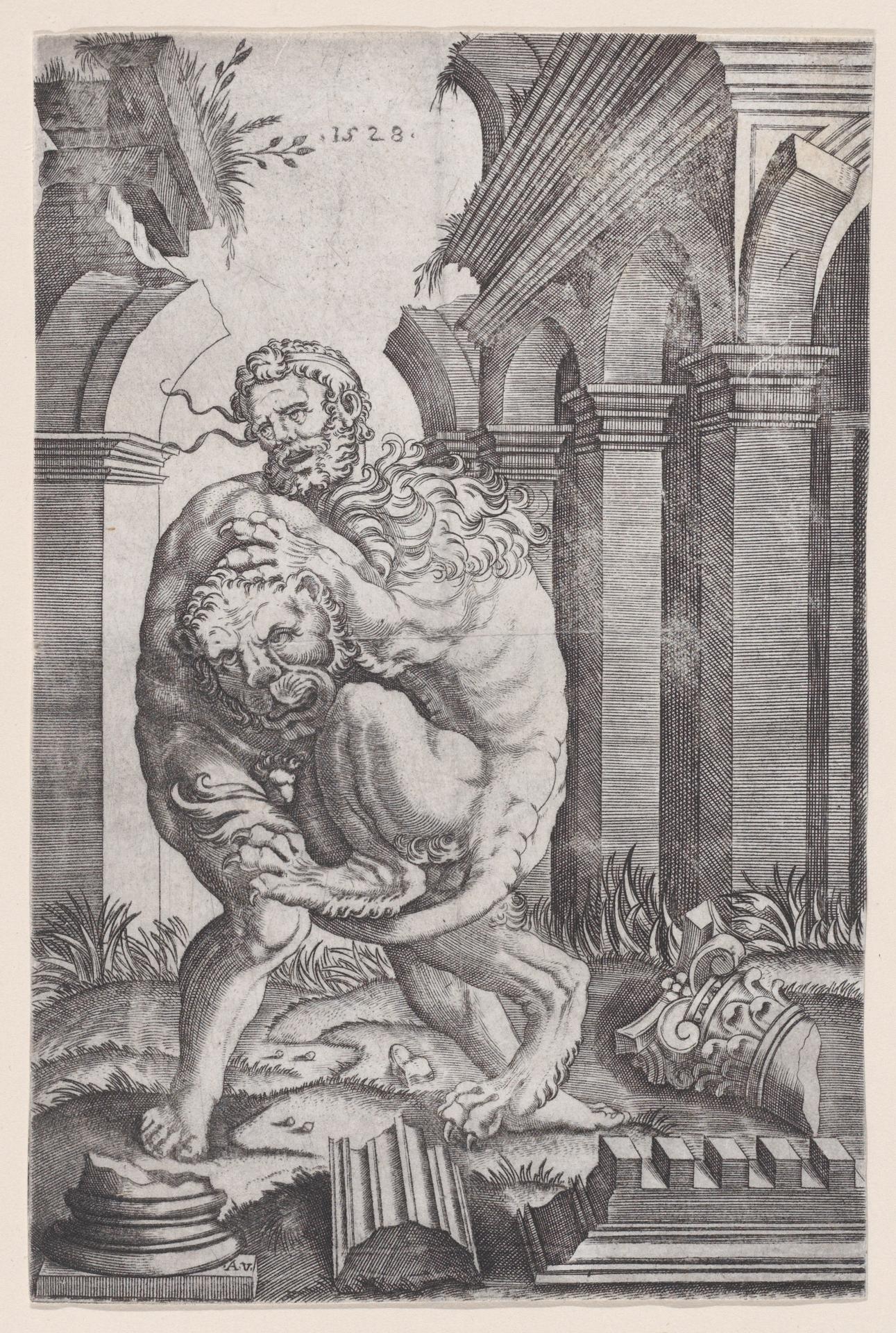
With his bare arms, Herakles wrestles the Nemean lion to the ground — Agostino Veneziano (Agostino dei Musi) captured this first of the hero's twelve labors in a 1528 engraving. The Greek hero and his opponent face each other in a struggle that sets the cycle of twelve deeds in motion.
Description
A bearded, short-haired man of powerful build throws his arms around the lion and forces it down. The thick-furred beast, its muscles sharply defined, fights against the grip. Behind the combatants rise ancient columns and arches, pointing to classical architecture. Broken stones and a shattered column shaft on the ground suggest a ruined setting. From the upper left, a leafy branch hangs into the picture. The scene is rendered in black and white with detailed linework.
Context
Born in Venice around 1490, Agostino Veneziano was one of the notable engravers of the Renaissance and worked in Rome and Florence. The 1528 sheet belongs to an era in which ancient myths were central to artists. Veneziano borrowed from Raphael and other masters and spread their inventions through his prints.
Impact
The viewer is drawn into an immediate physical duel, intensified by the trained bodies and the dynamic poses of the figures. The ruins in the background cast a melancholy tone over the action, contrasting with the heroic struggle and bringing the decline of ancient grandeur before our eyes.
Technique
For the engraving, the motif is incised into a copper plate and then printed on paper. Fine lines and hatching bring out sculptural details and reproduce the muscular physique as precisely as the lion's pelt. The black-and-white design emphasizes the graphic character of the print.
AI-generated description text
Source: Metropolitan Museum of Art · Public Domain (CC0 1.0)