Venus and Eros
Original title: Venus and Eros
kurzbeschreibung
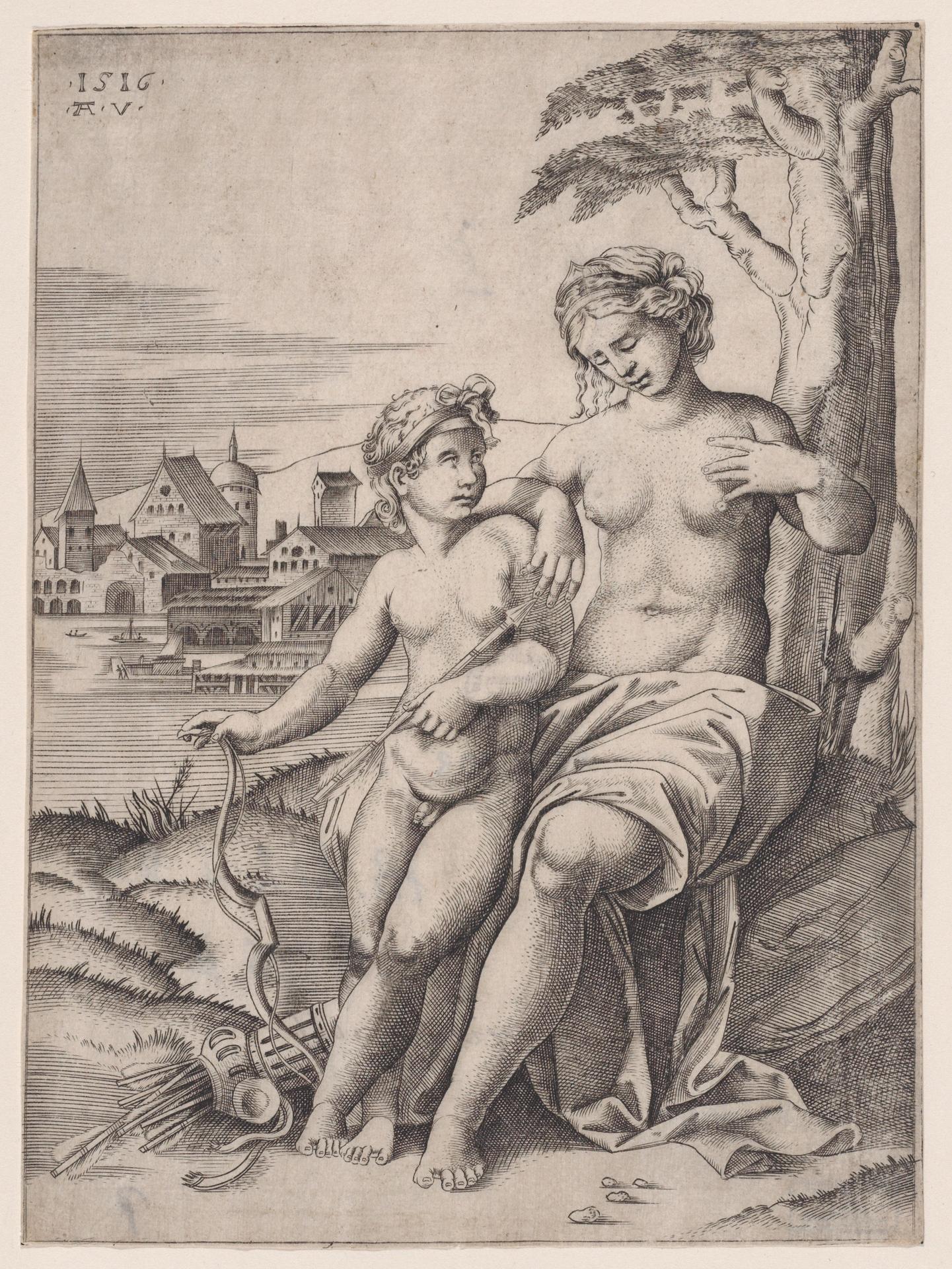
Agostino Veneziano (Agostino dei Musi) made this engraving, "Venus and Eros," in 1516. It places the goddess of love and her son together in an open landscape. The print measures 17.5 by 12.9 cm and belongs to the graphic art of the Renaissance.
Description
The eye settles first on the two figures at the heart of the image, facing one another amid natural surroundings. Venus stands barefoot in a light garment, one hand reaching out to touch Eros. He carries bow and arrows and wears a grotesque mask on his head. Shoes and arrows lie scattered in the foreground, while a tree and a building define the distance. Even light falls across the whole print, as was usual in work of this technical kind.
Context
Born in Venice around 1490, Agostino Veneziano ranked among the significant engravers of the Renaissance and worked in both Rome and Florence. He made this piece in 1516, a period when printmaking flourished in Italy and artists such as Marcantonio Raimondi pushed the technique further. Veneziano drew on classical models, producing mythological subjects that found a ready market among collectors.
Impact
Clean draughtsmanship and a calm, balanced grouping of the figures shape the first impression. Classical stylization and a emphasis on proportion give the sheet a harmonious, timeless air. Its monochrome execution turns attention to the delicate detail and the sculptural modeling of the bodies.
Technique
For this engraving, the lines were cut into a copper plate and then printed onto paper. The method allows great precision and subtle gradations of line, evident in the richly detailed drapery and facial features. Even lighting and crisp contours are characteristic of Renaissance printmaking.
AI-generated description text
Source: Metropolitan Museum of Art · Public Domain (CC0 1.0)