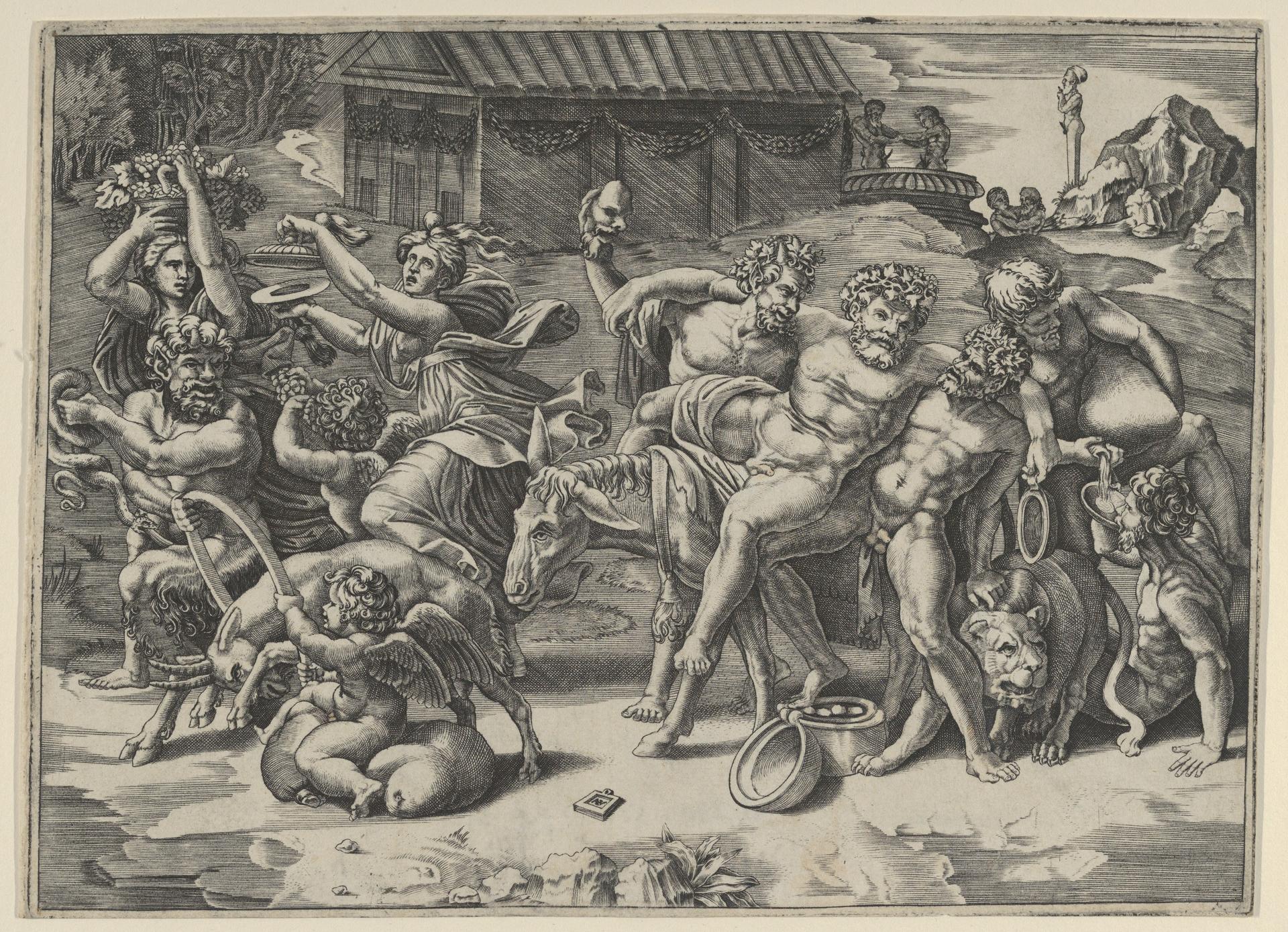
The Procession of Silenus
Original title: The procession of Silenus who is carried on an ass preceeded by a bacchant playing the cymbals and other figures
kurzbeschreibung
This copperplate engraving by Agostino Veneziano, also known as Agostino dei Musi, dates from around 1531. It presents a bacchic procession centered on Silenus riding an ass, surrounded by men, women, and other figures. The print is black and white and measures 18.5 by 25.9 cm.
Description
In the foreground a figure has settled onto an ass, while men and women crowd around with various implements in their hands. A winged figure kneels on the ground, and another carries a basket on her head. Behind them rises a building with a roof; nearby stand people, trees, and rocks. The layout feels animated: figures look in different directions, caught mid-step or mid-grasp. Even light, built from hatching and lines, defines the monochrome image.
Context
Agostino Veneziano was an Italian engraver of the Renaissance who worked in the workshop of Marcantonio Raimondi. The sheet belongs to the period around 1531, when printmaking spread widely in Italy. With the procession of Bacchus, the motif draws on a subject from classical mythology that was prized again in the Renaissance.
Impact
Precisely guided lines and lively bustle define the impression of this print. The animated arrangement and densely filled setting create a festive mood. Standing before the image, one almost follows the train of figures and senses their walking and pressing forward.
Technique
The print was made as an engraving: lines were incised into a copper plate and then printed. Finely graded shadows and evenly distributed light reveal a sure command of the burin. The monochrome design fully matches this printing method.
AI-generated description text
Source: Metropolitan Museum of Art · Public Domain (CC0 1.0)