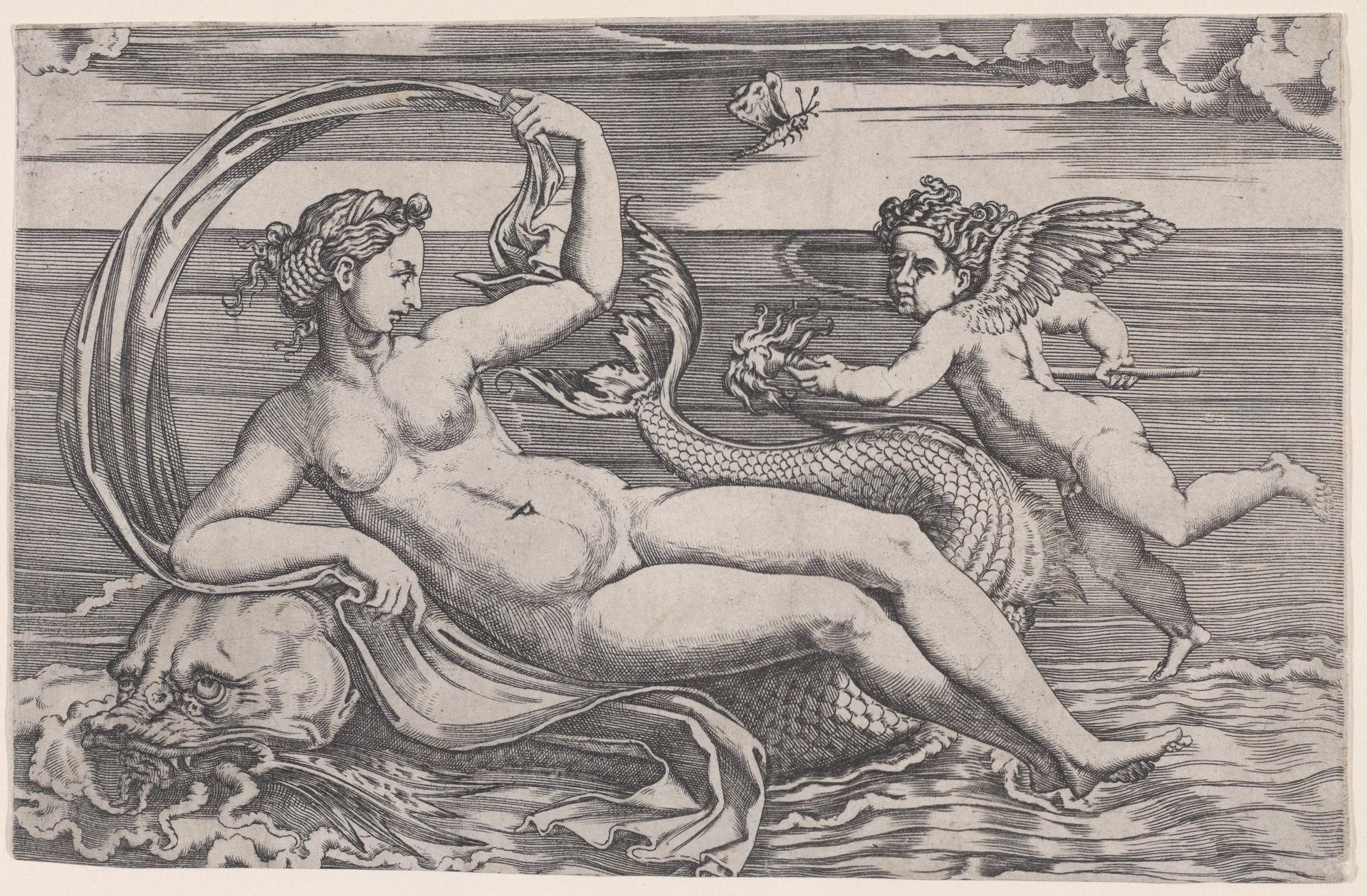
Venus Reclining on a Dolphin
Original title: Venus Reclining on a Dolphin
kurzbeschreibung
What sets this engraving apart from related Venus depictions of the period is the way Agostino Veneziano (Agostino dei Musi) pairs the goddess, reclining on a dolphin, with a snail in her hand and a small winged boy carrying a fish. Made around 1516, the sheet belongs to the engraver's early years and shows the goddess rendered with the detailed precision typical of his work.
Description
Venus lies at the center of the image on a dolphin; her right hand holds a snail. To the right, a winged boy hovers, carrying a fish in his hands. The ground remains sparse: wavy lines suggest the sea, while clouds line the upper edge. The layout is symmetrical, with Venus central and the angel offset to the side. The linework uses clear, detailed strokes characteristic of Renaissance printmaking.
Context
Agostino Veneziano, also known as Agostino dei Musi, was an Italian engraver of the Renaissance who worked in the workshop of Marcantonio Raimondi. The motif of Venus on a dolphin comes from classical mythology and was widely popular in the Renaissance. The print dates from around 1516, when Veneziano was active in Rome and influenced both by classical models and by contemporaries such as Raphael.
Impact
The symmetrical arrangement and the calm, balanced placement of the figures give the sheet a harmonious effect. The precise linework of the engraving creates a clear aesthetic that comes close to Renaissance ideals of beauty and order.
Technique
The print was made by engraving: the design is cut into a copper plate and then printed on paper. Even, fine lines and monochrome tonality are the hallmarks of this printing technique, common in the Renaissance. The lighting remains even, without harsh contrasts, suggesting careful work by the engraver.
AI-generated description text
Source: Metropolitan Museum of Art · Public Domain (CC0 1.0)