Cleopatra (1528)
Original title: Cleopatra
kurzbeschreibung
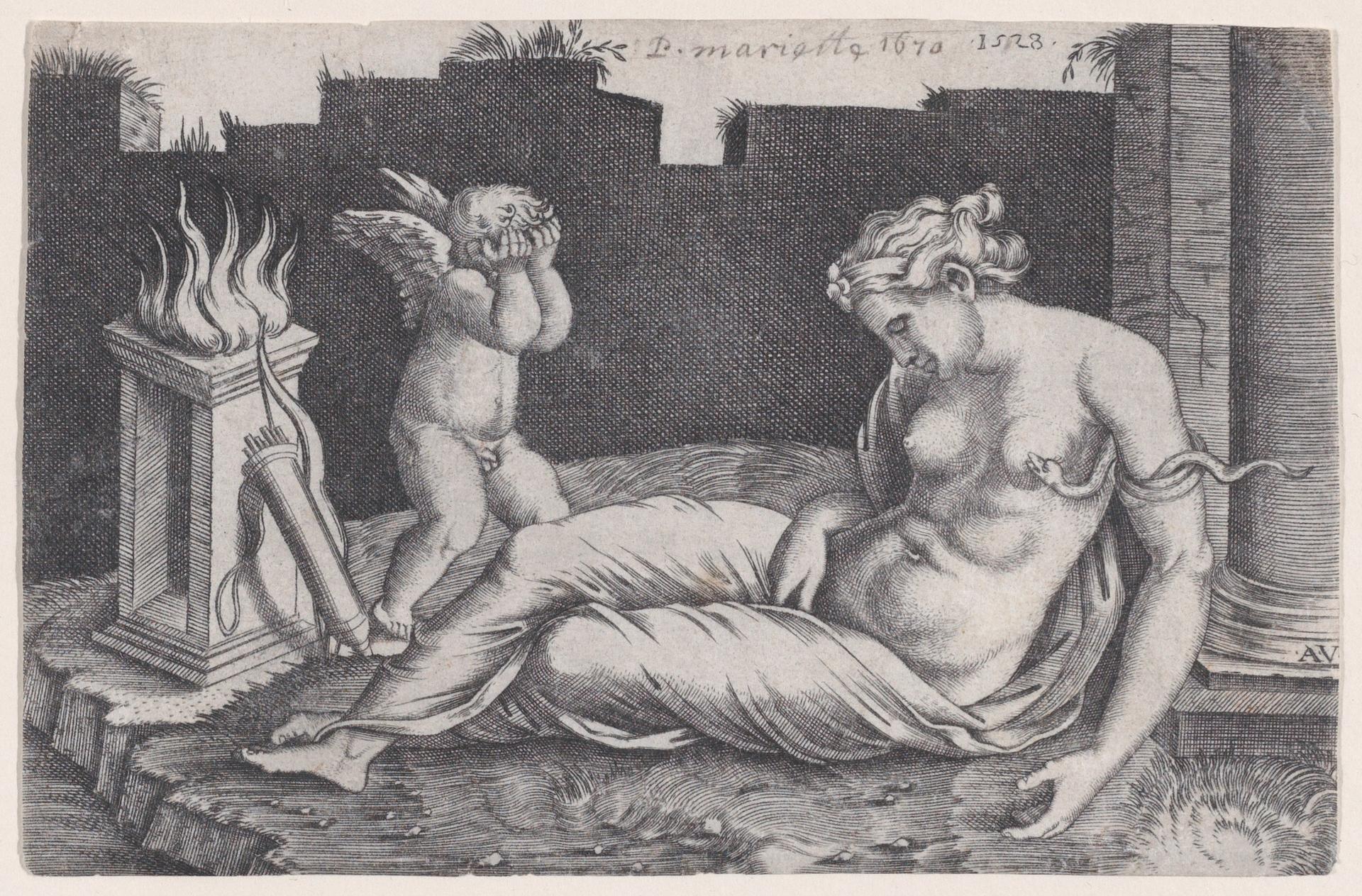
Agostino Veneziano, also known as Agostino dei Musi, made this engraving in 1528. It shows the Egyptian queen with a snake winding up toward her arm, while an angel holding a flame stands at her side. A carefully worked sheet of Italian Renaissance printmaking.
Description
Stretched out on a seat, Kleopatra lies with a serpent coiled around her arm. A small angel steps up beside her, carrying a bowl with a flame. Walls and plants hint at the setting. Kleopatra fills the foreground, the angel stands behind her, and the arrangement feels balanced. Light entering from the left casts shadows along the right side of the figures' bodies.
Context
Agostino Veneziano was an Italian Renaissance engraver who worked in the shop of Marcantonio Raimondi. In 1528, when this print was made, portraits of ancient rulers were widely popular. The motif of Kleopatra with the snake refers to her death from a serpent's bite.
Impact
Precisely guided lines and an even layout define the sheet. The greys of the monochrome rendering create a calm, almost elegiac mood. Despite the dramatic subject, the scene stays detached and raised toward the ideal.
Technique
The print is executed as an engraving in the burin manner, with the gradations of grey arising from the varying density and shading of the engraved lines. The paper used is handmade and shows an even structure.
AI-generated description text
Source: Metropolitan Museum of Art · Public Domain (CC0 1.0)