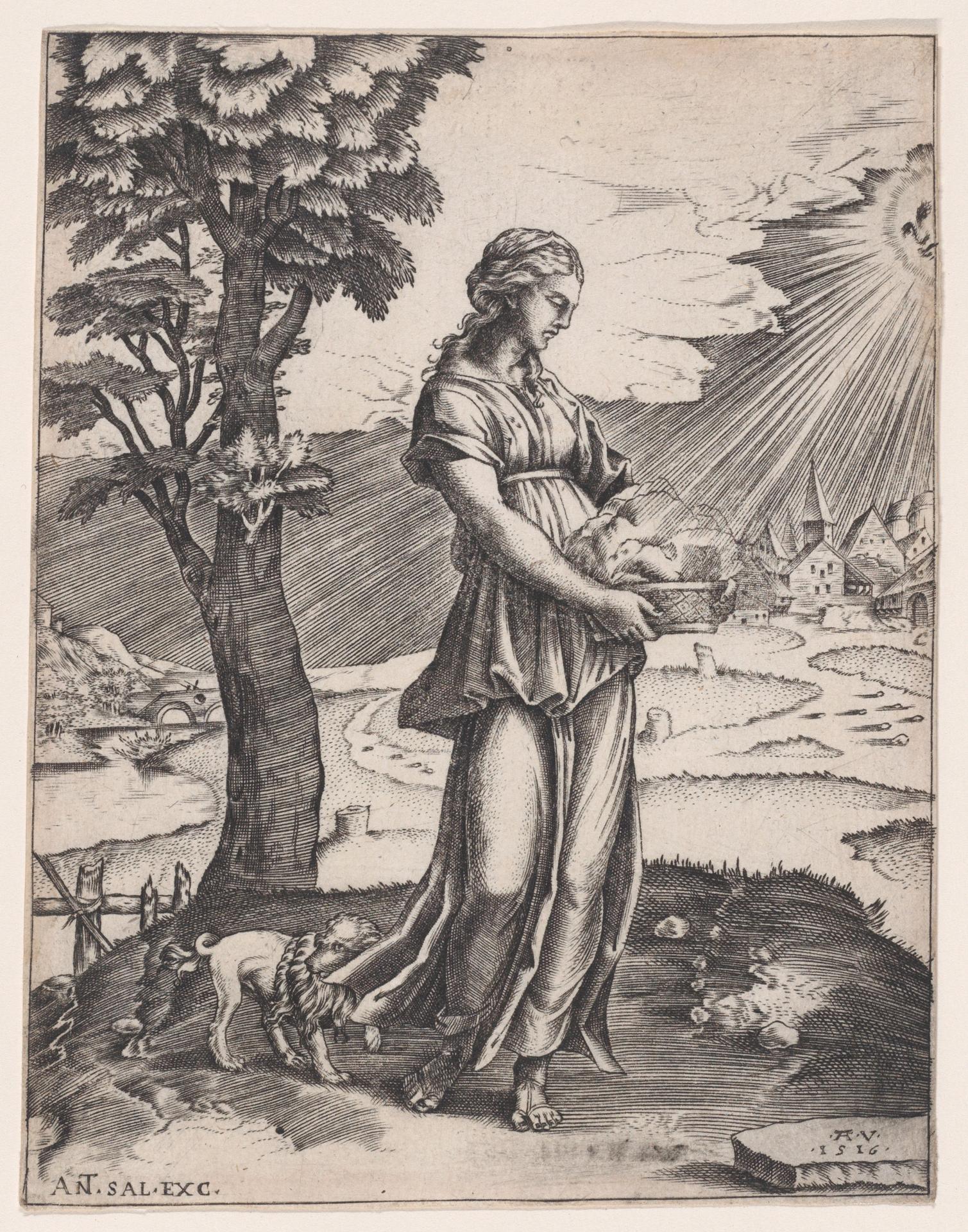
The Cumaean Sibyl
Original title: The Cumaean Sibyl
kurzbeschreibung
A woman in classical drapery holds a shallow bowl, a tree at one side and a dog on a hill at the other. Agostino Veneziano engraved this sheet in 1516. It belongs to Renaissance printmaking and shows the Cumaean Sibyl, a prophetess of antiquity.
Description
The Sibyl stands on a hill, her gaze lowered to the bowl in her hands. A tree rises to her left; a dog can be made out on the right. Behind her, a landscape with a village and a river opens up. Light falls from above onto the figure, creating tension. The layout is symmetrical, with the woman as the focal point.
Context
Agostino Veneziano, an Italian engraver, worked in the workshop of Marcantonio Raimondi. The print dates from 1516, when printmaking in Italy was flourishing. Sibyls, prophetic figures of antiquity, were a favored subject in the Renaissance.
Impact
Clear lines and an uncluttered arrangement define the sheet. Light and shadow produce a calm, almost solemn mood. Because the image is in black and white only, the details of the figure and the landscape stand out distinctly.
Technique
Engraving is an intaglio process in which the drawing is cut into a metal plate. Agostino Veneziano used fine lines and hatching to render shadow and physical form. The sheet measures 16.8 x 12.9 cm, making it a small, richly detailed print.
AI-generated description text
Source: Metropolitan Museum of Art · Public Domain (CC0 1.0)