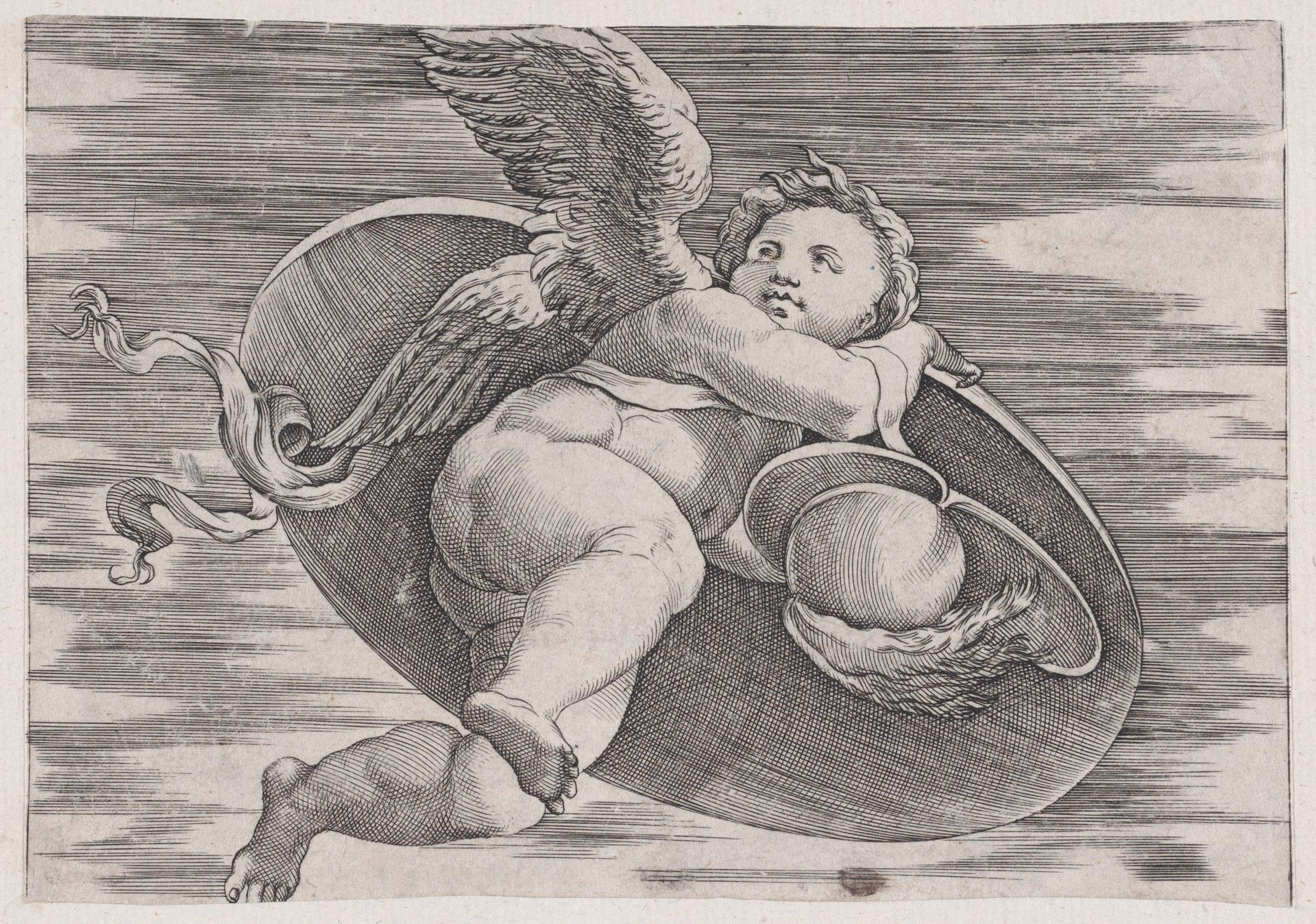
Eros Stealing Man's Shield
Original title: Eros Stealing Man's Shield
kurzbeschreibung
A winged putto makes off with a man's shield: Agostino Veneziano (Agostino dei Musi) engraved this scene between about 1514 and 1536. The oval shield bears a feather, which the putto drags along with it. The print belongs to Renaissance printmaking and pairs a mythological subject with a lively group of figures.
Description
The winged boy leans to the left, one hand gripping the oval shield, on which a feather lies and curls leftward. His other hand is raised, as if to fend something off or seize it. Horizontal strokes in the background suggest movement or flight. Fine lines and hatching shape contours and shadows and bring out bodies and surfaces.
Context
Agostino Veneziano, an Italian engraver of the Renaissance, worked in the shop of Marcantonio Raimondi, the leading reproductive engraver of the day. In this period printmaking flourished in Italy, and mythological themes were widespread. Because the exact date is uncertain, the range ca. 1514–36 covers a longer span.
Impact
The lively movement captures the fleeting moment of the theft. The precise linework and balanced arrangement give the sheet an elegant, almost dance-like lightness.
Technique
For engraving, lines were cut into a metal plate and then printed on paper. Hatching allows precise shading and fully modeled forms, as is characteristic of Renaissance printmaking.
AI-generated description text
Source: Metropolitan Museum of Art · Public Domain (CC0 1.0)