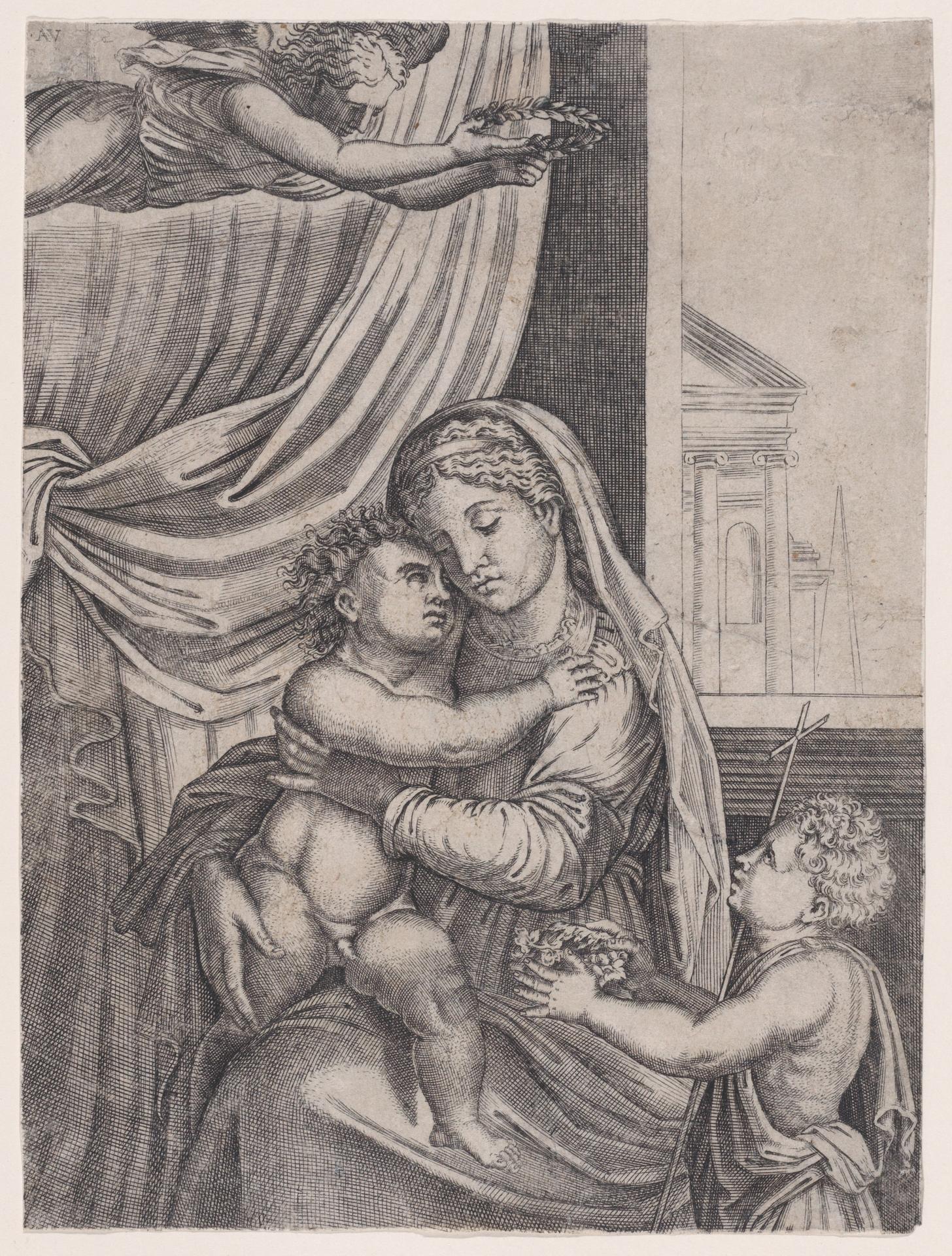
Madonna and Child (ca. 1518–20)
Original title: Madonna and Child
kurzbeschreibung
This engraving by Agostino Veneziano (Agostino dei Musi), made around 1518–20, places Mary with the Christ Child within a symmetrically ordered circle of figures that also includes a youthful figure holding a cross.
Description
Mary is seated and holds the child in a gentle embrace; the boy is barefoot and wears a simple garment. Beside her stands a curly-haired youth with a cross in his hand. A large, billowing cloth falls from the top edge of the image, held by a floating figure who also carries a wreath. At the right edge appears a cropped building with columns and a window. Madonna and Child occupy the middle, while the remaining figures are distributed to either side. The engraving stays monochrome, and the lighting reads as even because hatching and gradations of tone spread the light across the surface.
Context
Agostino Veneziano, also known as Agostino dei Musi, was one of the Italian engravers of the Renaissance and worked in the workshop of Marcantonio Raimondi. He often reproduced designs by Raphael and Giulio Romano as reproductive prints. Italian printmaking flourished in those years, and sheets of this kind helped make well-known works of art familiar beyond their original locations.
Impact
The even balance of light and dark and the carefully controlled linework produce a calm, poised mood. The mirror-like arrangement of the figures draws attention to Madonna and Child at the center and gives the sheet a solemn character that invites contemplation.
Technique
The image was made as an engraving: the design is cut into a copper plate and then printed. Fine lines and hatching create graduated tonal values and varied textures, which lend the figures their sense of volume.
AI-generated description text
Source: Metropolitan Museum of Art · Public Domain (CC0 1.0)