The Blinding of Elymas
Original title: The Blinding of Elymas
kurzbeschreibung
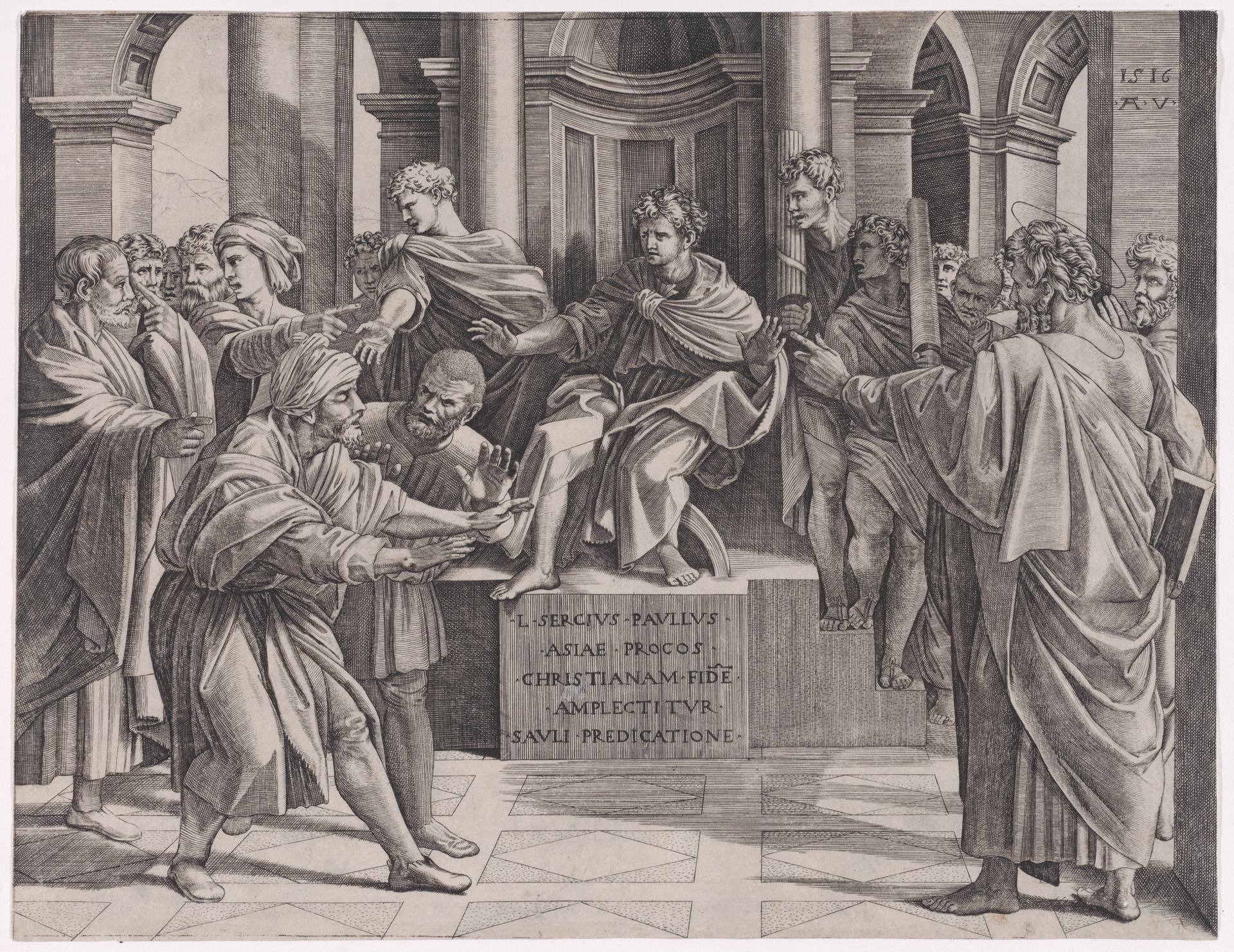
Agostino Veneziano, also known as Agostino dei Musi, made this engraving in 1516. It records an episode from the Acts of the Apostles: the magician Elymas is struck blind by Paul. The print is a finely worked black-and-white image, belonging to the Renaissance.
Description
A crowd of figures in antique drapery gathers in a columned interior with arcades. On a raised platform stands a man in a toga, surrounded by people who reach out to him or offer objects. Fine hatching models the bodies and makes their movements legible. More columns and arches divide the space behind, while Latin inscriptions along the bottom margin list the names of those depicted. The arrangement feels symmetrical, with the platform as its vanishing point; light falls evenly, without harsh shadows.
Context
Agostino Veneziano, also called Agostino dei Musi, was an Italian engraver of the Renaissance who worked in the shop of Marcantonio Raimondi. This sheet from 1516 goes back to a design by Raphael, whose pupil Veneziano was. It belongs to a series of prints that reproduced biblical scenes after Raphael's designs. The print is in the collection of the Metropolitan Museum of Art and was valued in early printmaking as a medium of reproduction.
Impact
Careful linework and a calm, balanced layout give the biblical event a solemn, theatrical tone. Even lighting and classical architectural elements create a timeless, classic mood that draws the viewer into the scene.
Technique
In engraving, lines are cut into a copper plate and then printed on paper. The monochrome gray tone comes from the printing process, in which the depth of the lines determines the shading. The detailed rendering of fabrics, faces, and architecture shows the artist's high technical precision.
AI-generated description text
Source: Metropolitan Museum of Art · Public Domain (CC0 1.0)