The Death of Ananias
Original title: The Death of Ananias
kurzbeschreibung
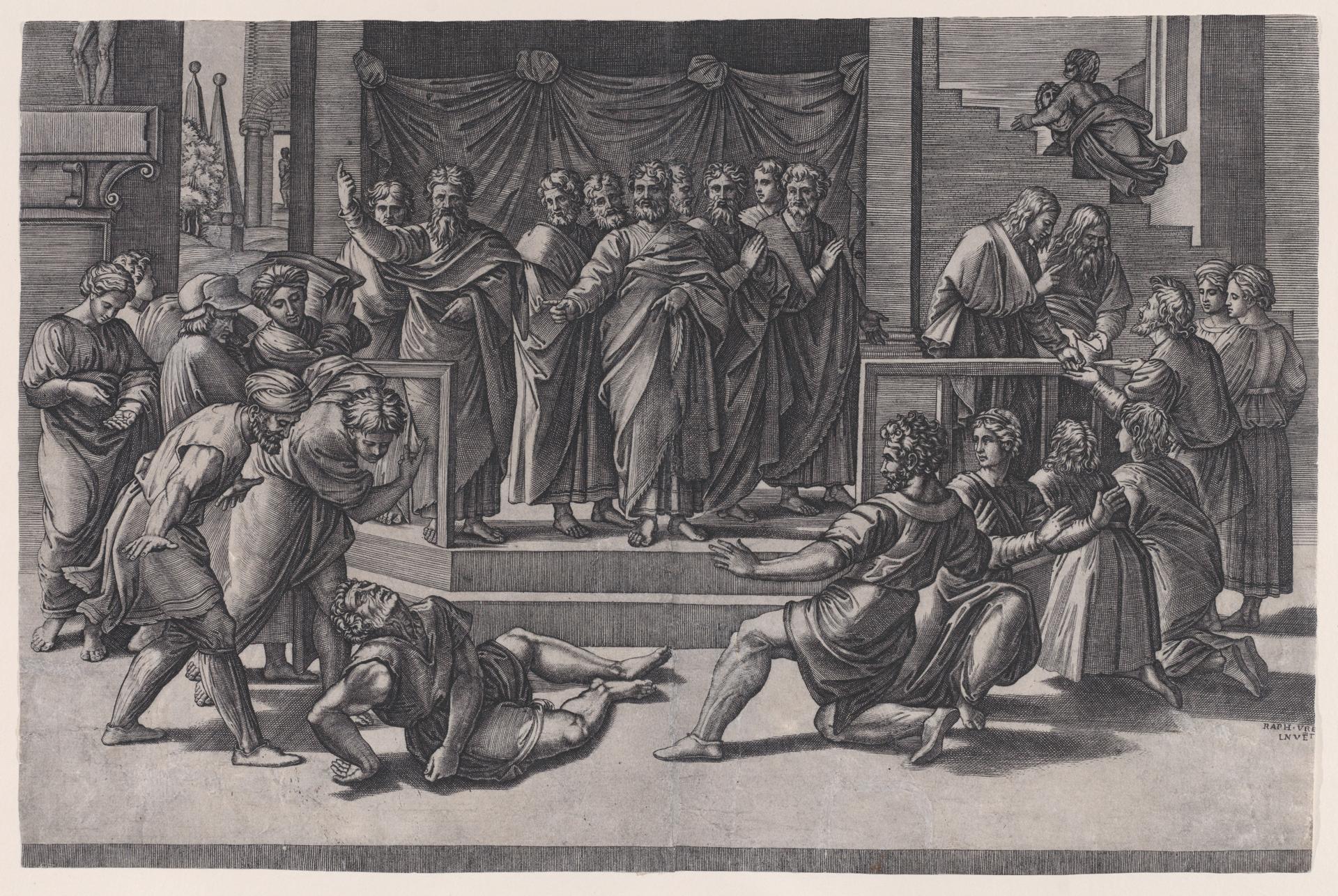
Ananias sinks to the ground while bystanders react to his collapse — this moment from the Acts of the Apostles is captured in Agostino Veneziano's engraving of about 1516. The black-and-white print presents the crowded action with a tightly packed cast of figures.
Description
In the foreground a man lies stretched out on the ground, surrounded by several bystanders; some reach for him or try to lift him up. On a raised platform stand further figures, from whom the decisive impulses of the action emanate. Antique-style garments dominate the image, and the many actors look and move in quite different directions, so that the layout remains restless. An even light brings out the contours and details of the figures as well as the space. Overall, the arrangement follows Renaissance conventions: carefully balanced proportions, emphasis on movement and emotion.
Context
Agostino dei Musi, known as Agostino Veneziano, worked as an Italian engraver of the Renaissance in close collaboration with Marcantonio Raimondi, the leading reproductive engraver of that era. The sheet was made around 1516 in Rome, where Veneziano's activity is documented. The model was an invention by Raphael, who had designed the death of Ananias in the cartoons for the tapestries of the Sistine Chapel. Reproductive engravings of this kind carried the inventions of famous masters throughout Europe and served other artists as models.
Impact
Moving figures and clear lines give the sheet a palpable drama. Because the light falls calmly and evenly, the eye is drawn to the man on the ground without losing sight of the rest of the action. Thus an insistent, almost theatrical quality emerges that draws the viewer into the biblical narrative.
Technique
For the engraving, the drawing is incised into a copper plate with a burin and then printed. This process allows fine, precise lines and high detail accuracy, which was particularly valued in the Renaissance. The monochrome print lets contrasts and hatching bring out the plastic effect of the figures.
AI-generated description text
Source: Metropolitan Museum of Art · Public Domain (CC0 1.0)