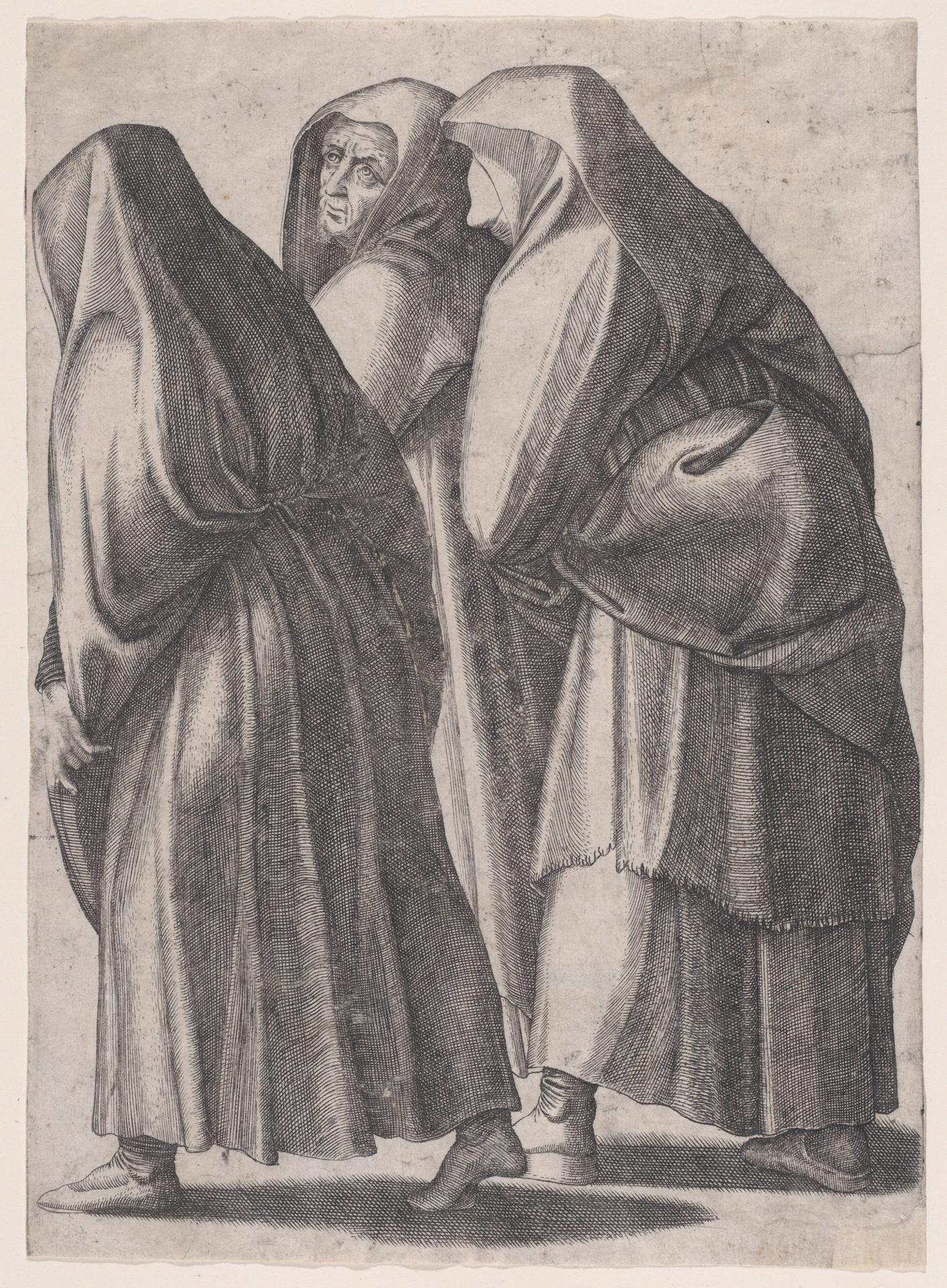
The Three Holy Women Going to the Sepulchre (ca. 1514–36, Met-Objekt 5777)
Original title: The Three Holy Women Going to the Sepulchre
kurzbeschreibung
This engraving by Agostino Veneziano (Agostino dei Musi) was made around 1514–36. Three women in long robes and headscarves stand in a half-open door, evidently on their way to the tomb of Christ. The print measures 24.7 x 17.9 cm and is executed in the engraving technique.
Description
Three women form the focal point, positioned slightly to the left and framed by a half-open door. Their faces are visible; headscarves and long garments are rendered with many folds and rich detail. The fabric's texture and drape are closely observed. Light is distributed evenly, without strong shadows or highlights, as is characteristic of engraving. The style remains detailed and follows the Renaissance emphasis on the human figure.
Context
Agostino Veneziano, an Italian Renaissance engraver, worked in the workshop of Marcantonio Raimondi, known for reproducing works by Raphael. The Three Marys at the Tomb is a common theme in Christian iconography and was frequently treated by Renaissance artists. A more precise date than around 1514–36 cannot be established, as Agostino is documented working during this period. The print was probably made in Rome, where he was active for several years and engraved both antique and contemporary models.
Impact
Clear lines and a calm, symmetrical layout give the engraving a balanced and solemn effect. The richly folded garments lend the figures plastic presence, while the even lighting creates a quiet, devotional mood. Because the women stand in the doorway, a sense of spatial depth emerges that draws the viewer into the scene.
Technique
For this engraving, the lines were cut into a copper plate with a burin. The process allows fine, precise lines and detailed rendering of textures, as can be seen in the garments. The even lighting results from parallel hatching, typical of Renaissance engraving.
AI-generated description text
Source: Metropolitan Museum of Art · Public Domain (CC0 1.0)