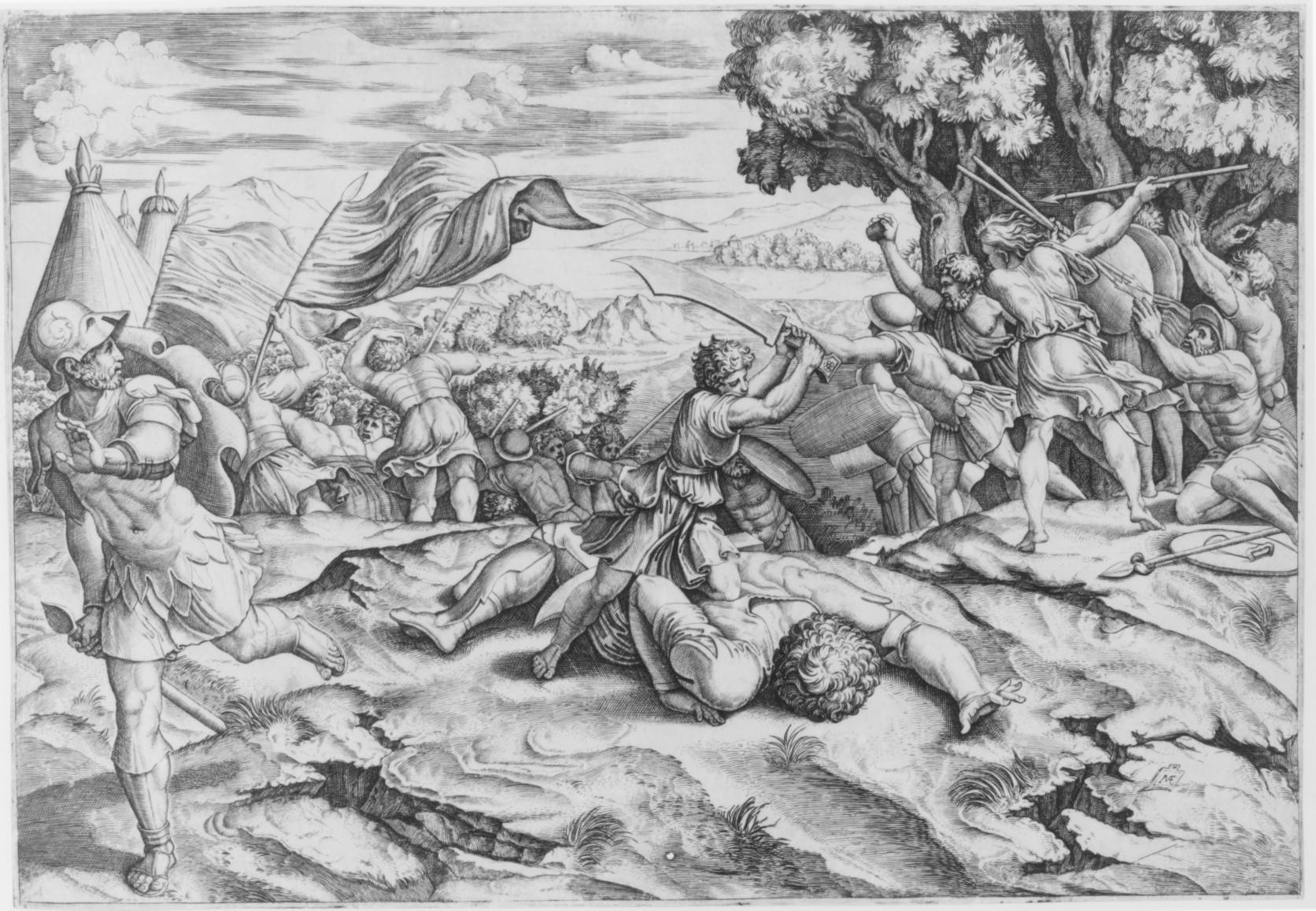
David raising sword to decapitate a fallen Goliath among battling soldiers
Original title: David raising sword to decapitate a fallen Goliath among battling soldiers
kurzbeschreibung
Marcantonio Raimondi made this engraving between 1520 and 1525. David is shown raising his sword to behead the fallen Goliath, while soldiers fight all around. The print is the first of three states and is in black and white.
Description
In the foreground David stands on a rock, sword already lifted for the blow; Goliath lies on the ground, his head severed from his body. Behind them a dense mêlée spreads out: warriors in helmets and armor, mixed with more lightly armed fighters. Mountains in the distance and trees at the right edge frame the site. Many figures in shifting poses fill the sheet, and the light falls evenly across the surface.
Context
Raimondi, an Italian engraver of the Renaissance, became known above all for reproductive prints after artists such as Raphael. This sheet dates from his Roman period, when he turned biblical subjects into dramatic battle scenes. The source is the story from the book of Samuel in which David defeats the Philistine Goliath. That the engraving was printed in several states points to a certain demand and circulation.
Impact
The tight staggering of the figures and their violent movements create immediate drama. At the same time, the clear linework and even distribution of light and shadow give the scene a calm, almost narrative clarity. The viewer is placed in the middle of the battle without the image feeling chaotic.
Technique
In engraving, lines are cut into the metal plate with a burin and then printed on paper. This method allows fine details and high precision in rendering figures and surfaces. The first of three states shows the plate at its earliest printing stage, before later reworking.
AI-generated description text
Source: Metropolitan Museum of Art · Public Domain (CC0 1.0)